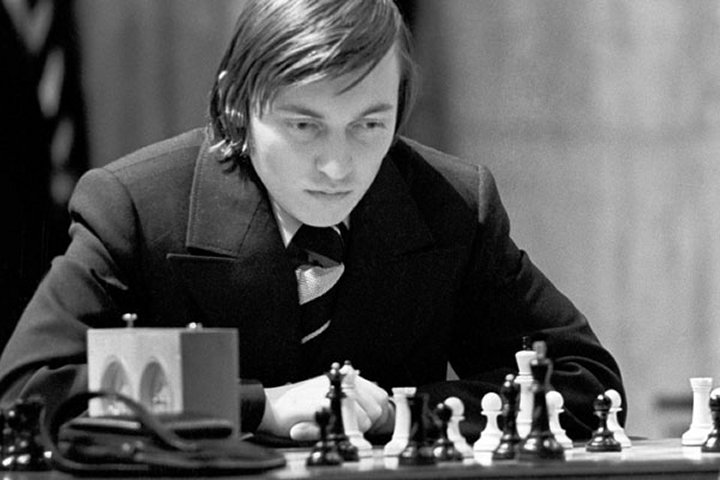
Anatoly Karpov had become world champion in 1975 without needing to win a match, since Bobby Fischer, his predecessor on the chess throne, had declined to defend his title. He was regarded as a very solid player who rarely lost. And, of course, in the first round of the tournament in Hanover against Wolfram Hartmann, Karpov was the clear favourite.
Karpov played in Hanover with an Elo rating of 2710, while the then 27-year-old Hartmann was, and remained throughout his life, an amateur. He studied law and later became a judge. Hartmann played successfully for Bamberg in the Bundesliga for many years and was part of the Bamberg team that became German team champion in 1976. But in Hanover, he started with an Elo rating of 2290, i.e. a rating 420 points lower than Karpov's.
When playing against a significantly stronger opponent, the textbooks recommend, in simplified terms, two different approaches: either play very sharply or very dryly. If one plays very sharply, the aim is to create double-edged, complicated positions and hope that the nominally superior opponent loses the thread, giving one the chance to counter. If one plays very dryly, the hope is to simplify the position in order to give the opponent few opportunities to demonstrate his superiority.
In the game against Karpov, Hartmann chose the sharp approach.
During his time as world champion, Karpov never lost to a player who was so much weaker nominally, and in the history of German chess there is no comparable outsider victory by an amateur against a reigning world champion.
At the time, this was notable enough for Der Spiegel to devote an article to it, while Tagesschau also reported the sensation from the chess world.
By the end of the tournament, however, order had been restored: Hartmann finished last with 5½ points from 15 games, while Karpov took clear first place with 11 points to his name. The best German player was Peter Ostermeyer, who scored 8½/15.
After the tournament, Hartmann was not to achieve any further sensational successes in chess. At his peak, he reached an Elo rating of 2315 and earned the FIDE Master title, but he never again made as many headlines as he did with his game against Karpov.
In this video course experts examine the games of Bent Larsen. Let them show you which openings Larsen chose, where his strength in middlegames were, how he outplayed his opponents in the endgame & you’ll get a glimpse of his tactical abilities!
Bent Larsen (1935–2010) was the greatest chess player in Danish history, and for a time, the second-strongest player in the Western world behind Bobby Fischer. Between 1954 and 1971, he won the Danish Championship six times, and achieved numerous international tournament victories throughout his career.
Free video sample: Introduction to Bent Larsen by Peter Heine Nielsen
Free video sample: Introduction to the Opening Section
Links