FIDE Press release, 21 March 2022
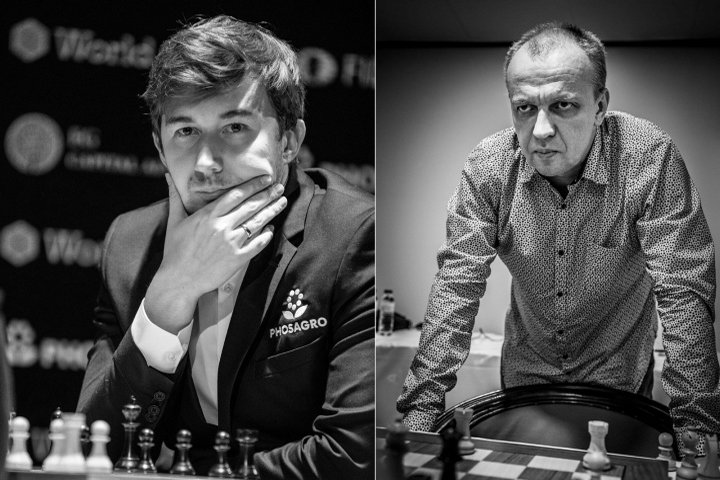
The FIDE Ethics and Disciplinary Commission (EDC) has reached a verdict on the case 2/2022, relating to public statements by grandmasters Sergey Karjakin (FIDE ID 14109603) and Sergei Shipov (FIDE ID 4113624).
The EDC First Instance Chamber, formed by Yolander Persaud (Guyana), Ravindra Dongre (India), and Johan Sigeman (Sweden) as Chairperson, unanimously decided as follows:
Sergey Karjakin is found guilty of breach of article 2.2.10 of the FIDE Code of Ethics, and is sanctioned to a worldwide ban of six months from participating as a player in any FIDE rated chess competition, taking effect from the date of this decision, 21 March 2022.
Sergei Shipov is found not guilty of breach of article 2.2.10 of the FIDE Code of Ethics.
The article 2.2.10 of the Code of Ethics reads as follows:
“(…) Disciplinary action in accordance with this Code of Ethics will be taken in cases of occurrences which cause the game of chess, FIDE or its federations to appear in an unjustifiable unfavorable light and in this way damage its reputation.”
“The statements by Sergey Karjakin on the ongoing military conflict in Ukraine has led to a considerable number of reactions on social media and elsewhere, to a large extent negative towards the opinions expressed by Sergey Karjakin”, reads point 7.37 of the 10-page document where the EDC explains the reasons and legal background for its decision.
It continues: “A necessary condition for the establishment of guilt is that the statements have reached the public domain. This concept, with respect to disrepute clauses in sport, is not the world at large but the sport in which the accused engages, such as chess. Information concerning the accused's conduct which is not published in the media, but which can be learnt without a great deal of labour by persons engaged in the chess world or a relevant part of it, will be in the public domain and satisfy the public exposure element. The EDC Chamber is comfortably satisfied that this condition is fulfilled in this case.”
“The EDC Chamber finds, against the background given above, on the standard of comfortable satisfaction that the statements of Sergey Karjakin, which, by his own choice and presentation, can be connected to the game of chess, damage the reputation of the game of chess and/or FIDE. The likelihood that these statements will damage the reputation of Sergey Karjakin personally is also considerable”, it concludes.
The Chamber explains its decision to not sanction Sergei Shipov with the following argument: “In comparison with Sergey Karjakin, Sergei Shipov is considerably less known and has, therefore, a less powerful platform. The statements made by Sergei Shipov are also of a slightly different and less provocative character than the ones made by Karjakin. In an overall evaluation of the potential negative impact on the game of chess and/or FIDE, the EDC Chamber is not sufficiently convinced that Sergei Shipov’s statements qualify as a breach of article 2.2.10.”
Sergey Karjakin has been advised by EDC that this decision may be appealed to the Appeal Chamber of the EDC by giving written notice of such appeal to the FIDE Secretariat within 21 days from the date upon which this decision is received. The notice of appeal must clearly state all the grounds for the appeal. Failing the due exercise of this right of appeal, the EDC Chamber's decision will become final.
Link
FIDE














A short list of books on Hiroshima and Nagasaki
1) Hiroshima by John Hersey (1946)
This narrative of six survivors is a classic
2)Fallout by Lesley M. Blume
“It tells the story of the US Government’s cover up of the truth on the bombing and how a courageous reporter revealed it to the world “(from the blurb)
3)To Hell and Back :The Last Train from Hiroshima by Charles R. Pellegrino
Survivors look back and tell their stories
4) Dear Grandpa: An American who lost his grandfather in the Pacific War Meets a Japanese Victim of Hiroshima Bombing
5) Culture Shock and Japanese –American relations by Sadao Asada
A collection of essays by the renowned Japanese historian.
In one of them he claims, both the bombing of Hiroshima & Nagasaki and also the entry of the USSR the war together brought about the surrender of Japan.
I have reason to disagree.
6)The Age of Hiroshima by Gordin and Ikenberry
However, I shall glad if fellow readers do not make non-serious comments on tragedies like Hiroshima and Nagasaki. Here are a few pointers for those interested in examining that part of history.
Was the bombing necessary? No. More than 150 American scientists who were aware of the nuclear test with all its terrifying effects had written an appeal to the U.S. President that the bomb should not be used. Did he see it or not?
That apart, there are two main arguments against the bombing:
1) Japan was already on the point of defeat with both military and economic blockade.
2) The entry of the USSR into the war against proved to be decisive. There was no way of Japan fighting against both the USA and the USSR.
Here one also has to examine the role of Hirohito and Truman. They were both heads of the state and their culpability is not evaded by historians.
Hirohito was vacillating and allowed himself to be used by the Japanese military chiefs.
Truman was worse and insisted on unconditional surrender, not allowing a defeated nation an honourable way of accepting defeat. If he had persuaded Stalin to support the war with Japan, Japanese surrender would have been immediate.
The dubious “honour” of ushering in the nuclear race belongs to Truman along with his hardline advisors.
I shall repeat what I wrote here in relation to the attack on Pearl Harbour with a slight change of wording.
Moderates on both sides tried their best to prevent the catastrophe. However, it was the hardliners on both sides prevailed in the end.
The deliberations that took place in the offices of the U.S. President and the monarch of Japan with all their misunderstandings and miscalculations of each other’s strength and ability make sad reading.
We have had this interaction on the bombing of Hiroshima before.
Now you comment, “Is there any difference to kill 100 000 people with nuclear bomb or fire bombs? Or with rifles? The last one will take "little" longer.”
Sorry, you will have to read a lot more and know more on Hiroshima and Nagasaki. Then you would not be making such casual & carefree remarks on the sheer magnitude of suffering that followed the bombing.
For those interested, here are a few links on the bombing of Hiroshima and Nagasaki.
The first offers a link to President Obama’s visit to Hiroshima:
https://www.youtube.com/watch?v=4Ey89C05FOw
Here is the text of his speech:
https://www.nytimes.com/2016/05/28/world/asia/text-of-president-obamas-speech-in-hiroshima-japan.html
And now for criticism of his speech:
https://www.nippon.com/en/currents/d00233/
The attitude of successive U.S. governments is summed up here:
https://thediplomat.com/2020/08/hey-lets-forget-that-no-us-apology-for-the-atomic-bombings-of-hiroshima-and-nagasaki/
The following link offers a series of short reviews on the subject. However, one has to be circumspect about the thesis in the book, “Racing the enemy”. According to Sadao Asada, the research into sources is not as thorough as it claims to be and the conclusion is rather one-sided:
https://www.armscontrol.org/act/2005_07-08/Kuznick
By way of general interest, I shall mention a few books and they are a key to our learning of history.
One important point is the extraordinary understanding and affection shown by some of the authors here, men who loved the “enemy country”.
James C. Grew, the U.S. Ambassador to Japan wrote this book, “Ten years in Japan” recalling his experiences during the critical years, 1932-1942. It was translated and it became a classic in Japan. He dedicated his life to the fostering of the American-Japanese relationship. Sadao Asada, renowned Japanese historian mentions how they followed his example in more ways than one.
List of Select Books
1) Ten years in Japan by James C. Grew (available in archive.org)
2) Culture shock and Japanese-American relations by Sadao Asada
3)Britain, Japan and Pearl Harbour by Antony Best
4)Bankrupting the Enemy, the U.S. Financial Siege of Japan before Pearl Harbour by James Miller
4)Japan Prepares for Total War :The search for Economic Security 1919-1941
by Michael Barnhart
5)From Mahan to Pearl Habour by Sadao Asada
You asked,“Wasn't it rather Japan that attacked the USA first?” meaning the 1941 attack on Pearl Harbour. No, the truth is not so simple and it’s more complicated than that.
From late 19th Century to the first four decades of the 20th Century three powers, Great Britain, the USA and Japan were competing for control over the Pacific Ocean and the Far East. The USA had reason to believe that its interests in the region were affected by the expansionism of Japan. It initiated an economic blockade with sanctions preventing the export of oil, iron and steel to Japan. The attack on Pearl Harbour was the culmination of cold war between the two countries. Moderates on both sides tried their best to prevent a confrontation between the two. However, it was the hardliners on both sides prevailed in the end. The negotiations that preceded the attack with mutual misunderstandings and miscalculations of each other’s strength and ability make fascinating reading. With the opening of British, American and Japanese archives and the first hand accounts of participants a whole new world has opened up. One important point between both American and Japanese historians is the absence of blame game like “You started it first!” “No, you did!” Both have been free in acknowledging errors of omission and commission on their own. Which side do they belong to? It’s the side of truth and our understanding of that truth is still evolving.
@Jacob Woge I fully agree with your support of free speech. And you are also making a good point when you argue that it is not about Karjakin, but about principles. If we accept the principle of thought policing, then much more reasonable positions than Karjakin's will also be persecuted.
@Martas I compare Putin and Stalin on factual basis and I avoid subjective speculation. Their similarity is that they are both dictators and expansionists. Yet, Stalin killed his own people en masse, Putin hasn't so far. In the current offensive war, the Russian army attacks Ukraine's forces and cynically allows Ukrainian civilians to be killed as side-effect. Yet, the United States was doing similar type invasion against Japan, bombing the innocent as well in order to win the war. Does it violate human rights? Surely. Can we call it a genocide based on factual grounds? Most probably. But, the genocide by letting people die as a side-effect of a war is quite different from a planned and deliberate genocide, since Putin's goal is to win the war and he resorts to genocide if he needs to do so in order to win, while Stalin had the exact purpose of genocide in many cases. Putin is still terrible, but equating him to Stalin lacks factual basis.
"Would you be happy to see him winning some prize money in candidates and giving part of it to support war in Ukraine?"
I'm not particularly supporting his effort to win tournaments or prize money. But my lack of support for him does not mean that I would support his discrimination either.
Very few Russians support Putin's war once they have presented the facts. Sergey Karjakin is an exception. On his Twitter account, he has shown a picture of himself with boxing gloves on and the subtitle: “Celebrating the first day of spring. A Russian spring day ”. It is a clear support for the violence perpetrated by the Russians in Ukraine.
https://chess24.com/en/read/news/sergey-karjakin-shunned-by-top-chess-events
There are no precedents. No Russian chess player has ever posed with boxing gloves on and support for an illegal invasion. FIDE's reason for excluding him is crystal clear and in Norway, Chief Organizer Kjell Madland has said that he is no longer welcome in Stavanger:
"Sergey Karjakin chose to support a nation and a president that is responsible for cruel war acts against another nation and innocent people. We cannot be associated with people who show support for cruelty like that. That makes it completely unlikely that we will want to invite him to Norway Chess in the future."
For Sergey Karjakin, it's personal. He received enormous support from Putin in his attempt to become world champion in chess. He did not succeed, but he has not forgotten the support. He is Putin's puppet now, and he only expresses Putin's views.
Ukraine's struggle to respond to their independence and freedom has been impressive. Morality has been rather die in battle than return to a slave life under a tyrant. As a result, Putin is now sitting on the edge of his seat. He can no longer hold back the truth about the outrageous assault and the doll Karajkin must find another master.
https://rb.gy/eozttw
Karjakin, as mentioned by others, he has all rights to state what he wants, but he has to live with consequences. So does FIDE. Would you be happy to see him winning some prize money in candidates and giving part of it to support war in Ukraine? Regarding his GM title - his public support of Putin these days is a big shame. Loosing it has nothing to do with his chess skills, same with Rausis. No ordinary chess player without title would doubt loosing heavily playing either of these guys. But they both managed to do something where loosing GM title is/was worth considering. Not up to us to decide it, it's up to FIDE. And it's up to Zelensky deal with Putin. Here we can only state our opinions, which in my case is suporting any FIDE sanctions against Karjakin and a hope that Russian army leaves Ukraine.
Video of the destroyed Mariupol' below. Reminiscent of the nazi destruction of Warsaw. And this is in the 21st century!. As Winston Churhill said: " Fascists of the future will call themselves anti-fascists". Do you have am answer to this Mr. Karjakin? What do you think happened to women and children under rubble? By the way, Mariupol was 95% Russian speaking. So much for "protecting" Russian speaking people from "genocide".
Once you’re into sanctioning expression of belief, you cannot go back. The barre is set, and there is no pushing it up. It can only be lowered. And it will be.
Time for a change of slogan. “The world is black and white” ? Some prefer black.
I seem to have heard this any number of times. In times of war, nobody objects. Rarely was that statement subject to sanctions.
On the contrary. Especially if your loyalty might be questioned, due to former citizenship. It looks genuine, but who knows. Call the Inquisition.
Why not ignore social media. After all, arent these platforms mostly for kids and drug dealers.
@Jacob Woge I agree with you. While I strongly oppose Karjakin's one-sided view (where he only focuses on Russian civilian casualties, but completely ignores Ukrainian civilian casualties), I would not question his right to have that view and express it freely.
Stalin worse? Perhaps you should conduct a poll in Mariupol on that subject.
I just hope FIDE will muster the courage to also deduct aforesaid player five hundred rating points, photoshop out of any official chess-related image, avoid direct reference by name, and declare that the world chess championship match of 2016 never took place.
Gens una erant.
That's the trouble: Karjakin is a complete idiot who does not think by himself for one microsecond.
Theis fkind o people are easily led to the worse. I am French, and I completely disapprove some things that France did or still do, like selling weapons to Saudi Arabia.
You forget notice Dresden, Mosul, Raqqa for better comparing.
@MauvaisFou Freedom of speech is nonexistent in Russia. But that does not justify stifling it in the West as well.
@Martas I think there is no reason to be outraged due to the fact that Karjakin is troubled by the fact that Russian civilians are being killed in Eastern Ukraine. I do not think that Ukrainian civilians are more valuable than Russian civilians in the Donbass. I think all unnecessarily killed civilian is a tragedy. Is Karjakin suddenly a patzer in chess, just because we dislike his political views?
@Quanber I see that everyone you disagree with is still an FSB agent for you.
@klklkl I think that the purpose FIDE exists for is to promote chess and help organize the World Championship. I don't believe that Karjakin would become a weaker player because he expressed some views many of us strongly disagree with. He is a top GM and he has earned a spot in the candidates tournament. The fact that he was arbitrarily excluded from there because of his political views, punishing him in hindsight for thought crimes is an Orwellian attitude. Yes, Russia is a dictatorship now, where opposition is stifled. But FIDE has shown the same totalitarian approach against views it dislikes as Putin.
We see that the Quran incites for violence against non-Muslims and, Muslims are considering the Quran to be holy. Should we ban all Muslims from chess?
We see that there were many who supported the offensive side in other wars as well, where innocent civilians were killed just like now. We could speak about the war on Yugoslavia, the Iraqi war or Ukraine's war on the Donbass, to name a few.
Also, globally today many expressed total support towards Zelensky. Yet, Zelensky just banned 11 parties, so he is quite autocratic. Yet, it would be in ill-faith to assume that all supporters of Zelensky automatically support all his misdeeds. Yes, the West lifted Zelensky on high heels, but that does not lift him above international law. So, instead of seeing the perspective of a single side, I choose to try to understand as much of the conflict as possible. While I agree with the majority here that Ukraine's efforts to drive out the hostile armies attacking them deserve support, I do not support censorship or collective guilt.
If someone supports Putin, that does not mean that the person supports genocide, even though we may argue that the civilians killed in this war are victims of Putin's genocide.
So, if we are consistent with thought policing, then there would be very few chess players not banned. So, my position is that if a chess player is banned, there must be some very good reasons. Being a fanboy of Putin is not such a reason.
"I am on the side of Russia and my President. No matter what happens, I will support my country in any situation without thinking for a second!"
I don't see the source of the quote above, so, to make sure everyone agrees that this is genuine, here's the source: https://twitter.com/sergeykaryakin/status/1502029284227129350
However, if this is the worst tweet written by Karjakin, where he did not incite for any hostile action, then the case for considering Karjakin an inciter for violence is on very weak foundations. All he did here was to express support for his country and his president. I agree with the opinion that Russia's current president is a bloody dictator, but being astray ideologically should not be banned.
I see large problems with consistency here. If we ban people for thought crimes, then we need to ban many more people.
People have eyes and ears, some have even brains. They can also read in Finland. What JanneKejo says does not change things other than for the better. Finns understand how the world is going and know how to think independently. JanneKejo and his friends do not change that.
You think you know, but actually you know nothing. By the way, bat is not blind but you seem to be blind, deaf and dumb. Do you remember those three statues of monkeys?
Still, you should not teach us to do the things you do in your own country. We have a saying in Finland: "Don´t try to teach your father to fuck your mother."
JanneKejo tells us that he hears about the war in Ukraine from both sides, and therefore he is able to better express himself nuanced and critical. That's a huge lie. JanneKejo is only critical of the West's views on the war in Ukraine. If at any point he expressed the slightest bit critical about the Russian narrative he would get 15 years in prison the next time he visited Russia or North Korea.
Consequently there is nothing nuanced in any of what JanneKejo writes, it is pure Russian propaganda, lie after lie. And I get so angry when the proud Finnish people, who have fought such fierce battles for their independence from Russia during World War II, have to find themselves in this 5th column undermining their country.
I know Finland in and out, having a summerhouse so close to its border. JanneKejo is everything Finland is not.
Finn (by Jorma Etto)
A Finn is one who answers when not asked
asks when not answering, does not answer when asked.
One who gets lost in the road, roars on the beach,
and on the opposite side roars back another similar:
the forest rumbles, echoes, old pine trees wobbles.
There will be a Finn and roars, is there and roars,
there goes and roars, is like in sauna, and roars
when another throws water into the stove.
Such a Finn always has a buddy
never is he alone and that buddy is a Finn.
And you cannot separate a Finn from a Finn,
no one can do it but death and the police.
Bullshit. You should not talk about Finland as expert, if you don´t know anything about it. Read the history of Finland. There is this little difference between you and me. I live in Finland and know about my country´s history, you don´t. Even though you read about the history of Finland, I have lived here and still do it. I have had many sources of information, books, schools, parents, grand parents... I have heard stories from the early days of independence from people who lived then or whose parents lived and experienced it. Stories about the Finnish Civil War, prison camps after civil war, improving relations between the parties to the civil war. How do you think Finland could have fought against Soviet Union with great tenacity in Winter War? Because all of us, communists, merchants, peasants, townspeople, leaders and workers, were all on the same side against the common enemy.
Before the Winter War, many communists moved to the Soviet Union, but most of them were assassinated by Stalin. After WW2 there were more communists in Finland than before the war but still they were in the minority. Finland did not come a communist country. We don´t have two party system but many party system. Maybe USA should also have the same? Two party system like, right and left party, religion or not religion party, humans and aliens party.
What JanneKejo believes is his business. If it is legal, then you, Quanber or other people, you can only focus on discussing things. I`m not at the same ideological side as he is but I defend his right to be what he has chosen, even though a communist Finn. Such is the Finn.
The vast majority of communists are decent citizens who distance themselves from violence. Including a number of communists among the 44 top-class players from Russia who have distanced themselves from the invasion.
JanneKejo represent af PolPot / Kim Jong- un / Putin edition af communism that should not exist on the planet.
Thank God JanneKejo has no influence in Finland. Else we will be one step closer til Putins madness.
I guess in Israel you can´t say there is the "Palestinian problem." or you can say it but there is this public denial?
Depends on the countries, obviously.
In France there are limits to the freedom of speech, e.g., you cannot deny the Holocaust, or call for murder of some categories of people, etc. In Russia, if you say "war" you can go to jail for some years ... In USA, you can say anything, or sell nazi stuff ...