.jpeg)

At the beginning of the year, a YouTube video by Felix Blohberger went viral, in which the young Austrian grandmaster reflected on the challenges of making a living as a chess professional in Europe. A few months after watching this remarkable and thought-provoking video, I noticed that Blohberger had recorded a two-part 1.Nf3 repertoire for ChessBase. My interest was immediately piqued—especially since I had only recently added the Réti to my own White repertoire.
Volume 1
The first part of the course deals with fianchetto systems—that is, Black setups resembling the King’s Indian, Queen’s Indian, Hedgehog, or Grünfeld.
In his recommendations, however, Blohberger tends to rely on strategically grounded surprise weapons rather than following the absolute mainstream. To illustrate this, here are a few highlights from his choice of variations:
1.Nf3 Nf6 2.g3 g6 3.Bg2 Bg7 4.0-0 0-0 5.d4 d6 and now 6.Re1!?
This modest-looking rook move appears in only about 7 percent of games. White’s idea is to follow up quickly with e2–e4. More importantly, by holding back c2–c4, White makes it difficult for Black to achieve the typical King’s Indian counterplay. Most often Black continues with 6…Nbd7 7.e4 e5, but after 8.Nc3 the game can suddenly transpose into somewhat unfamiliar Old Indian structures.
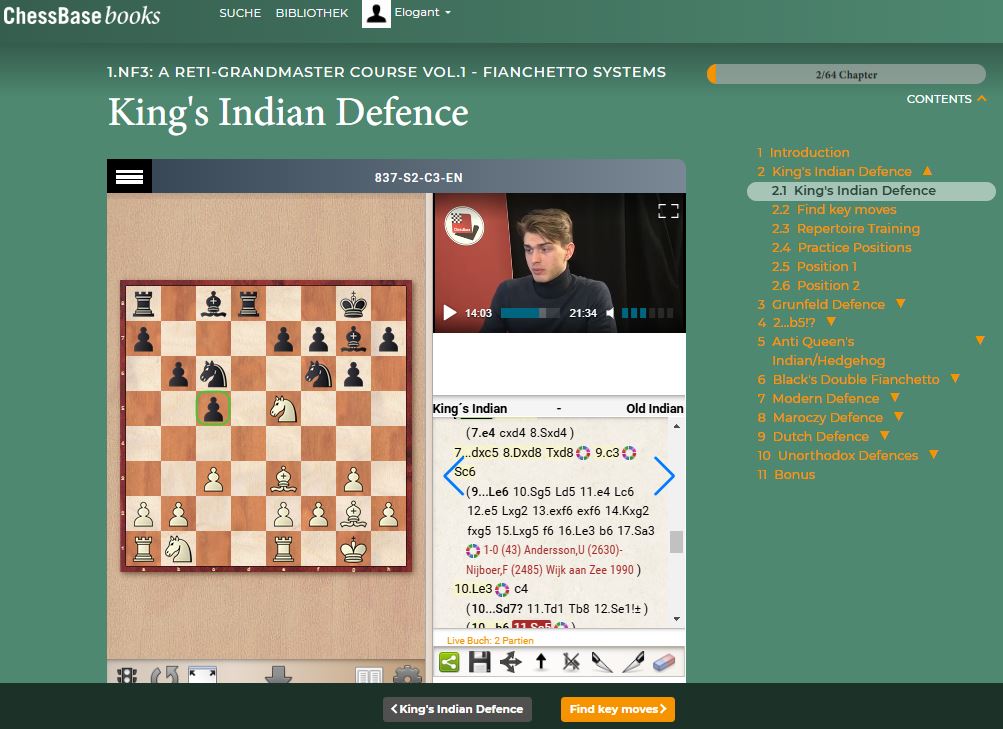
"I was surprised myself at how good White’s position already is here," explains the Austrian national player, before demonstrating how Black can be faced with serious problems.
1.Nf3 Nf6 2.g3 b6 3.Bg2 Bb7 4.0-0 e6 5.c4 c5 6.Nc3 Be7 7.Re1
Here 7.Re1 is in fact a well-known line and the second most common move. If Black insists on the Hedgehog, then after 7…d6 8.e4 a6 9.d4 cxd4 10.Nxd4 Qc7 11.Be3 Nbd7 12.Rc1 0-0 13.f4 the game tends to head into a dangerous version, where White can combine play with g3–g4 to build up an initiative on the kingside. Of course, Blohberger also covers Black’s attempts to sidestep this scenario with 7…d5 or 7…Ne4.
Against the Queen’s Indian setup and against the double fianchetto with …b6 and …g6, Blohberger likewise relies on an early Re1 with the idea of e2–e4. The Austrian grandmaster has in mind the practical needs of his students—after all, it is much easier to internalize similar structures than to have to memorize something different against every system.
1.Nf3 d5 2.g3 g6 3.Bg2 Bg7 4.d4 Nf6 5.0-0 0-0 6.c4 c6 7.a4!?
The ultra-solid Symmetrical Grünfeld is a tough nut to crack, so it’s essential to have something up your sleeve here. According to my database, the move recommended by Blohberger, 7.a4!?, which I hadn’t even heard of before watching the course, appears in only about 2 percent of games! Blohberger points out that this poisonous sideline has already made its way into top-level play, but at the amateur level it can certainly catch many opponents by surprise.
The advance of the rook pawn is, on the one hand, prophylaxis against an immediate …dxc4—after 7…dxc4?! 8.Na3, the push 8…b5? wouldn’t work with the pawn already on a4, and otherwise Black also struggles to defend the c4 pawn. On the other hand, a4–a5 can itself become an option. And in many variations, if Black eventually captures on c4, White can simply play for compensation with a strong center after f4, e4, and so on.
Free video sample: Introduction
The second part of the Réti repertoire deals with a range of further main systems such as 1.Nf3 c5, the "classical" setups with …d5, …Nf6, …e6, …Be7, the formation with …d5 and …c5, and much more. The large complex 1.Nf3 d5 2.g3 with Black developing the bishop to g4 or f5, as well as modern sidelines like 2…Nbd7 and 2…b6, is also covered in depth.
Blohberger remains true to his approach of avoiding highly theoretical battles. A key cornerstone of the repertoire is the flexible double fianchetto after 1.Nf3 d5 2.g3 Nf6 3.Bg2 e6 4.0-0 Be7 5.c4 0-0 6.b3!?:
A complex that is quite popular at GM level, where the focus is above all on strategic subtleties.
An important point for the repertoire is that after 1…c5, White for once does not play 2.g3, but instead 2.c4, transposing into English territory. This is often followed by a quick e2–e3 together with d2–d4, for example after 2…Nc6 3.Nc3 e5 4.e3 or 3…g6 4.e3. In the latter case, 4…Nf6 5.d4 cxd4 6.exd4 d5 7.cxd5 Nxd5 8.Qb3 leads to an Isolani position in which White scores very well—for instance after 8…Nxc3 9.Bc4! Nd5 10.Bxd5 e6 11.Bxc6+ bxc6 12.0-0, with good chances on the dark squares.
Conclusion: In a pleasant presentation style, GM Felix Blohberger offers 7 hours and 30 minutes of video content presenting a promising, strategically based Réti repertoire for White. The Austrian grandmaster’s choice of variations is extremely clever. Rather than following well-trodden mainstream paths and heading into long theoretical duels, he tends to look for ways to pose practical problems. At the same time, there is a certain coherence—for example, the Re1 concept against both the King’s Indian and the Queen’s Indian (or the Hedgehog)—which makes learning easier.
The PGN file provided with the course is a little sparse in some lines—this is because the theory file contains exactly those variations that Blohberger also presents in the videos. From around the 2000+ level, I would recommend analyzing further with the latest Mega Database and an engine, to dig deeper and get the maximum benefit from the course.
Felix Blohberger is not just a grandmaster—he’s a multiple Austrian national champion and a permanent force on the Austrian national team. Earning his GM title at just 19, Felix brings a wealth of experience both as a competitive player and as a second to top players.
Felix Blohberger in the ChessBase Shop...