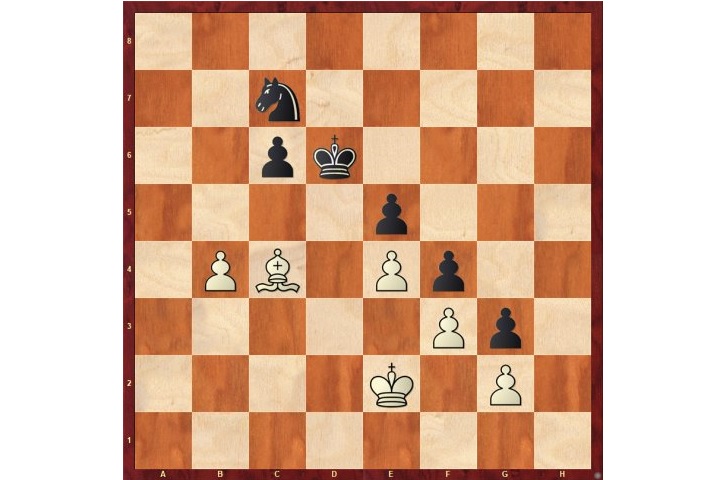
Endgame riddle: The eternal duel - bishop vs knight

by Karsten Müller
4/15/2021 – The International Master Ole Jakobsen (19 October 1942 - 30 June 2010) from Denmark is not particularly well-known but from 1960 to 1980 he was one of the best players of his country and in 1969, 1971 and 1980 he won the Danish Championship. In 1973 he finished fourth in the IBM-B Tournament in Amsterdam, where he defeated Eugenio Torre, who was soon to become one of the world's best players, in an interesting endgame bishop versus knight. Karsten Müller has taken a closer look at this endgame and invites you to help analysing it.

Rules of thumb are the key to everything when you are having to set the correct course in a complex endgame. In this final DVD of his series on the endgame, our endgame specialist introduces you to the most important of these rules of thumb.

The eternal duel: bishop vs knight

Endgames in which the bishop fights against the knight – and vice versa – are often full of surprising subtleties. Often they are also complicated and not easy to understand. The following endgame, in which Black performs long manoeuvres with king and knight to win in the end, is a typical example. Was this win indeed forced or could White have saved himself, perhaps with the help of the 50-move rule?

The reader is invited to search for the truth about this endgame – could White have saved himself, and if so, when and how?


Share your analyses and findings in the comments!

Links


Karsten Müller is considered to be one of the greatest endgame experts in the world. His books on the endgame - among them "Fundamentals of Chess Endings", co-authored with Frank Lamprecht, that helped to improve Magnus Carlsen's endgame knowledge - and his endgame columns for the ChessCafe website and the ChessBase Magazine helped to establish and to confirm this reputation. Karsten's Fritztrainer DVDs on the endgame are bestsellers. The mathematician with a PhD lives in Hamburg, and for more than 25 years he has been scoring points for the Hamburger Schachklub (HSK) in the Bundesliga.

Discuss

Rules for reader comments


Not registered yet? Register

malfa malfa 4/17/2021 04:29
KM: well, 70...Nh7 is natural and actually was my first try, but the difference is that it allows White an amazing opportunity to activate his king, though at the cost of his golden passed pawn: namely 71. Ba4! Ng5 72.Bd1! Kc6 73.Kd3 Kxb6 74.Kc4 Kc6 75.Ba4+ Kd6 76.Bd1, when the black king is constantly tied to the defence of the Pc5 and of the invasion square on d5, and I see no way to remove the white king from his blockading square. Instead after 70...c4!! White cannot transfer his king so readily: 71.Kd2 Ng4!! when 72.Bxc4 Ne3 73.Bd5 Nxg2 is hopeless. And on 71.b7 (or directly 71.Bxc4 for what it matters) there follows 71...Kc7 72.Bxc4 (or 72.Bc6 Nh7 73.Bd5 Ng5 74.Bxc4 Kxb7 75.Bg8 Kc6 and though Black's knight cannot move, Zugzwang allows his king to penetrate after 76.Ke1 Kc5 77.Ke2 Kd4-+) 72...Kxb7 73.Kd2 Kc6 74.Kc3 Kc5 75.Be2 Nh7 76.Bd1 Ng5 77.Be2 Ne6 78.Bd1 Nd4 79.Kd3 Kb4 80.Kd2 Kc4 81.Be2+ Kb3 reaching the same position which occurred in the game after 85...Kb3, but no less than 4 moves earlier.
Karsten Müller Karsten Müller 4/17/2021 09:22
malfa: Deep points indeed! Can you give more details after 70...c4 and what about 70...Nh7 ?
malfa malfa 4/17/2021 03:51
KM: OK, working my way backwards, as by now you'll have understood that I am used to proceed, it seems to me that the winning path should have surprisingly begun as early as on 67...c5! instead of 67...Kd7, i.e. Black must clarify the situation on the queenside before the enemy king has the chance to participate in the defence of that wing: after 68.b5 Ne8 69.b6! Nf6 (69...Kc6?? would even lose to 70.Bb5+!) 70.Bb5 c4!! (blocking the white king's path to the queenside is more vital than winning a pawn) and less than a dozen of further moves, I eventually reach the same position as after 84...Kb3 in my previous line, but I apparently manage to spare no less than 3 moves over the latter, so that the decisive blow Nxf3 should occur on move 126, i.e. enough to dodge a draw by the 50-move rule.
Karsten Müller Karsten Müller 4/16/2021 07:35
malfa: Yes. 74.Bf1? is a losing mistake as 74.Be2! draws.
malfa malfa 4/16/2021 06:13
KM: thanks, I'll try to find it. Meanwhile I should point out that this apparently is not the end of the story: there are at least two previous stages at which White could have liquidated the queenside on his own terms, namely 73.b5! instead of 73.Bd3 and 74.Be2! instead of 74.Bf1, followed by b5 and the idea of eventually putting the bishop on d1: this way his king would have no longer been in charge of protecting c2 against the manoeuvre Nd4-c2-e3 and thus would have remained free to contest space to his opponent much more efficiently.
Karsten Müller Karsten Müller 4/16/2021 02:07
malfa: Yes. Black has a shorter route to win within the limits of the 50 move rule...
malfa malfa 4/16/2021 01:05
KM: does 80...Kc6 really win? Putting together all the improvements I have found, what I consider the best line for both sides seems one move too long, with reference to 78...Kxc5, to avoid the 50 move rule: 80.Kd2 Kc6! 81.Kd3! Kb5! 82.Kc3+ Kc5 83.Kd3 Kb4 84.Be2 Kb3 85.Bd1+ Kb2 86.Kd2 Kb1 87.Ke1 Ka2! 88.Kd2 Kb2 89.Ke1 Kc3 90.Ba4 Kd3 91.Bd1 Ke3 92.Kf1 Kd2 93.Ba4 Ne2 94.Bd1 Nc3 95.Be2 Nb1 96.Bc4 Na3 97.Bb3 Kc3 98.Ba4 Nc4 99.Bb5 Ne3+ 100.Kg1 Kd2 101.Ba6 Ke1 102.Bd3 Nd1 103.Ba6 Nc3 104.Bd3 Na4 105.Bc4! Nb6 106.Ba6 Na8! 107.Bb5 Nc7 108.Bc4 Ne8 109.Bb5 Nd6 110.Ba6 Nf7 111.Bb7 Ng5 112.Bc8 Ke2 113.Bg4 Nf7 114.Bc8 Nd6 115.Ba6+ Ke1 116.Bd3 Nb7! 117.Bb5 Na5 118.Ba4 Nc4 119.Bb5 Nd2 120.Ba6 Nb3 121.Bc4 Nd4 122.Ba6 Kd2 123.Bc8 Ke3 124.Bg4 Ke2 125.Bh5 Ke1 126.Be8 Ne2+ 127.Kh1 Kf2 128.Bb5 Nd4 129.Bf1 Nxf3. So you mean that somewehere Black has a shorter path to victory, don't you?
Karsten Müller Karsten Müller 4/16/2021 11:22
malfa: Very well done! Indeed 80...Ka5? gives away the win due to the 50 move rule and 80...Kc6 wins. And 83.Be2? is a mistake after which Black again can win within the limits of the 50 move rule. 83.Kd3 prevents that.
malfa malfa 4/16/2021 10:25
KM: yes, meanwhile I found another moment which would have decisively added on the move count: it is much earlier, when White should have played 83.Kd3 instead of 83.Be2, putting maximum resistance to the attempted invasion by the black king; then 83...Kb5! 84.Kc3 Kc5 gains the opposition, however after 85.Kd3 Kb4 86.Be2 Kb3 87.Bd1+ Kb2 88.Kb2 a position is reached which is identical to the one in the game after Black's 86th move, but here it is his turn, so there is no Zugzwang which forces White to concede the c3 square. Black can triangulate with 88...Kb1 89.Ke1 Ka2! 90.Kd2 Kb2 finally transposing to the game, but as I said the extra plies needed, included in the best line of defence I showed in my previous message, would add up to the overall move count enough to raise it over the 50-moves limit. Black in his turn could have spared a couple of moves had he directly played 80...Kc6 instead of 80...Ka5, but that improvement would not have cut down the move count enough.
Karsten Müller Karsten Müller 4/16/2021 09:09
malfa: Yes well done! 108.Ba6 is more tenacious but does not defend. There is more to be found earlier. There is a moment in the game, when the 50 move rule prevents Black's win...
malfa malfa 4/15/2021 11:14
Actually White had at least another improvement to prolong his resistance, i.e. 108.Ba6! instead of 108.Ba4, in order to keep the black king away from f3. Incorporating this attempt into the other improvement at move 103 we have something like the following:

103.Bc4 Nb6 104.Ba6 Na8 105.Bb5 Nc7 106.Bc4 Ne8 107.Bb5 Nd6 108.Ba6 Nf7 109.Bb7 Ng5 110.Bc8
Ke2 111.Bg4 Nf7 112.Bc8 Nd6 113.Ba6+ Ke1 114.Bd3 Nb7 115.Bb5 Na5 116.Ba4 Nc4 117.Bb5 Nd2 118.Ba6 Nb3 119.Bc4 Nd4 120.Ba6 Kd2 121.Bc8 Ke3 122.Bg4 Ke2 123.Bh5 Ke1 124.Be8 Ne2+ 125.Kh1 Kf2 126.Bb5 Nd4 127.Bf1 and now 127...Nxf3! allows Black to avoid the 50-move rule by just one move, doesn't it?
malfa malfa 4/15/2021 08:22
KM: definitely it is critical that White prevents the knight from getting to d4 when the black king is on e1. And it is amazing that after 103.Bc4! the apparently fastest winning manoeuvre, as suggested by Jakobsen, requires the knight to start with 103...Nb6, i.e. to go on a terribly awkward square with respect to d4! I do not find anything wrong with his analysis, so had things gone that way White would have prolonged his resistance for no less than ten moves before transposing back to the game after 105...Na5, which would have brought him dangerously close to the 50-move limit, though arguably not enough, unless he could have played better somewhere after the transposition.
Karsten Müller Karsten Müller 4/15/2021 07:31
malfa: A good concept of course. The situation with Black's knight on d4 is critical with the king manovers and the idea to bring the knight to e3...
malfa malfa 4/15/2021 05:15
Well, what I mean for "digging" is trying first to understand what's going on: this endgame resembles to a famous one by Grigoriev, which he solved thoroughly by systematically applying the theory of "corresponding squares". My feeling is that the same technique could be applied to solve this one, and that is the reason why my main concern is to establish which are its critical positions, rather than having my engines spit out tons of variations which would give me no clue of the underlying ideas.
Karsten Müller Karsten Müller 4/15/2021 04:17
malfa: Yes 103.Bc4! was called for. It was also mentioned by Jakobsen. Then Black must play very precisely to win with the 50 move rule. Please dig deep!
malfa malfa 4/15/2021 03:58
@ K.M.
Thanks! Another position which strikes me as critical is the one after 100.Bd3: here too, if White were to move he would be quickly lost, whereas as things actually go I feel that he could have made Black's life much more difficult, had he later played 103.Bc4 instead of 103.Bb5, in order to meet 103...Nc5 with 104.Bd5 and so forbid the Nc5-b7-a5 manoeuvre. After 103.Bc4 it is not clear to me how Black should continue.
Karsten Müller Karsten Müller 4/15/2021 01:42
malfa: Good and deep question. I think that: Black is winning also with 50 move rule (but that is very very close), but Black can not force the position after 91.Ba4 with White to move...
malfa malfa 4/15/2021 01:25
To me the position after 91.Ba4 looks critical: if White were to move he would be quickly lost, since he eventually would be unable to avert either the decisive sacrifice on f3 for two pawns or the capture of the Pg2 by the knight. Therefore my questions are: can Black reach the same position with White to move? And can he do this quickly enough to avoid the 50-moves rule?
Karsten Müller Karsten Müller 4/15/2021 09:21
brian8871: Yes 73.Kc4 does draw, but 73.Bd3 is no mistake...
brian8871 brian8871 4/15/2021 09:07
73. Bd3 doesn't look like the best move. 73. Kc4 seems better, although with such a long and complex endgame, it's impossible to analyze every line to completion.