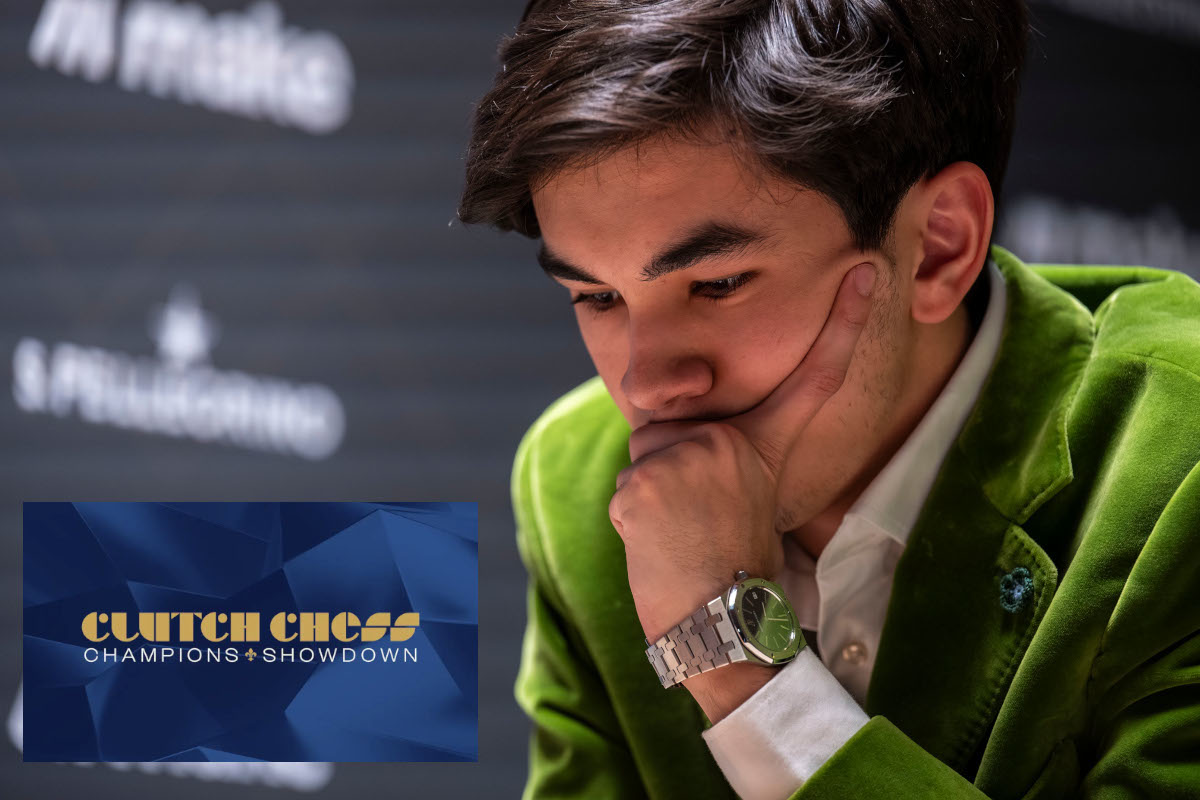
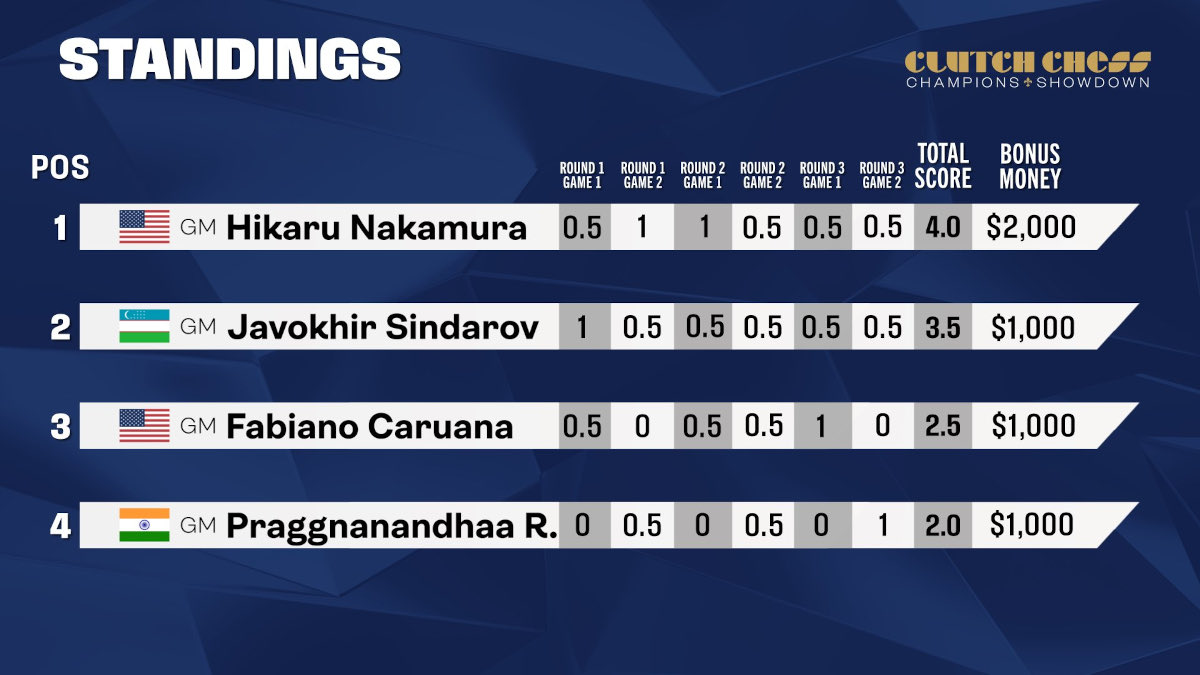
10/28/2026 – Hikaru Nakamura took the early lead at the Clutch Chess: Champions Showdown tournament in Saint Louis, scoring two wins and four draws to finish day one on 4/6 points. Javokhir Sindarov follows half a point behind, while Fabiano Caruana and Praggnanandhaa Rameshbabu occupy third and fourth place. The opening day featured five decisive games and plenty of exciting battles. Victories will be worth increasingly more points over the next two days. | Photo: Lennart Ootes / Saint Louis Chess Club
new: ChessBase Magazine 225
Chess Festival Prague 2025 with analyses by Aravindh, Giri, Gurel, Navara and others. ‘Special’: 27 highly entertaining miniatures. Opening videos by Werle, King and Ris. 10 opening articles with new repertoire ideas and much more. ChessBase Magazine offers first-class training material for club players and professionals! World-class players analyse their brilliant games and explain the ideas behind the moves. Opening specialists present the latest trends in opening theory and exciting ideas for your repertoire. Master trainers in tactics, strategy and endgames show you the tricks and techniques you need to be a successful tournament player! Available as a direct download (incl. booklet as pdf file) or booklet with download key by post. Included in delivery: ChessBase Magazine #225 as “ChessBase Book” for iPad, tablet, Mac etc.!
YOUR PERSONAL CHESS COACH - Whether you’re taking your first steps into the world of club chess, or already playing at a tournament level: with FRITZ, you can train more efficiently, intelligently and with a more personalised approach than ever before. FRITZ is more than just a chess engine – it’s a training revolution! Whether you’re taking your first steps into the world of club chess, or already playing at a tournament level: with FRITZ, you can train more efficiently, intelligently and with a more personalised approach than ever before.
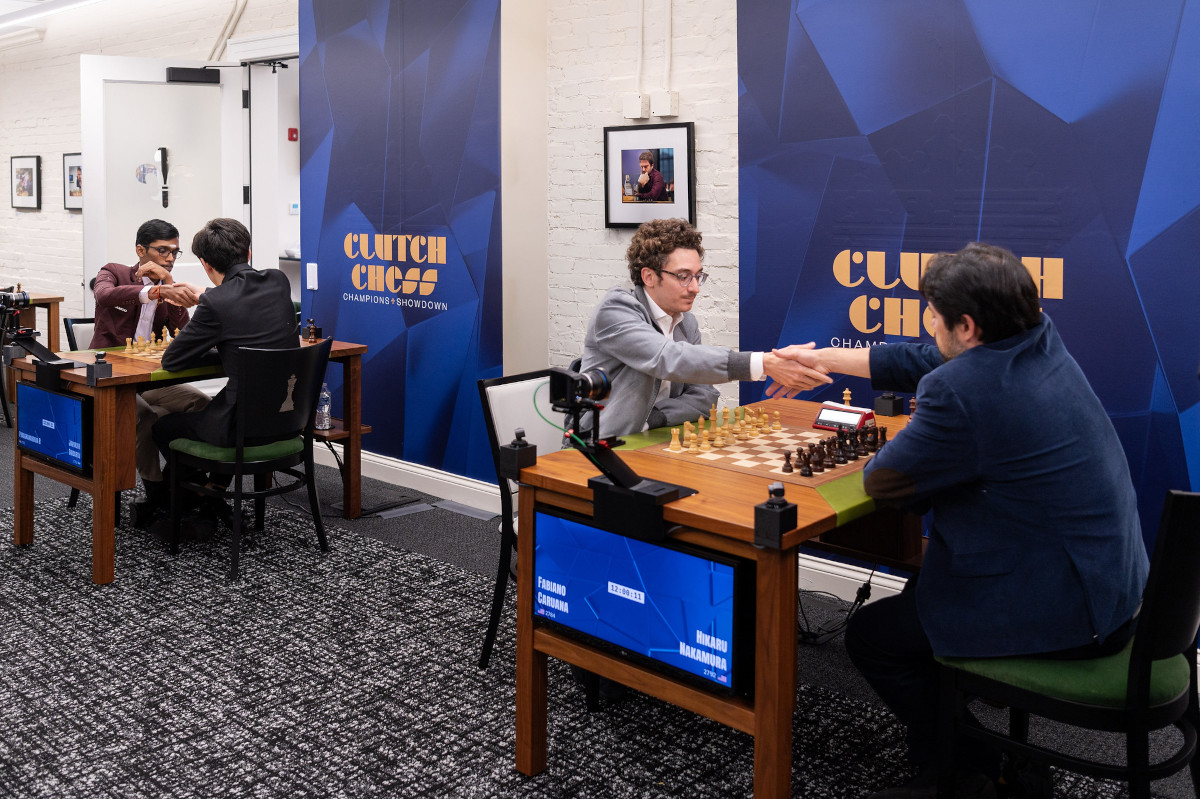
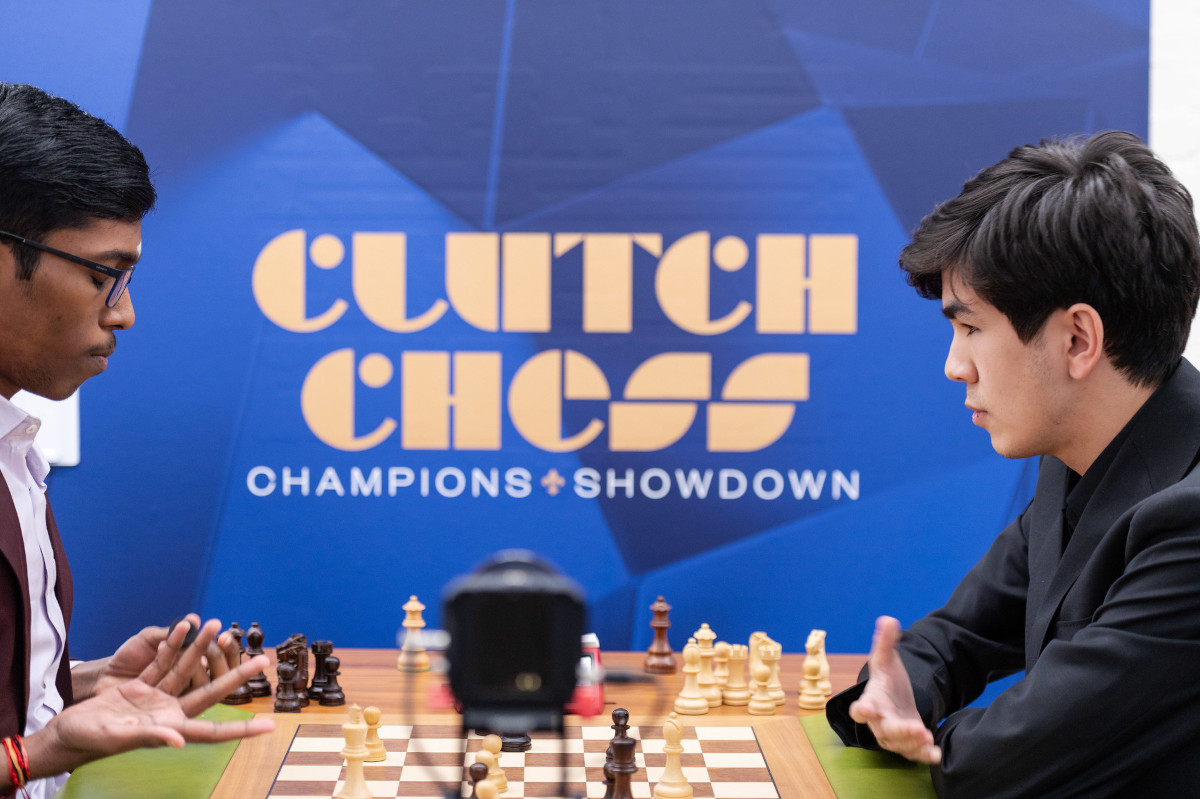
The Clutch Chess: Champions Showdown event kicked off on Tuesday at the Saint Louis Chess Club, with four elite GMs competing in a rapid tournament that uses an innovative scoring system. Fabiano Caruana, Hikaru Nakamura, Praggnanandhaa Rameshbabu and Javokhir Sindarov will play three double round-robins over three days, with six games per player each day at a time control of 10 minutes plus a 5-second increment.
How grandmasters win without fireworks: GM Jan Markos shows you 11 very practical tips from "How to play in a lost position" to "Be patient like Carlsen" that will improve your tournament chess. Most chess books teach you what to think about. This series teaches you what to actually do when the clock is running and the result is on the line. Compiled from GM Jan Markos's acclaimed "Practical Tips for the Tournament Player" column in ChessBase Magazine, Volume 1 covers the decisions every tournament player faces before the position ever gets complicated: how you use your time, how you handle pressure, and how you think when the stakes are real.
Free Video Sample: How to use your time effectively
The main feature of the format, devised by Maurice Ashley, is that victories become increasingly valuable as the tournament progresses. Wins are worth one point on Tuesday, two on Wednesday and three on Thursday. Draws count for half a point on the opening day and one point on each of the following two days. The event has a total prize fund of $425,000, including a jackpot funded by the prize money allocated to drawn games.
Four of the absolute best players in the world in action! | Photo: Crystal Fuller
Hikaru Nakamura emerged as the early leader, scoring two wins and four draws to finish the first day with 4/6 points. Javokhir Sindarov also remained undefeated, collecting one win and five draws for a 3½/6 score. Fabiano Caruana stands third on 2½/6, while Praggnanandhaa Rameshbabu had the toughest day of the four participants, finishing with 2/6.
Despite the gaps in the standings, all four players remain firmly in contention. With victories worth twice as much on Wednesday and three times as much on Thursday, the remaining twelve games offer plenty of opportunities to make up lost ground.
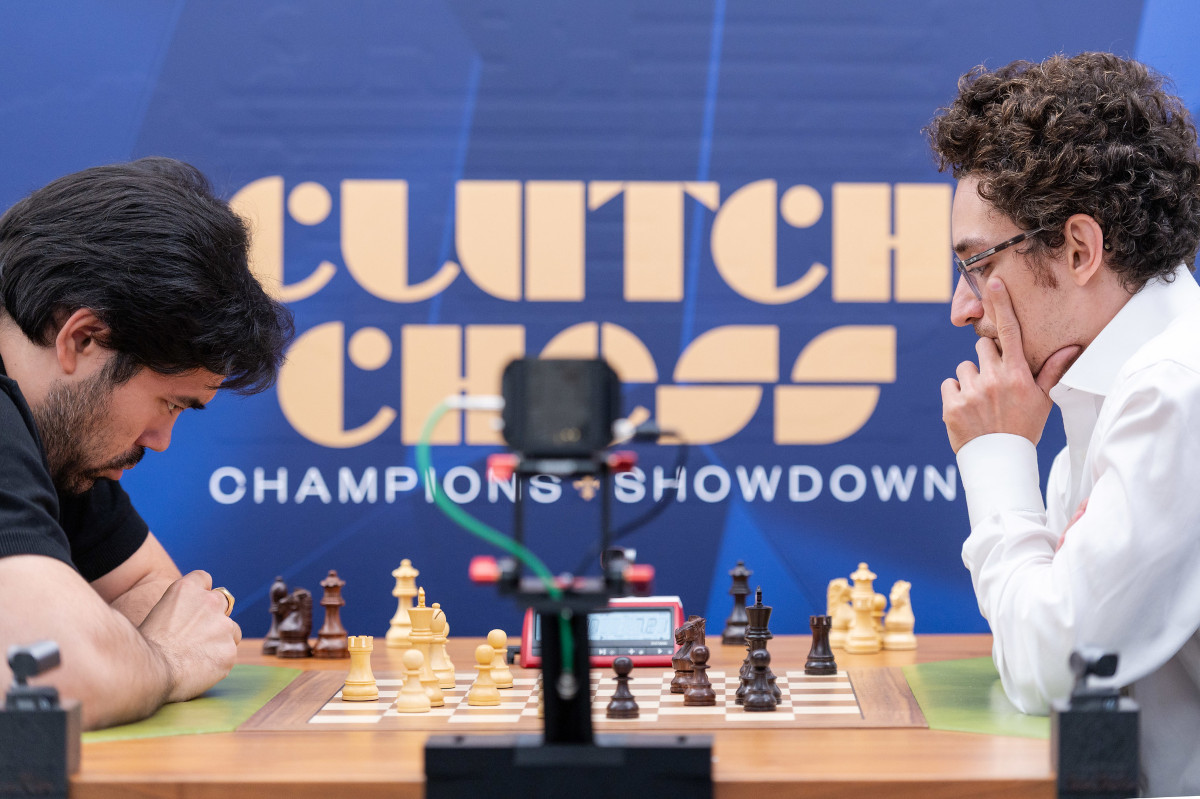
Nakamura was the most consistent performer on Tuesday, obtaining mostly favourable positions and scoring his two victories in consecutive encounters. After drawing his opening game against Caruana with black, he defeated his compatriot with white in their second meeting. He followed this up with another win, this time against Pragg, also playing white.
The early leader could have also collected a win point in his first encounter with Caruana. Playing black, Nakamura obtained a winning position and entered a queen endgame with two extra pawns. Caruana, however, managed to find a way to give perpetual check, escaping with a draw despite his material deficit.
Caruana was already in desperado mode, attempting to complicate matters by creating a passer on the kingside in an objectively lost position. In this case, his strategy worked out, as here Nakamura faltered by responding to 58.g5 with 58...hxg5??, allowing White to force a trade of rooks on c3 with 59.Rc8+ Kb4 60.Rxc3 Kxc3.
The point is that White will promote to a queen on h8 with check, as was seen in the game!
In this setup, Black has no way to escape the perpetual checks, and the game was agreed drawn only a few moves later.
Master your middlegame with the complete strategy series – now available as a bundle at a reduced price. Take your chance to save and improve! Master your middlegame with the complete strategy series – now available as a bundle at a reduced price. Take your chance to save and improve!
The winning move for Black in the first diagrammed position is 58...Re3+, a crucial intermediate check that prevents White from capturing on the key c3-square. After the king moves to either side, Black can safely collect the pawn on g5, with an easily winning position.
We got to enjoy two exciting encounters between the two strongest American chess players in the world | Photo: Crystal Fuller
Nakamura's final game of the day saw him on the other side of a difficult endgame. Sindarov obtained a winning position in an encounter that eventually reached an ending with rooks, opposite-coloured bishops and passed pawns for both players. The position was far from straightforward, and Nakamura managed to hold the draw after a lengthy struggle.
This position is winning for White, but in order to convert it, Sindarov needed to figure out that he should play 63.c6! here, allowing Black to push his passer on the f-file all the way down the board - and the Uzbek star only had 20 seconds on the clock.
Sindarov played 63.Bd4? instead, allowing Black to keep the balance by eventually trading into a pure rook and bishop against rook endgame. Still, the battle was only agreed drawn after Black played his 117th move.
Speaking to Maurice Ashley after the games, Nakamura admitted that his performance had surprised him. Given his lengthy absence from over-the-board competition, he had expected to be the most out-of-form player in the field. Instead, he felt he had generally outplayed his opponents, remarking:
I think everyone else has been super active and they should come out guns blazing, and it actually seemed the other way around. [...] I seem to be the sharpest player. To be fair, one of the players is saving their preparation, but I still felt that compared to Fabi and Pragg I pretty much outplayed them in the games that we had. So it was very surprising because I thought it would be the other way around.
The first day featured five decisive games and seven draws, although the number of peaceful results did not reflect the amount of fighting chess on display. Several encounters saw substantial changes in the evaluation, with time trouble playing an important role.
Sindarov's only victory came in his first game against Pragg. The Indian GM had obtained a promising position earlier in the encounter, but inaccuracies under time pressure allowed his opponent to equalise. The players eventually reached an opposite-coloured bishop endgame in which Pragg failed to maintain the balance. After blundering a pawn, he also ran out of time.
Pragg faltered decisively with 47.g4??, when after 47...hxg4 48.Bf7 (48.Kg3 Kh5 is no good either), Black wins with 48...Be1. Pragg ran out of time before the winning move appeared on the move, though.
There might have followed 48...Be1 49.e5 Bxh4 50.Be6 Kh5 51.f5 gxf5 52.Bxf5 Kg5, and Black will win by making use of the two far-apart passers on the a and g-files.
In this video course, experts including Dorian Rogozenco, Mihail Marin, Karsten Müller and Oliver Reeh, examine the games of Boris Spassky. Let them show you which openings Spassky chose to play, where his strength in middlegames were and much more.
A sudden blunder ended the game between the two representatives of the young generation in Saint Louis | Photo: Crystal Fuller
The other two decisive games not involving Nakamura came in the final mini-match between Caruana and Praggnanandhaa. Both players won with the black pieces, although the character of the two encounters was markedly different.
In their first meeting, Caruana managed to turn the tables in a sharp and complicated struggle, securing his only victory of the day.
Pragg was clearly for choice in the middlegame after his brilliant 21.Nc6! - in case of 21...Qxc6 White has 22.Nf6+, grabbing the queen next.
However, an inaccuracy by White on move 27 allowed Caruana to get back in the game (though Pragg was still slightly better). And a blunder on move 32 ended the game at once.
32.Qf3?? allowed Caruana to play the great-looking 32...c2, prompting Pragg's resignation, as 33.Qxe3 fails to 33...cxd1Q+, while other alternatives would be followed by 33...c1Q+.
Correct would have been 32.Qf4, with a sharp battle ahead.
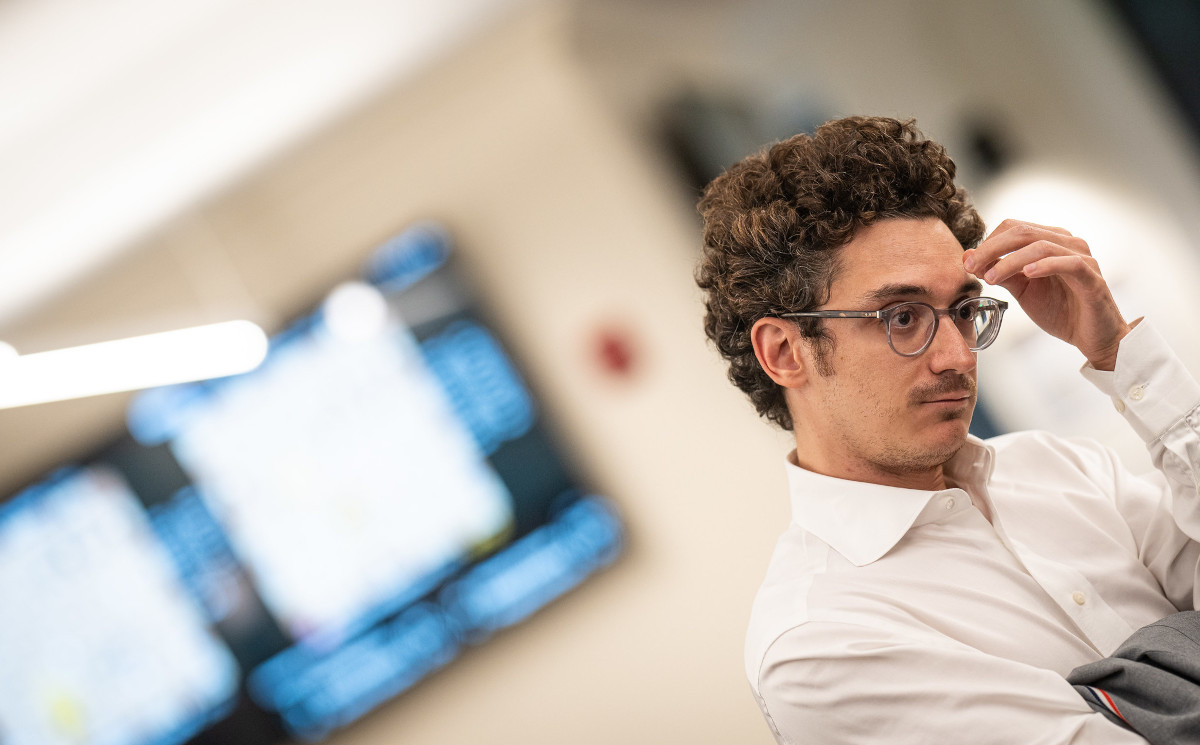
Fabiano Caruana | Photo: Lennart Ootes
Pragg bounced back in their return encounter, demonstrating how a materially balanced position with bishops of the same colour can still offer winning chances in a simplified ending.
After 57...h6! White is in zugzwang (he could go for 58.h4, but then 58...h5 would leave him equally powerless).
The bishop on d2 is defending both the pawn on a5 and the one on f4, while a king move would allow the black monarch to decisively infiltrate. Caruana played 58.Bc3, allowing 58...Bxf4, and Pragg had little trouble converting his advantage into a win.
The Indian GM's win was a welcome result after a difficult start to the competition, and it allowed him to finish Tuesday on a positive note.
Most players prefer to attack rather than defend. But what is the correct way to do it? GM Dr Karsten Müller has compiled many rules and motifs to guide you, along with sharpening your intuition for the exceptions.
Wednesday's games will follow the same double round-robin structure, but with each victory now worth twice as much. The increased weighting means that even a single successful mini-match could substantially alter the standings before the final day, when the scoring system will place an even greater premium on decisive results.
Carlos Alberto ColodroCarlos Colodro is a Hispanic Philologist from Bolivia. He works as a freelance translator and writer since 2012. A lot of his work is done in chess-related texts, as the game is one of his biggest interests, along with literature and music.
10/28/2026 – Clutch Chess: Champions Showdown is a high-profile rapid tournament gathering four elite competitors. Javokhir Sindarov, who is set to challenge Gukesh Dommaraju for the World Championship title next month, joins Fabiano Caruana, Hikaru Nakamura and Praggnanandhaa Rameshbabu in a three-day battle. The competition runs from 27 to 29 October and follows a "clutch" structure of three double round-robins, where results become progressively more valuable with each round-robin. | Follow the action live starting at 18.00 CET (13.00 ET, 22.30 IST) | Photo: Crystal Fuller
10/26/2026 – The Clutch Chess: Champions Showdown event returns to Saint Louis on 27–29 October, with Fabiano Caruana, Hikaru Nakamura, Praggnanandhaa Rameshbabu and Javokhir Sindarov (pictured) competing in an 18-game rapid tournament. The four elite GMs will play three double round-robins, with victories worth progressively more points over the three days. A jackpot funded by drawn games further adds entertainment value to the competition. | Photo: Nils Rohde / ChessBase
YOUR PERSONAL CHESS COACH - Whether you’re taking your first steps into the world of club chess, or already playing at a tournament level: with FRITZ, you can train more efficiently, intelligently and with a more personalised approach than ever before.
Most players don’t lack the urge to attack, they just strike at the wrong moment, and GM Sipke Ernst shows you which signals tell you to go for the king and which tell you to choose another plan.
How grandmasters win without fireworks: GM Jan Markos shows you 11 very practical tips from "How to play in a lost position" to "Be patient like Carlsen" that will improve your tournament chess.
The Nimzo-Indian has stood the test of time for over a century: Still a top choice for elite players today, from Magnus Carlsen to Praggnanandhaa, it remains one of Black's most reliable ways to fight for real chances against 1.d4 2.c4 3.Nc3.
1.c4 e5 2.Nc3 Bb4!? is an opening idea well worth considering. Black immediately threatens to double the pawns on c3 in the style of the Trompowski or Sicilian Grand Prix attack.
Italian Game Powerbase 2026 is a database and contains 8571 top class games from Mega 2026 and the Correspondence Database 2026, of which 479 are annotated.
€9.90
We use cookies and comparable technologies to provide certain functions, to improve the user experience and to offer interest-oriented content. Depending on their intended use, analysis cookies and marketing cookies may be used in addition to technically required cookies. Here you can make detailed settings or revoke your consent (if necessary partially) with effect for the future. Further information can be found in our data protection declaration.
Pop-up for detailed settings
We use cookies and comparable technologies to provide certain functions, to improve the user experience and to offer interest-oriented content. Depending on their intended use, cookies may be used in addition to technically required cookies, analysis cookies and marketing cookies. You can decide which cookies to use by selecting the appropriate options below. Please note that your selection may affect the functionality of the service. Further information can be found in our privacy policy.
Technically required cookies
Technically required cookies: so that you can navigate and use the basic functions and store preferences.
Analysis Cookies
To help us determine how visitors interact with our website to improve the user experience.
Marketing-Cookies
To help us offer and evaluate relevant content and interesting and appropriate advertisement.




.jpeg)











.jpeg)