11/15/2018 – In this tutorial, learn all about "replay training", a new feature of ChessBase 15 that invites you to guess the moves in games — a well-known and powerful way to improve. Correct proposals are rewarded with points which allows you to measure your progress. "Replay training" is a nice feature that you can use for light-hearted fun and playful challenges but also for some serious training. Give it a try! | Drawing: ChessBase
new: Fritz 20
Your personal chess trainer. Your toughest opponent. Your strongest ally. FRITZ 20 is more than just a chess engine – it is a training revolution for ambitious players and professionals. Whether you are taking your first steps into the world of serious chess training, or already playing at tournament level, FRITZ 20 will help you train more efficiently, intelligently and individually than ever before.
The very best: the ChessBase package for professional standards. With Mega Database 2019, new endgame turbo on a USB stick and Corr Database 2018. Plus ChessBase Magazine (DVD + magazine) and CB Premium membership for 1 year!
ChessBase is a personal, stand-alone chess database that has become the standard throughout the world. Everyone uses ChessBase, from the World Champion to the amateur next door. It is the program of choice for anyone who loves the game and wants to know more about it. Start your personal success story with ChessBase and enjoy the game even more.
Michael Kotyk presents a complete repertoire after 1.e4 e5, built around creative ideas, surprising move orders, and practical weapons designed to catch your opponents off guard.
€34.90
Replay training in action
Let's first have a look at the "Replay Training" in action. In a later tutorial, we will have a look at the settings and how to save our training results.
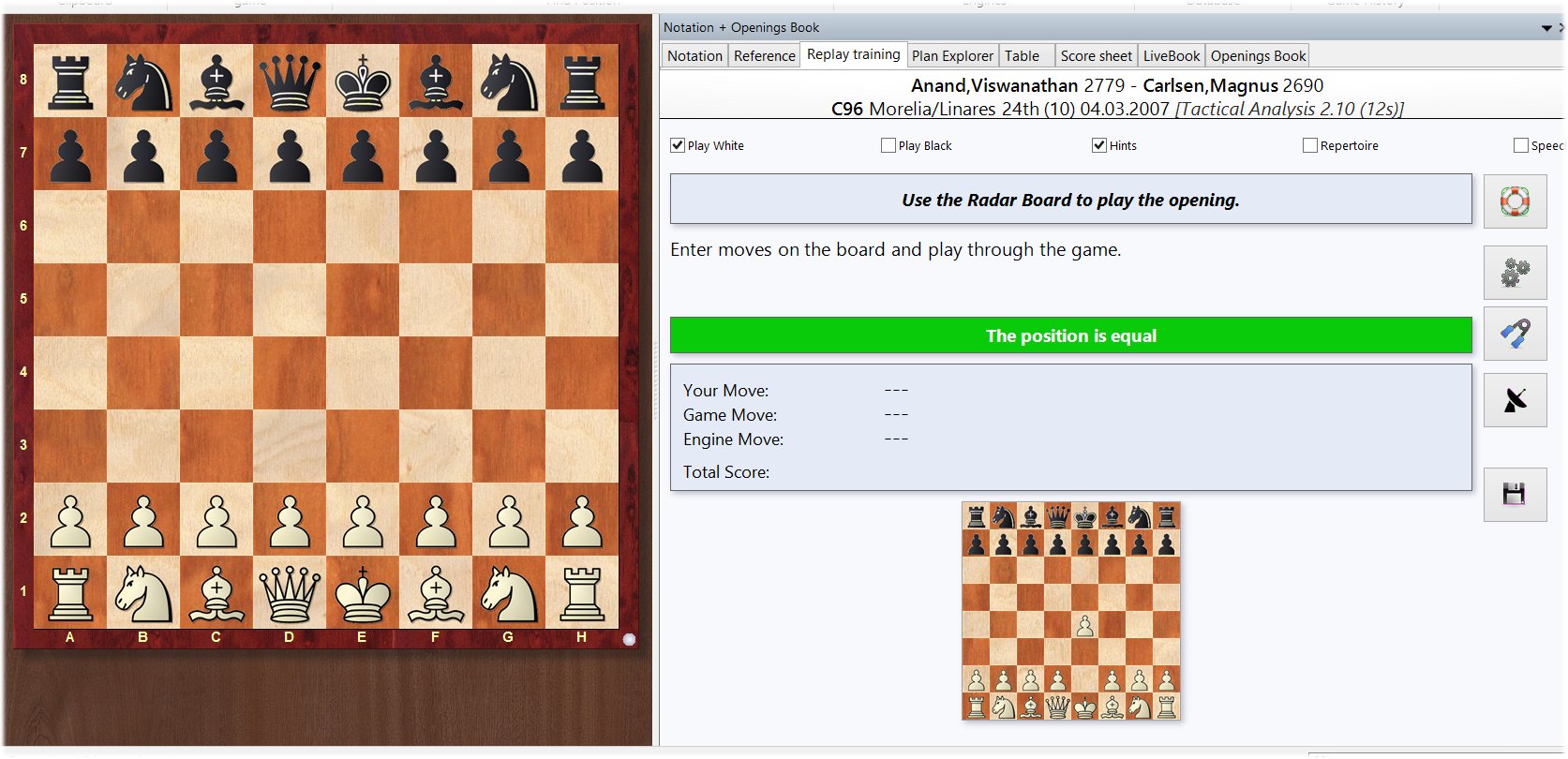
Start the "Replay training" by clicking on the tab "Replay training" above the notation.
Our sample game is Anand vs Carlsen, Linares 2007.
Note: The replay training can begin with the very first move but you can also begin at any other point of the game.
The opening
What to do in the opening is often a question of taste and repertoire. However, the "Radar Board" in "Replay training" tells you which position will later arise in the game you play through and you are asked to find out how the position that will occur was actually reached.
You enter your moves with the mouse and the program gives feedback.
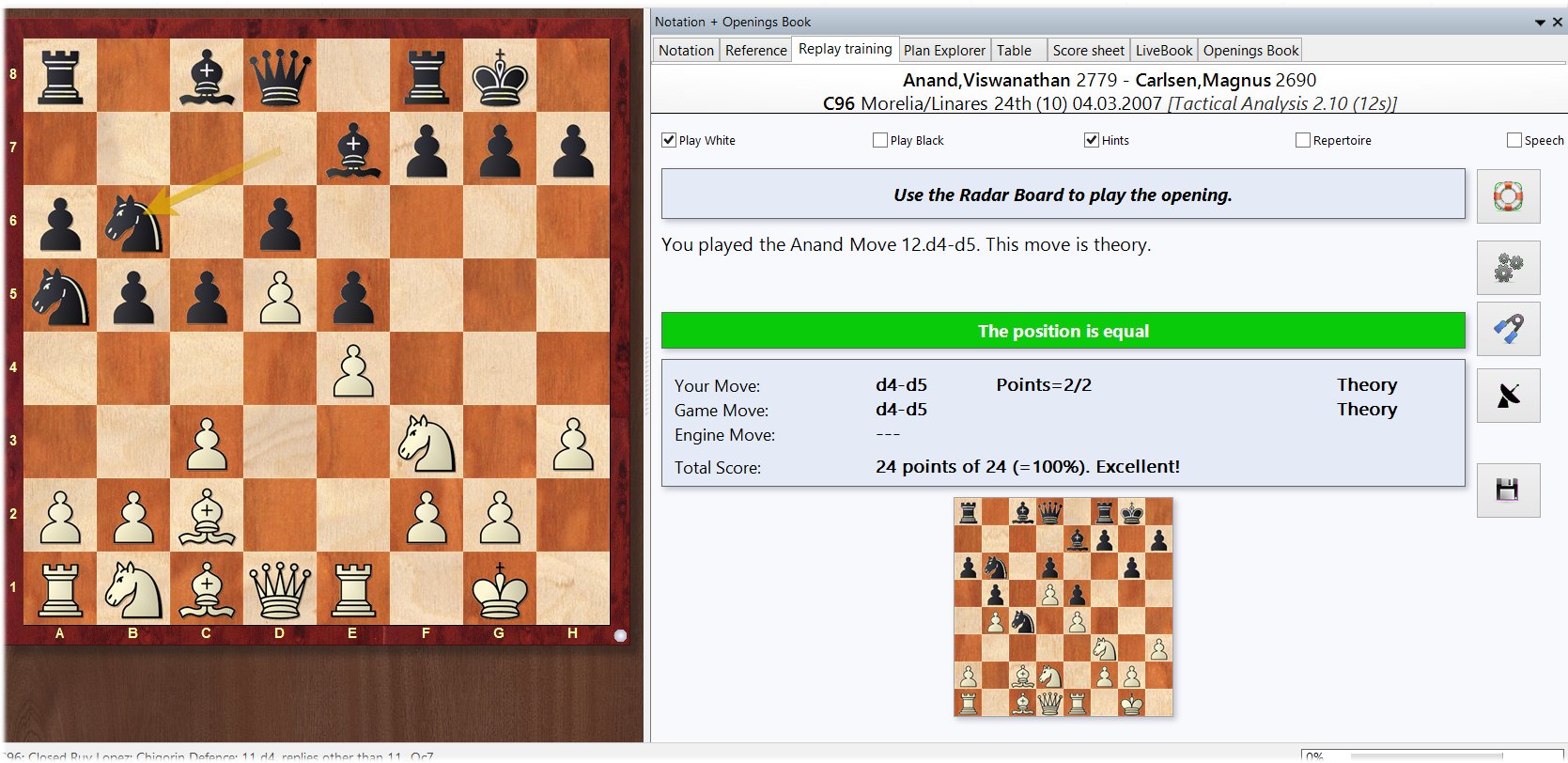
The diagram above shows the position that arose in the Anand vs Carlsen game after Black's move 12...Nb6.
The radar board shows the position after three more moves were played. Your task is to find out how this position was reached. During the opening phase, opening hints do not appear automatically but only after asking for them by clicking on the life preserver icon. After clicking the icon in this position (which costs no points) a hint would appear.
You also get feedback about the move you wanted to play (12.d5) and how many points you currently have (24 out of 24).
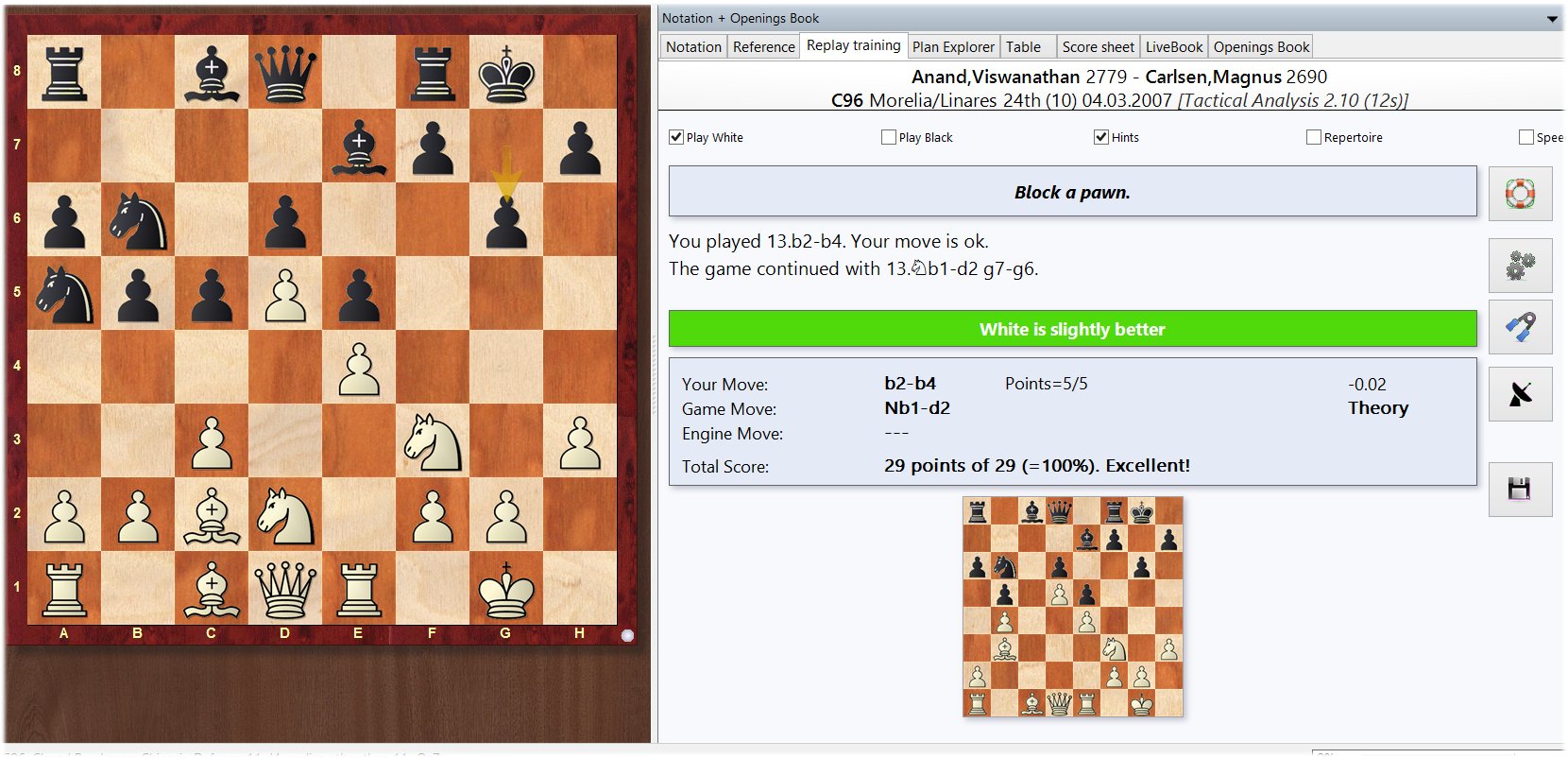
Not every proposal hits the mark. The proposal in the position above was 13.b4, but the move in the game was 13.Nbd2.
The program evaluates your proposal (here "Your move is ok"). After a small delay, the program retracts the move you wanted to play and continues with the move played in the game. The replay training continues.
After the opening
When the opening is over, the radar board vanishes. But you can reactivate it by clicking the radar screen (on the right).
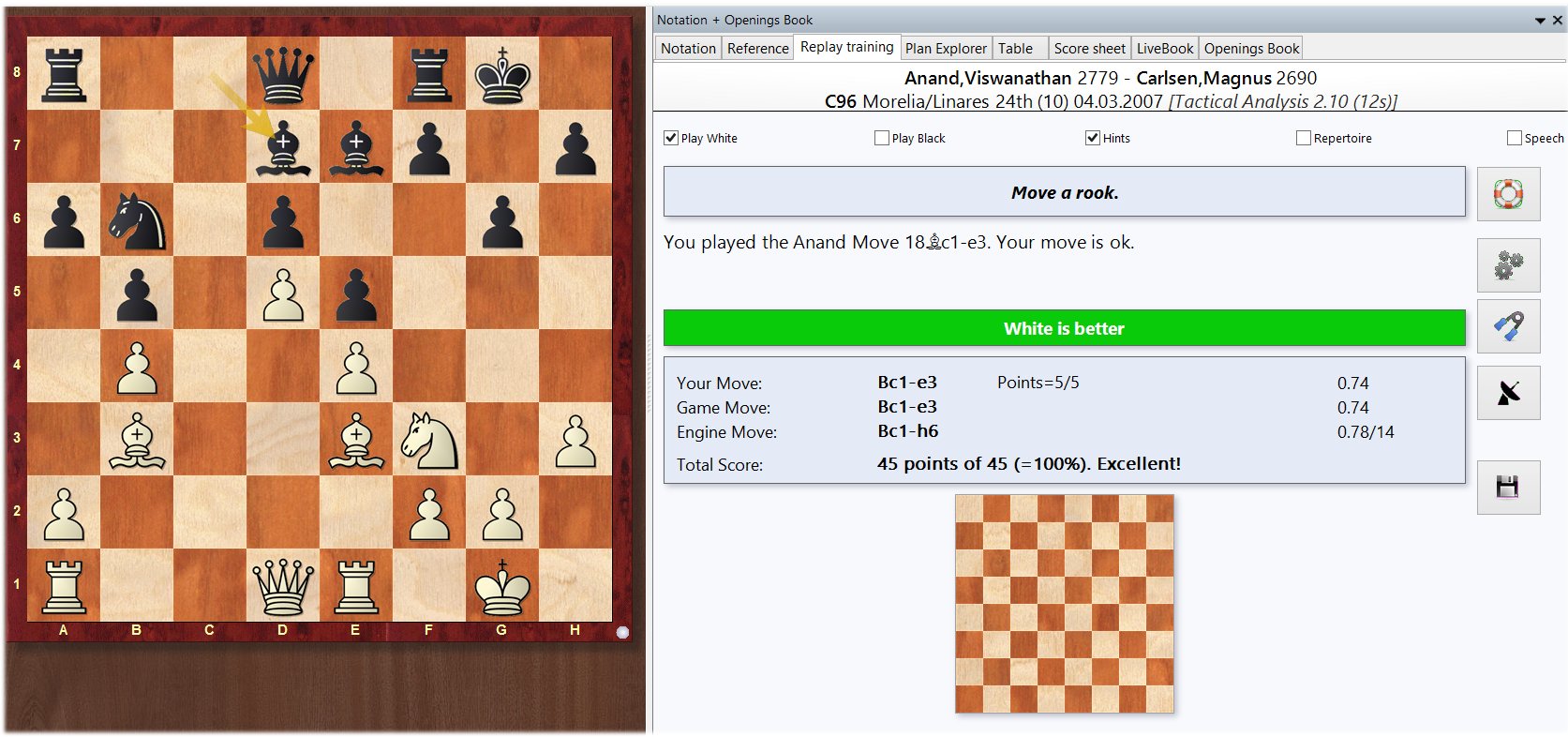
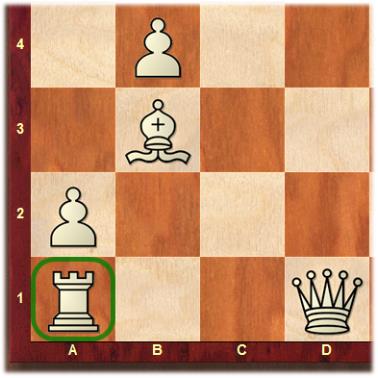
Now you get verbal hints. Here it is "Move a rook". If you are not satisfied with this hint, you can ask for more help by clicking the life preserver icon. The same happens in case of "inactivity". New hints appear and the piece that should move is highlighted in green.
Not proposing the best move
The game move is not the best move!
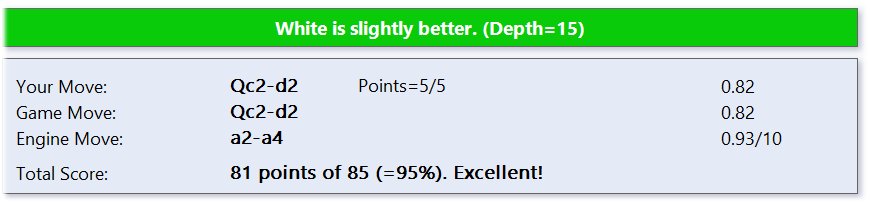
The game move is not always the best (engine) move. However, when the difference between the moves is not serious the game move will get full points.
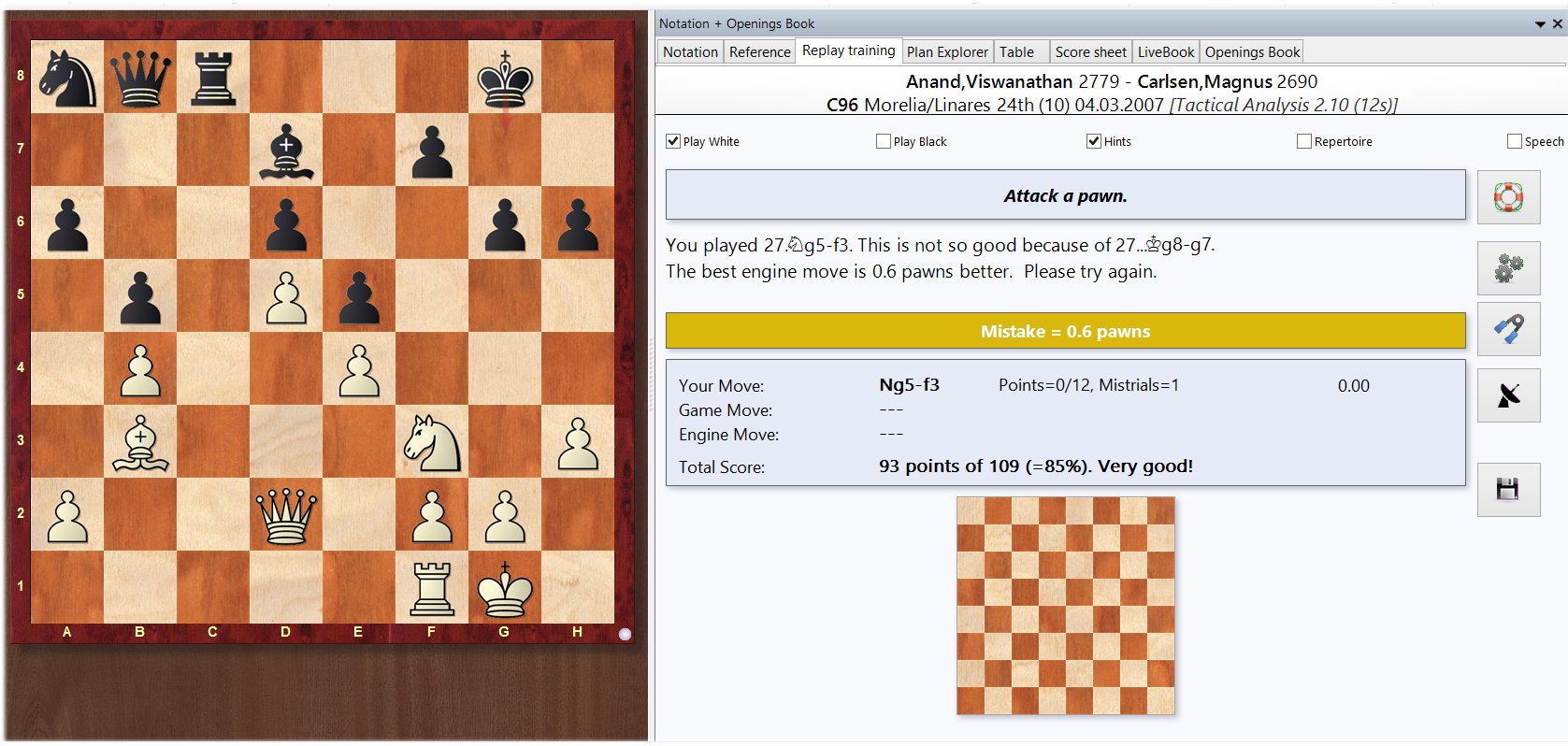
The move proposed is not accurate!
Sooner or later you will propose a bad move.
Here:
The program indicates the error and shows what the opponent might play
You do have a second try
The bad move is taken back
Only a few or no points will be awarded
The move proposed is a mistake
The program calls a mistake a mistake.
The engine is brutally honest!
Colours (up to deep red) highlight the gravity of the error
The error is taken back
You do have a second try
No points are awarded, but the move is entered into the list of errors (in the example given it is the third error)
Combination alert!
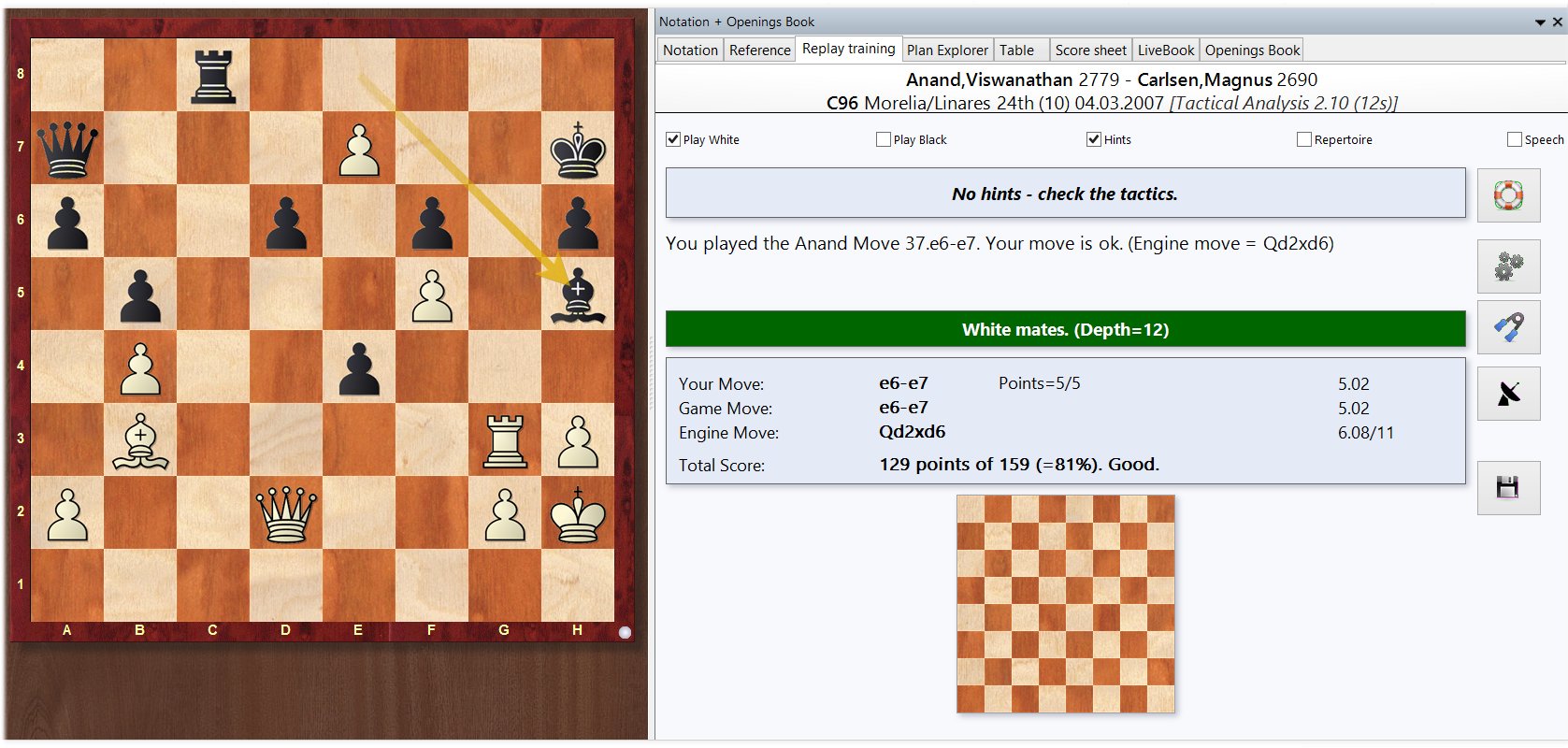
If the position in the game allows a forced tactical win no hints for a particular move are given. instead, the message "No hints — check the tactics" appears.
You're on your own!
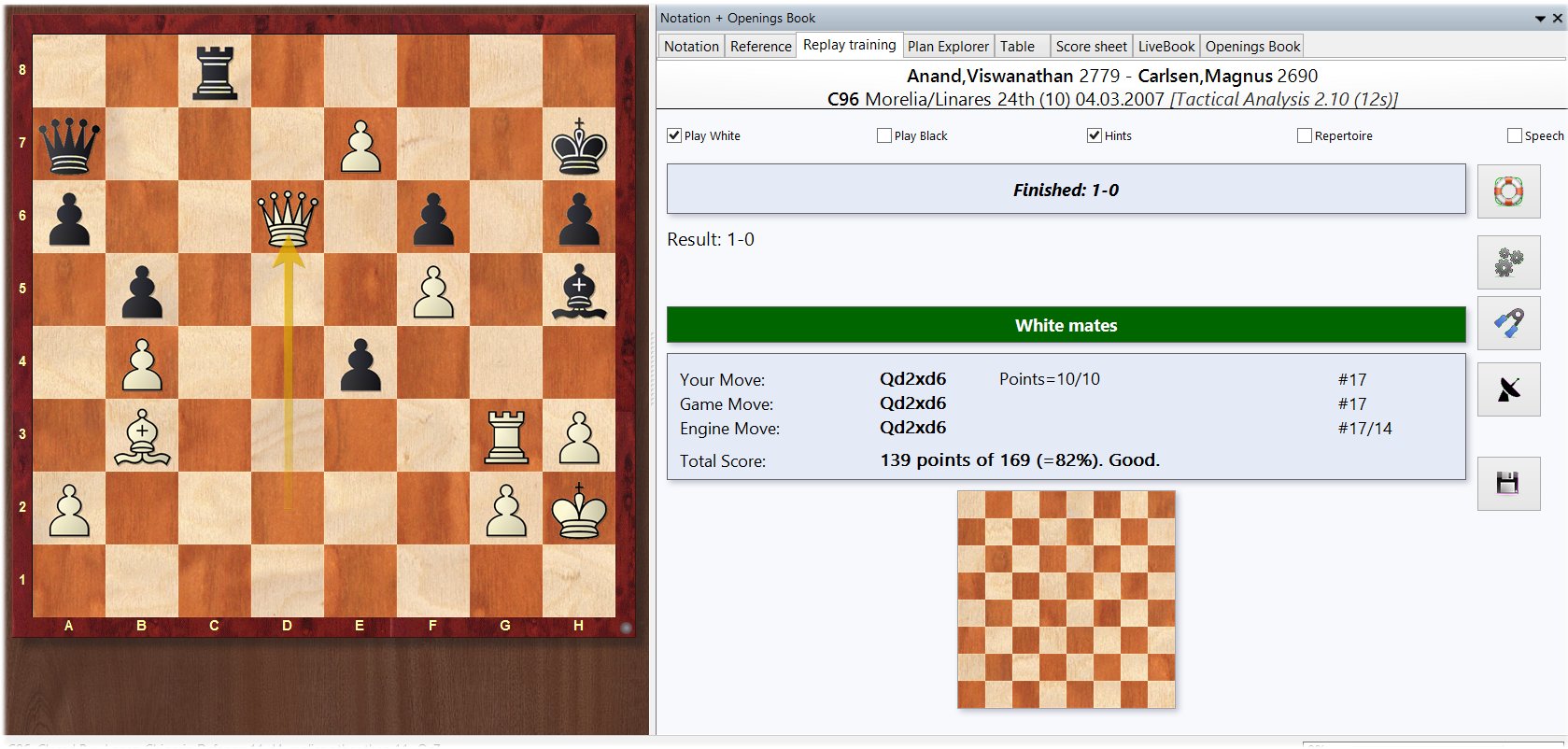
The message "Finished: 1-0" indicates the end of the game.
Clicking the disk icon (right) saves your proposals as variations to help you to save and analyse them later.
The function "Replay training" also offers a tool for analysis, calculation training, and various possibilities to adjust hints and help. The next tutorial will explain these functions.
The "Mega" is the database every serious chessplayer needs. The database contains 7.6 million games from 1500 to 2018, in highest quality standard, full of top level analyses and completely classified.
CEO and chief programmer, Matthias Wüllenweber demonstrates how it works in practice
ChessBase is a personal, stand-alone chess database that has become the standard throughout the world. Everyone uses ChessBase, from the World Champion to the amateur next door. It is the program of choice for anyone who loves the game and wants to know more about it. Start your personal success story with ChessBase and enjoy the game even more.
Martin FischerMartin Fischer, born 1962, is a ChessBase staffer who, among other things, organizes and holds seminars throughout Europe and helps administer playchess.com.
YOUR PERSONAL CHESS COACH - Whether you’re taking your first steps into the world of club chess, or already playing at a tournament level: with FRITZ, you can train more efficiently, intelligently and with a more personalised approach than ever before.
The Nimzo-Indian has stood the test of time for over a century: Still a top choice for elite players today, from Magnus Carlsen to Praggnanandhaa, it remains one of Black's most reliable ways to fight for real chances against 1.d4 2.c4 3.Nc3.
1.c4 e5 2.Nc3 Bb4!? is an opening idea well worth considering. Black immediately threatens to double the pawns on c3 in the style of the Trompowski or Sicilian Grand Prix attack.
Italian Game Powerbase 2026 is a database and contains 8571 top class games from Mega 2026 and the Correspondence Database 2026, of which 479 are annotated.
Videos: Nico Zwirs discusses the Sicilian with 2…e6 3.d4 cxd4 4.Qxd4 Nc6 5.Qe3 Nf6 6.Nc3. Mihail Marin examines Sindarov’s 6.Ne5 in the Queen’s Pawn Defence. Plus the ‘Lucky bag’ featuring 41 analyses by Berg, Ftacnik, Gupta and many others.
If you're looking for a dynamic alternative to the Slav, Queen's Gambit Declined, or other mainstream systems, the Chigorin Defence offers exactly what modern tournament players need.
€34.90
We use cookies and comparable technologies to provide certain functions, to improve the user experience and to offer interest-oriented content. Depending on their intended use, analysis cookies and marketing cookies may be used in addition to technically required cookies. Here you can make detailed settings or revoke your consent (if necessary partially) with effect for the future. Further information can be found in our data protection declaration.
Pop-up for detailed settings
We use cookies and comparable technologies to provide certain functions, to improve the user experience and to offer interest-oriented content. Depending on their intended use, cookies may be used in addition to technically required cookies, analysis cookies and marketing cookies. You can decide which cookies to use by selecting the appropriate options below. Please note that your selection may affect the functionality of the service. Further information can be found in our privacy policy.
Technically required cookies
Technically required cookies: so that you can navigate and use the basic functions and store preferences.
Analysis Cookies
To help us determine how visitors interact with our website to improve the user experience.
Marketing-Cookies
To help us offer and evaluate relevant content and interesting and appropriate advertisement.