.jpeg)

Round two of the women's Chess Olympiad in Samarkand produced the first major match upset of the tournament, as second-seeded Georgia were held to a 2–2 draw by 48th-seeded Montenegro.
All four games in the match were decisive. Nana Dzagnidze and Meri Arabidze scored the two victories for Georgia, while Bella Khotenashvili (2435) lost to Alena Skvortsova (2143) and Lela Javakhishvili (2424) was defeated by Aleksandra Milovic (2068).
Khotenashvili was outplayed by Skvortsova after the Montenegrin sacrificed a pawn to generate attacking chances in a double-edged position. Javakhishvili, meanwhile, appeared to be heading towards victory before faltering decisively and eventually losing the game.
Skvortsova 1-0 Khotenashvili
By playing 21.Ng5!?, Skvortsova offered a pawn sacrifice in order to infiltrate the opposite camp with her queen via h7.
Engines show that after 21...Bxg5 22.hxg5 Rxg5 23.Qh7 White has given up all the advantage she had accumulated in the opening phase - moreover, it is Black who is for choice in the ensuing position.
However, the brave decision by the Montenegrin player ended up paying off.
Amid mutual time trouble, Khotenashvili made the decisive mistake when she played 31...Qa7?, as she needed to go for 31...Qc7 - if White goes for 32.Ng5, as in the game, Black has 32...Qe5, neutralising White's initiative.
There followed 32.Ng5 Rxc5 (32...Re2 fails to 33.Nh7, and there is no stopping Qg7-f8+ next) 33.Nxe4 Rxc1 34.Qf6+ Ke8 35.Nd6+ Kd7 36.Rxc1
Khotenashvili tried 36...Qa3, but soon resigned since 37.Rc8 is devastating.
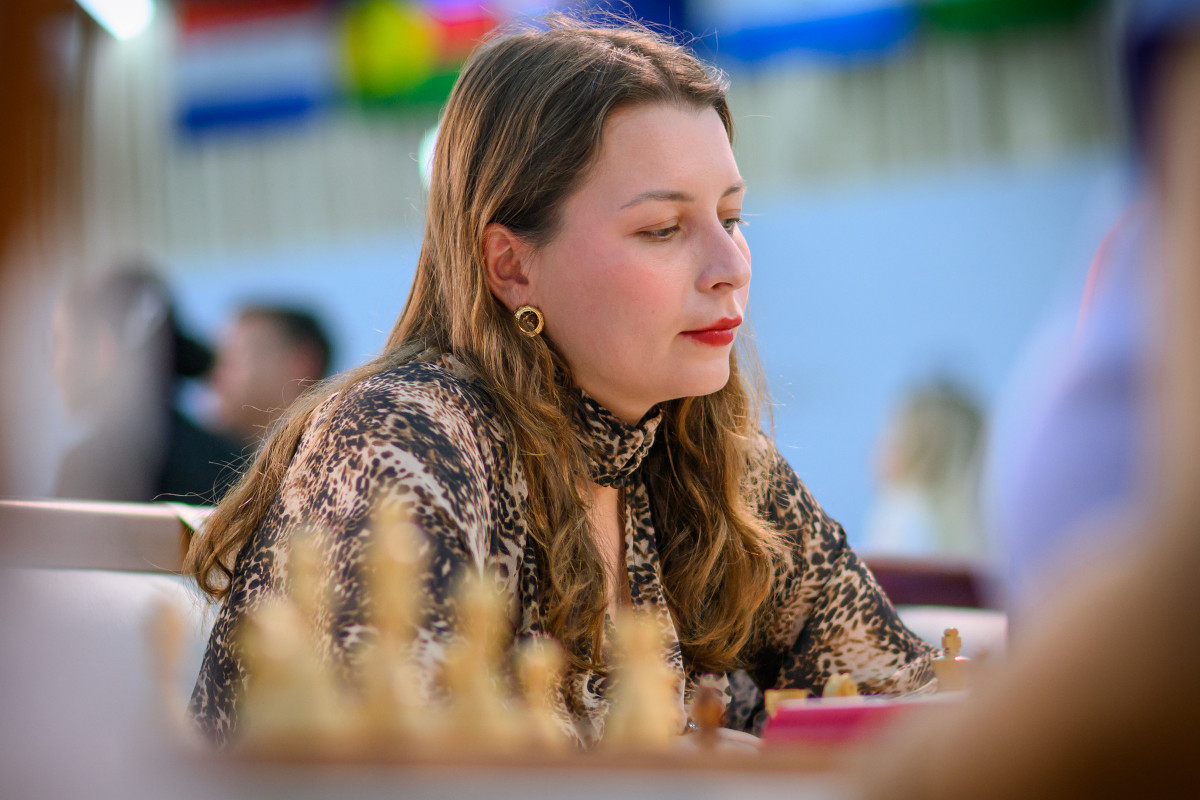
Alena Skvortsova | Photo: Michal Walusza / FIDE
All the remaining favourites down to the 35th seeds scored match victories.
The next draw came on board 36, where Czechia were held 2–2 by the United Arab Emirates, seeded 83rd. The Emirati team is captained by experienced Polish GM Bartosz Socko.
Two games in that match were drawn. Alserkar Rouda Essa (United Arab Emirates, 2036) scored the key upset victory over Joanna Worek (Czechia, 2278), compensating for the UAE's defeat on board four.
Worek 0-1 Rouda Essa
Worek was already dealing with an inferior position before she faltered decisively by playing 23.b4?. Rouda Essa quickly played the refutation: 23...Qf4
The black queen attacks both the bishop on h4 and the knight on e4. Worek resigned.
There were notable match wins for Tajikistan, seeded 84th, who defeated 37th-seeded Slovakia, and for Kenya, seeded 93rd, who got the better of 46th-seeded Norway.
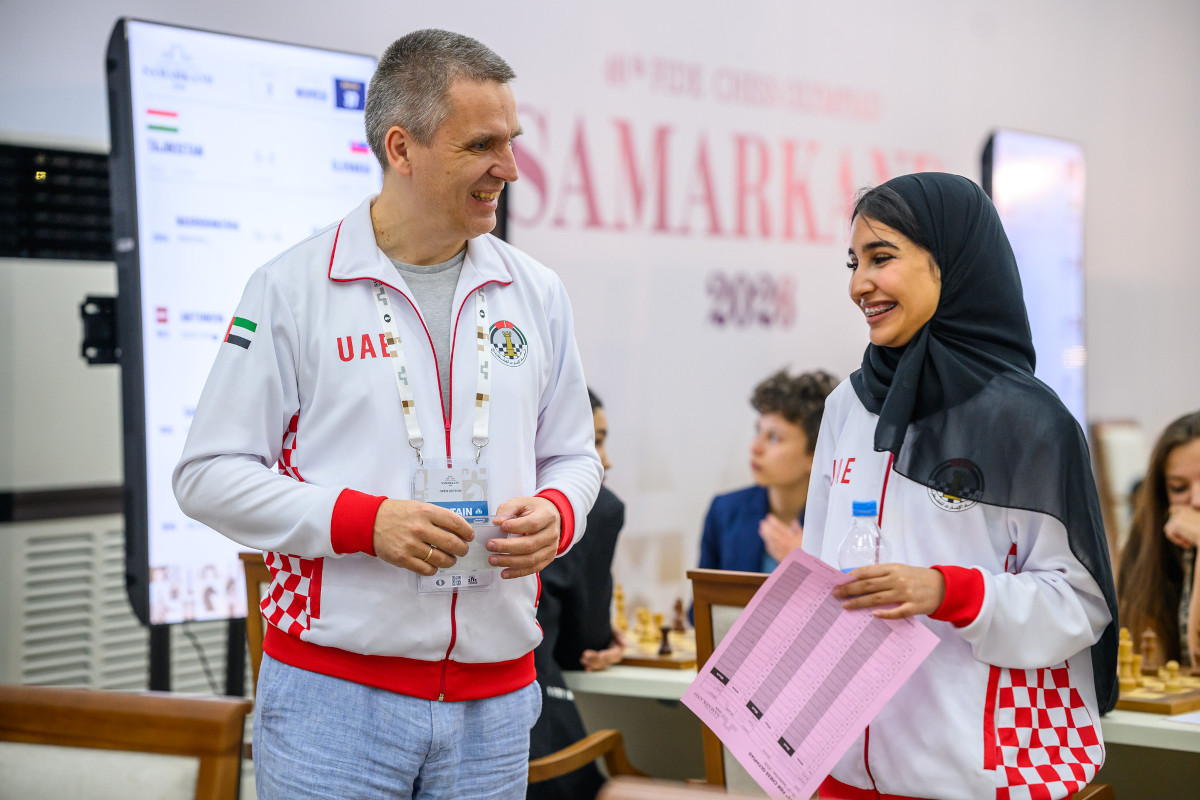
Bartosz Socko and Nasser Alshamsi Mouza after the latter drew her game on board four, securing a great result for the United Arab Emirates | Photo: Michal Walusza / FIDE
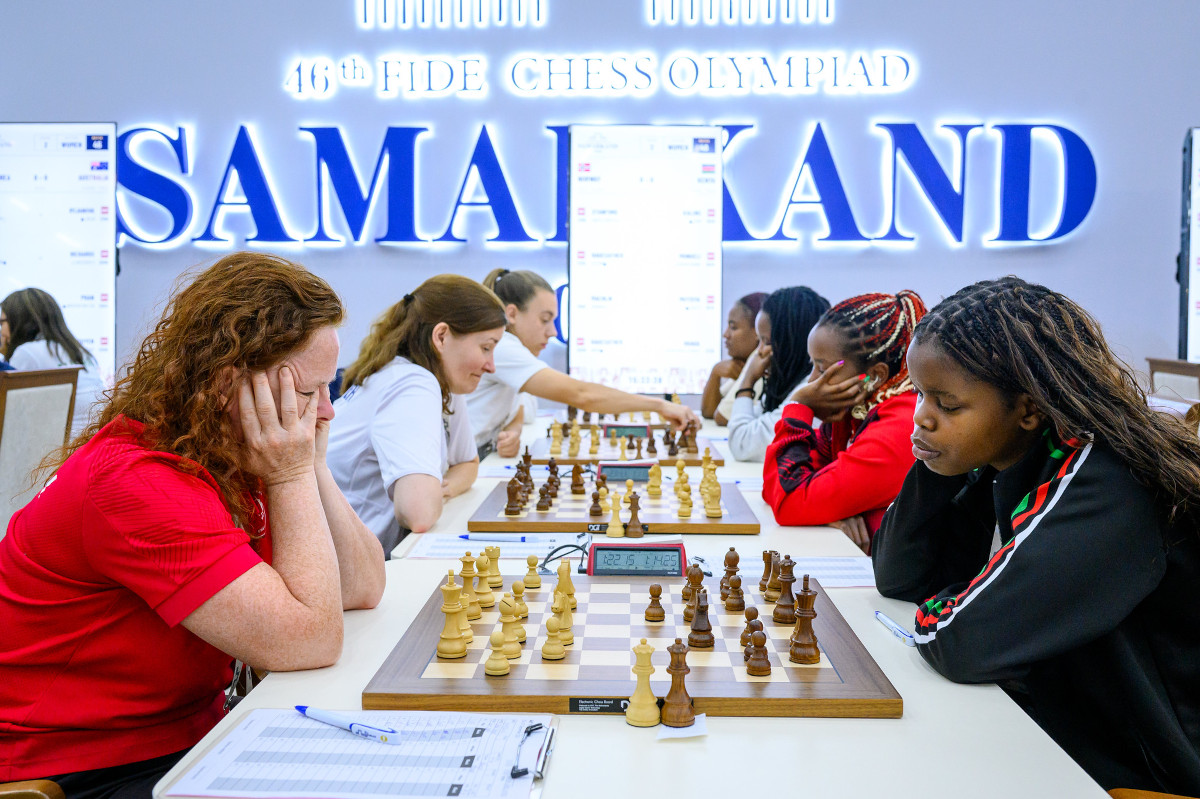
Norway v. Kenya - the African team upset their Nordic rivals in Thursday's second round | Photo: Michal Walusza / FIDE
Several leading teams score 4–0 wins Unlike in the open section, many of the strongest teams in the women's competition recorded clean sweeps in round two. Nine of the top 20 seeds won their matches by 4–0.
England, ranked 20th and led by 11-year-old prodigy Bodhana Sivanandan, defeated Nigeria by a 3½-½ score, with Sivanandan collecting her second win of the event.
The higher-ranked teams will begin to face stronger opposition in round three on Friday. India will take on Greece, Kazakhstan will face Slovenia, China will meet Türkiye, while the United States will play Cuba.
Sivanandan 1-0 Quickpen
Sivanandan concluded what turned out to be a very efficacious attack with the elegant 31.Ba3
The Nigerian representative resigned, as there is no defence against Ba3-c1 next.
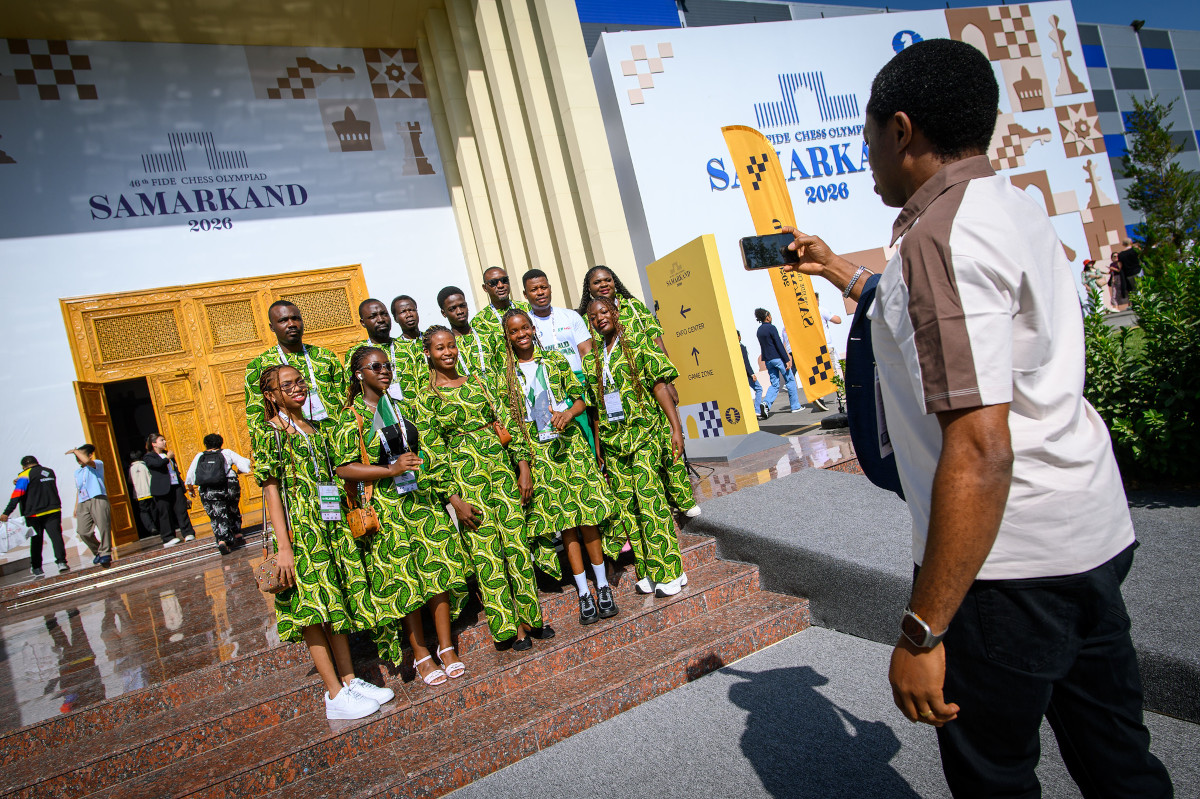
The Nigerian squads | Photo: Michal Walusza / FIDE
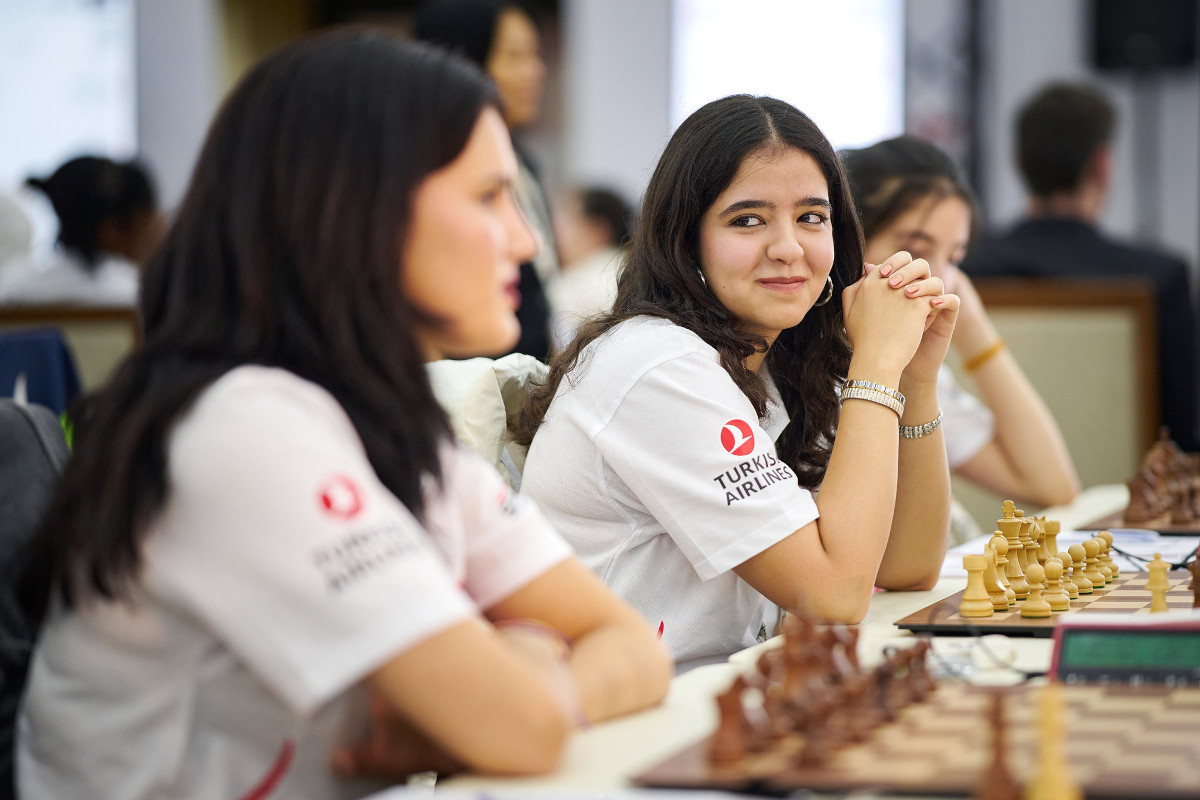
Türkiye defeated Bangladesh in round two | Photo: Rafal Oleksiewicz / FIDE
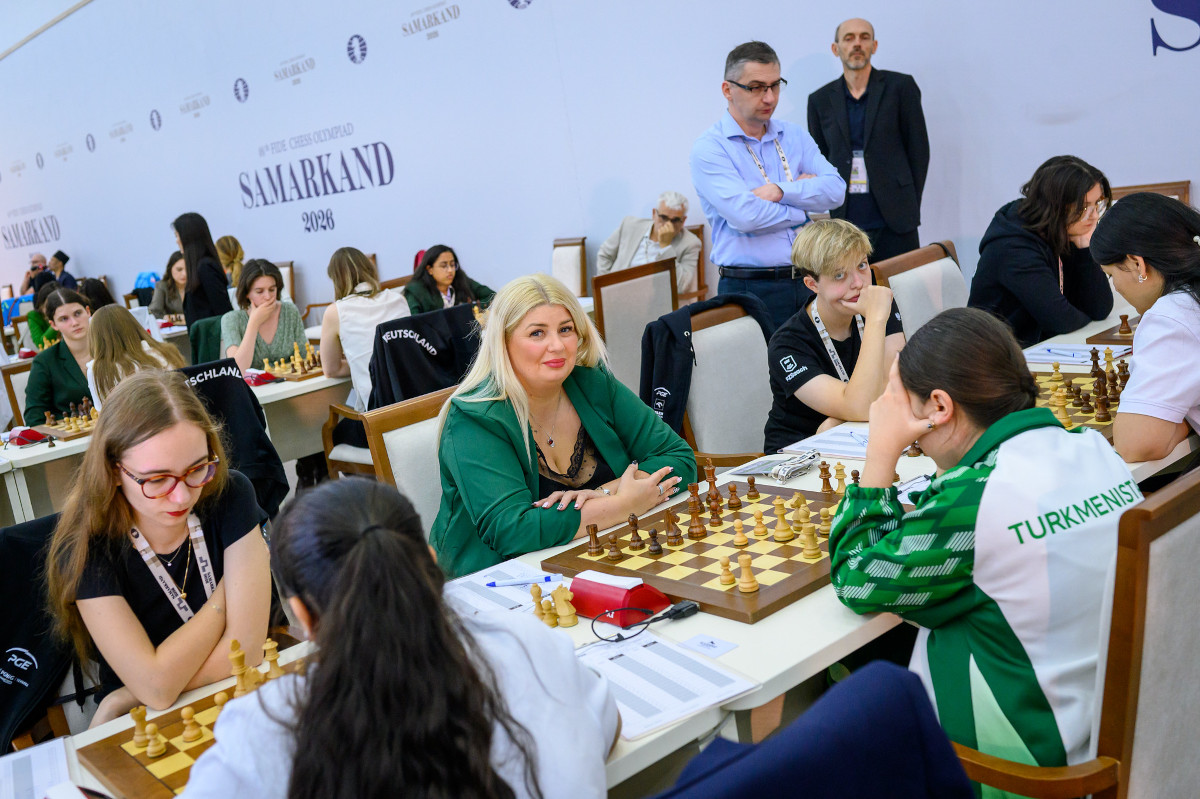
Poland obtained a 3-1 victory for Turkmenistan, with wins on the top three boards and Mahri Agamuradova upsetting Alicja Sliwicka on board four | Photo: Michal Walusza / FIDE
| Rk. | SNo | FED | Team | Group | Games | + | = | - | TB1 | TB2 | TB3 | TB4 | |
|---|---|---|---|---|---|---|---|---|---|---|---|---|---|
| 1 | 5 | USA | United States of America | A | 2 | 2 | 0 | 0 | 4 | 8 | 8 | 2 | |
| 6 | UKR | Ukraine | A | 2 | 2 | 0 | 0 | 4 | 8 | 8 | 2 | ||
| 7 | AZE | Azerbaijan | A | 2 | 2 | 0 | 0 | 4 | 8 | 8 | 2 | ||
| 12 | NED | Netherlands | A | 2 | 2 | 0 | 0 | 4 | 8 | 8 | 2 | ||
| 13 | UZB | Uzbekistan | A | 2 | 2 | 0 | 0 | 4 | 8 | 8 | 2 | ||
| 14 | SRB | Serbia | A | 2 | 2 | 0 | 0 | 4 | 8 | 8 | 2 | ||
| 17 | SUI | Switzerland | A | 2 | 2 | 0 | 0 | 4 | 8 | 8 | 2 | ||
| 21 | VIE | Vietnam | A | 2 | 2 | 0 | 0 | 4 | 8 | 8 | 2 | ||
| 25 | SLO | Slovenia | A | 2 | 2 | 0 | 0 | 4 | 8 | 8 | 2 | ||
| 38 | CAN | Canada | A | 2 | 2 | 0 | 0 | 4 | 8 | 8 | 2 | ||
| 40 | CRO | Croatia | B | 2 | 2 | 0 | 0 | 4 | 8 | 8 | 2 | ||
| 12 | 1 | IND | India | A | 2 | 2 | 0 | 0 | 4 | 8 | 7,5 | 2 | |
| 4 | CHN | China | A | 2 | 2 | 0 | 0 | 4 | 8 | 7,5 | 2 | ||
| 11 | BUL | Bulgaria | A | 2 | 2 | 0 | 0 | 4 | 8 | 7,5 | 2 | ||
| 15 | MGL | Mongolia | A | 2 | 2 | 0 | 0 | 4 | 8 | 7,5 | 2 | ||
| 20 | ENG | England | A | 2 | 2 | 0 | 0 | 4 | 8 | 7,5 | 2 | ||
| 23 | ROU | Romania | A | 2 | 2 | 0 | 0 | 4 | 8 | 7,5 | 2 | ||
| 24 | GRE | Greece | A | 2 | 2 | 0 | 0 | 4 | 8 | 7,5 | 2 | ||
| 27 | CUB | Cuba | A | 2 | 2 | 0 | 0 | 4 | 8 | 7,5 | 2 | ||
| 42 | PHI | Philippines | B | 2 | 2 | 0 | 0 | 4 | 8 | 7,5 | 2 | ||
| 21 | 3 | KAZ | Kazakhstan | A | 2 | 2 | 0 | 0 | 4 | 8 | 7 | 2 | |
| 9 | POL | Poland | A | 2 | 2 | 0 | 0 | 4 | 8 | 7 | 2 | ||
| 10 | GER | Germany | A | 2 | 2 | 0 | 0 | 4 | 8 | 7 | 2 | ||
| 18 | HUN | Hungary | A | 2 | 2 | 0 | 0 | 4 | 8 | 7 | 2 | ||
| 22 | ISR | Israel | A | 2 | 2 | 0 | 0 | 4 | 8 | 7 | 2 | ||
| 28 | ARG | Argentina | A | 2 | 2 | 0 | 0 | 4 | 8 | 7 | 2 | ||
| 30 | IRI | Iran | A | 2 | 2 | 0 | 0 | 4 | 8 | 7 | 2 | ||
| 32 | BLR | Belarus | A | 2 | 2 | 0 | 0 | 4 | 8 | 7 | 2 | ||
| 35 | INA | Indonesia | A | 2 | 2 | 0 | 0 | 4 | 8 | 7 | 2 | ||
| 39 | PER | Peru | B | 2 | 2 | 0 | 0 | 4 | 8 | 7 | 2 |


| Advertising |