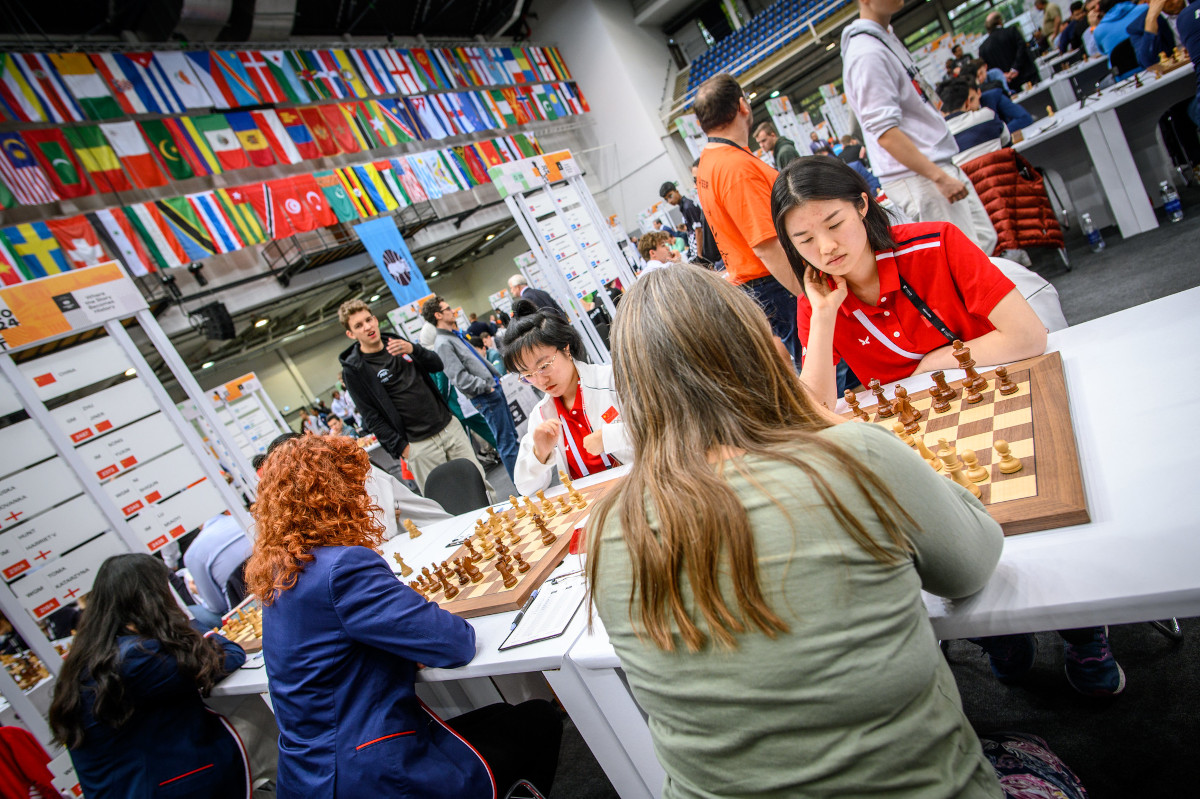
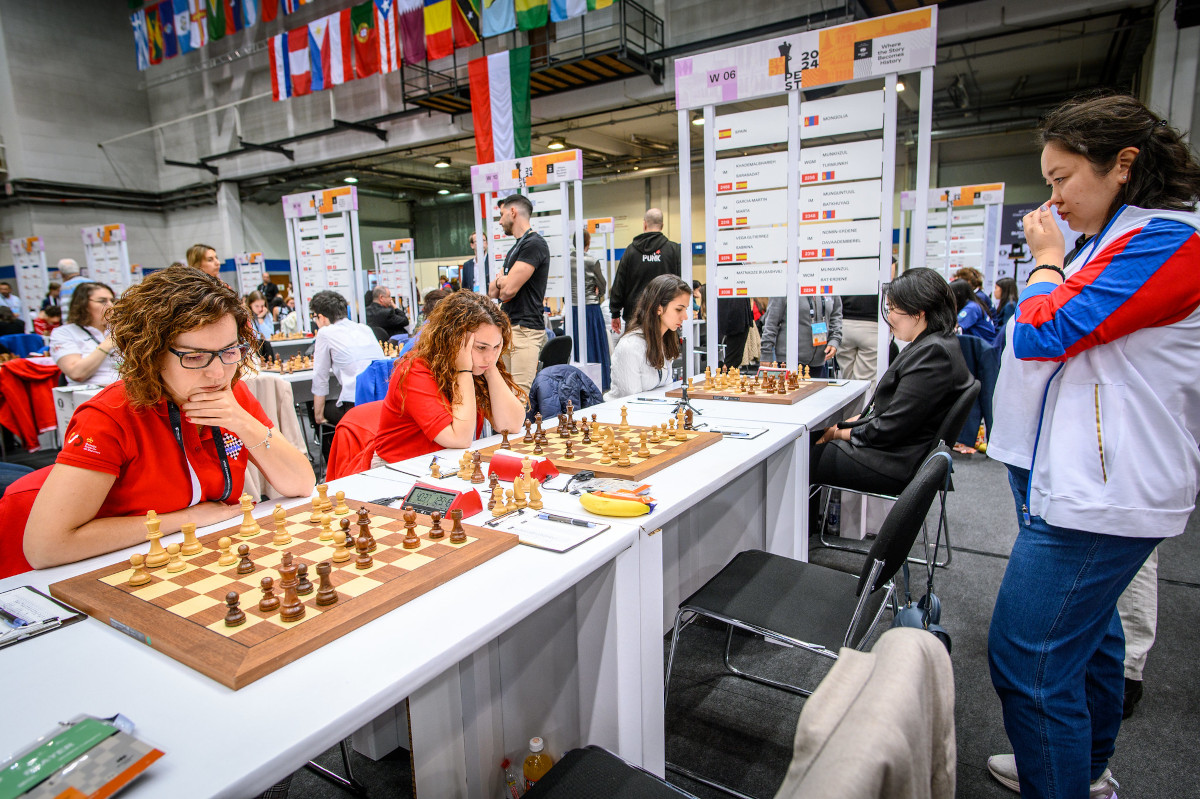
9/15/2024 – Seven teams emerged as co-leaders after round 4 of the Women's Chess Olympiad, four of which were ranked in the top 10 at the start of the tournament. Among the surprises, Mongolia and Uzbekistan secured upset victories, with Uzbekistan continuing their strong run after defeating Hungary in round 3. Meanwhile, China have been the most dominant team so far, scoring an impressive 15½ out of 16 points on individual boards. | Pictured: Bulgaria v. Uzbekistan | Photo: FIDE / Michal Walusza
new: ChessBase Magazine 225
Chess Festival Prague 2025 with analyses by Aravindh, Giri, Gurel, Navara and others. ‘Special’: 27 highly entertaining miniatures. Opening videos by Werle, King and Ris. 10 opening articles with new repertoire ideas and much more. ChessBase Magazine offers first-class training material for club players and professionals! World-class players analyse their brilliant games and explain the ideas behind the moves. Opening specialists present the latest trends in opening theory and exciting ideas for your repertoire. Master trainers in tactics, strategy and endgames show you the tricks and techniques you need to be a successful tournament player! Available as a direct download (incl. booklet as pdf file) or booklet with download key by post. Included in delivery: ChessBase Magazine #225 as “ChessBase Book” for iPad, tablet, Mac etc.!
YOUR PERSONAL CHESS COACH - Whether you’re taking your first steps into the world of club chess, or already playing at a tournament level: with FRITZ, you can train more efficiently, intelligently and with a more personalised approach than ever before. FRITZ is more than just a chess engine – it’s a training revolution! Whether you’re taking your first steps into the world of club chess, or already playing at a tournament level: with FRITZ, you can train more efficiently, intelligently and with a more personalised approach than ever before.
YOUR PERSONAL CHESS COACH - Whether you’re taking your first steps into the world of club chess, or already playing at a tournament level: with FRITZ, you can train more efficiently, intelligently and with a more personalised approach than ever before.
€49.90
A dominating performance by China
Three of the seven co-leaders after round 4 of the Women’s Chess Olympiad - India, China, and the United States - are not surprising contenders. Among them, China have shown remarkable dominance, with their youthful team securing an impressive 15½ points out of 16 on individual boards. Zhu Jiner, Guo Qi, Ni Shiqun, and 14-year-old Lu Miaoyi all have perfect scores so far, making them the standout team in the competition.
Kazakhstan and Armenia, ranked 10th and 11th in the starting seeding, are also in the leading group. Both countries have deep chess traditions and solid squads, each featuring four players rated above 2300. This balance of strength gives them the potential to challenge the higher-seeded teams going forward.
Mongolia and Uzbekistan have been the biggest surprises among the co-leaders. Mongolia, seeded 18th, secured a key victory over Spain thanks to two decisive wins with the white pieces from Batkhuyag Munguntuul and Bat-Erdene Mungunzul. Uzbekistan, seeded 34th, continued their impressive run by defeating Bulgaria. The Uzbek team drew on boards 2-4, while Afruza Khamdamova delivered a crucial win over former women's world champion Antoaneta Stefanova on the top board.
In this video course, experts (Pelletier, Marin, Müller and Reeh) examine the games of Judit Polgar. Let them show you which openings Polgar chose to play, where her strength in middlegames were, or how she outplayed her opponents in the endgame.
Round 5 promises exciting clashes as the leaders face off. India will meet Kazakhstan, with Bibisara Assaubayeva, one of the strongest young players in the world, leading the Kazakh team. China will take on Armenia, and the United States will face Mongolia in what is expected to be a tough battle.
Uzbekistan's Afruza Khamdamova | Photo: FIDE / Michal Walusza
China defeated England on Saturday | Photo: FIDE / Michal Walusza
Sabrina Vega's king walk
Despite suffering a painful loss against Mongolia, the women's team from Spain got to witness her representative on board 3, Sabrina Vega, playing a marvellous king walk to beat Mongolia's Nomin-Erdene Davaademberel.
White has a clearly winning position with her active major pieces completely dominating in this setup. Vega could have converted her advantage by pushing the f-pawn, but instead chose to walk her king to h6 via the dark squares to get the win.
There followed 32.Kg3 Ra8 33.Qf6 Rf8 34.Kf4 Kh7 35.Kg5 Qa8 36.Rxf7+ Rxf7 37.Qxf7+ Kh8 38.Kh6 and checkmate will follow.
Looking for a realistic way to play for a win with Black against 1.e4 without taking unnecessary risks? The Taimanov Sicilian is a reliable system, and hence one of the best options out there!
38...Qg8 39.Qf6+ Qg7 40.Qxg7#
Sabrina Vega on the left grabbed the only full point for Spain in their match against Mongolia | Photo: FIDE / Michal Walusza
ChessBase TV presents
Irina Krush - "I might be the most chaotic person you have ever met!"
Carissa Yip - "I'd be down to smoke a cigar with TAL"
In this Fritztrainer: “Attack like a Super GM” with Gukesh we touch upon all aspects of his play, with special emphasis on how you can become a better attacking player.
Carlos Alberto ColodroCarlos Colodro is a Hispanic Philologist from Bolivia. He works as a freelance translator and writer since 2012. A lot of his work is done in chess-related texts, as the game is one of his biggest interests, along with literature and music.
YOUR PERSONAL CHESS COACH - Whether you’re taking your first steps into the world of club chess, or already playing at a tournament level: with FRITZ, you can train more efficiently, intelligently and with a more personalised approach than ever before.
The Nimzo-Indian has stood the test of time for over a century: Still a top choice for elite players today, from Magnus Carlsen to Praggnanandhaa, it remains one of Black's most reliable ways to fight for real chances against 1.d4 2.c4 3.Nc3.
1.c4 e5 2.Nc3 Bb4!? is an opening idea well worth considering. Black immediately threatens to double the pawns on c3 in the style of the Trompowski or Sicilian Grand Prix attack.
Italian Game Powerbase 2026 is a database and contains 8571 top class games from Mega 2026 and the Correspondence Database 2026, of which 479 are annotated.
Videos: Nico Zwirs discusses the Sicilian with 2…e6 3.d4 cxd4 4.Qxd4 Nc6 5.Qe3 Nf6 6.Nc3. Mihail Marin examines Sindarov’s 6.Ne5 in the Queen’s Pawn Defence. Plus the ‘Lucky bag’ featuring 41 analyses by Berg, Ftacnik, Gupta and many others.
If you're looking for a dynamic alternative to the Slav, Queen's Gambit Declined, or other mainstream systems, the Chigorin Defence offers exactly what modern tournament players need.
€34.90
We use cookies and comparable technologies to provide certain functions, to improve the user experience and to offer interest-oriented content. Depending on their intended use, analysis cookies and marketing cookies may be used in addition to technically required cookies. Here you can make detailed settings or revoke your consent (if necessary partially) with effect for the future. Further information can be found in our data protection declaration.
Pop-up for detailed settings
We use cookies and comparable technologies to provide certain functions, to improve the user experience and to offer interest-oriented content. Depending on their intended use, cookies may be used in addition to technically required cookies, analysis cookies and marketing cookies. You can decide which cookies to use by selecting the appropriate options below. Please note that your selection may affect the functionality of the service. Further information can be found in our privacy policy.
Technically required cookies
Technically required cookies: so that you can navigate and use the basic functions and store preferences.
Analysis Cookies
To help us determine how visitors interact with our website to improve the user experience.
Marketing-Cookies
To help us offer and evaluate relevant content and interesting and appropriate advertisement.