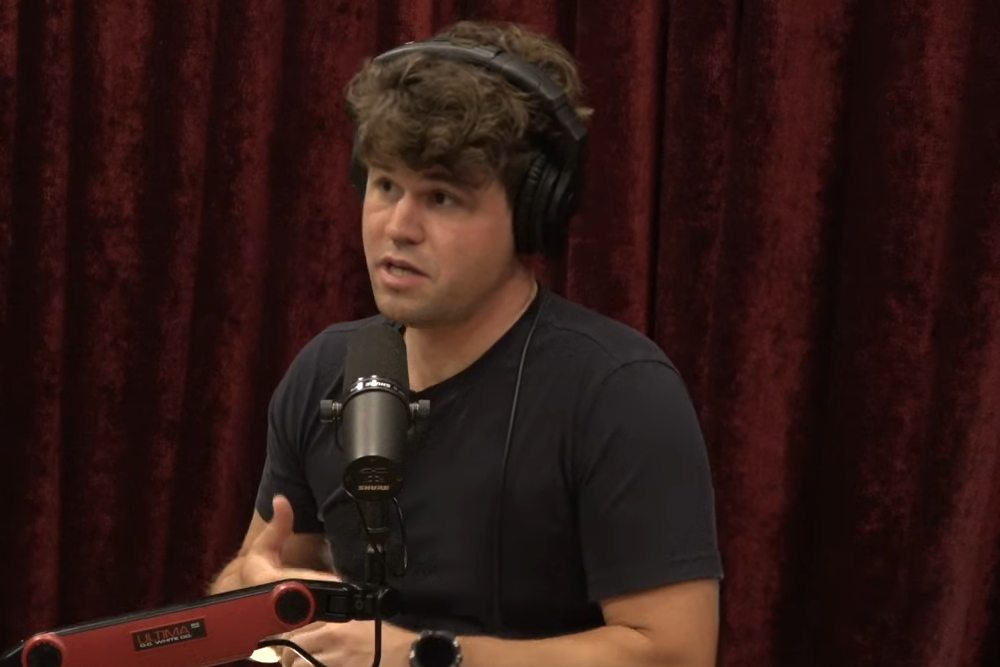
2/21/2025 – This week Magnus Carlsen was a guest of Joe Rogan, host of the very popular podcast "The Joe Rogan Experience". In a two hour interview Carlsen talked about the beginning of his chess career, chess engines, Hans Niemann, golf, creativity, how Vishy Anand and Garry Kasparov helped him to a deeper understanding of chess, his continuing passion for the game and the highlights of his career.
new: Fritz 20
Your personal chess trainer. Your toughest opponent. Your strongest ally. FRITZ 20 is more than just a chess engine – it is a training revolution for ambitious players and professionals. Whether you are taking your first steps into the world of serious chess training, or already playing at tournament level, FRITZ 20 will help you train more efficiently, intelligently and individually than ever before.
YOUR PERSONAL CHESS COACH - Whether you’re taking your first steps into the world of club chess, or already playing at a tournament level: with FRITZ, you can train more efficiently, intelligently and with a more personalised approach than ever before. FRITZ is more than just a chess engine – it’s a training revolution! Whether you’re taking your first steps into the world of club chess, or already playing at a tournament level: with FRITZ, you can train more efficiently, intelligently and with a more personalised approach than ever before.
Expand your Chess Horizon
The perfect equipment for 2026 with the latest ChessBase program '26, Mega Database, ChessBase Magazine and Premium-Account!
€349.90
"The Joe Rogan Experience" is a popular, if sometimes controversial, podcast by American comedian and wrestling commentator Joe Rogan, which was launched in 2009.
Rogan has hosted countless celebrity guests over the years, including Elon Musk, Bernie Sanders, Edward Snowden and President Donald Trump. He has also spoken with many scientists, show stars, musicians, and wrestling and martial arts stars.
Now Rogan had Magnus Carlsen as a guest. In a long conversation Carlsen spoke very openly about the beginning of his career, his joy in chess, when chess does not become an obsession and degenerate into work.
Carlsen revealed how his father taught him to play chess at the age of five, but he was more interested in Lego. At some point, however, the fiercely competitive young Magnus wanted to beat his sister at chess.
Carlsen began playing tournament chess at the age of 11 or 12, and mused that children nowadays start much earlier. In India he had seen a three-year-old playing "decent" chess and he was sure that Faustino Oro, the 11-year-old Argentinian talent, would soon become a grandmaster.
Early in the discussion Carlsen was asked about the controversy with Hans Niemann and how he came to the conclusion that Niemann had cheated during the tournament in Saint Louis with the help of a computer. Carlsen did not want to go into too much detail about this, as a documentary will soon be released on Netflix which will go into greater detail. However, Carlsen claimed that the quality of Niemann's play back then, his statements in joint analyses and his play against Carlsen did not match.
Carlsen also admitted that players are becoming increasingly paranoid about the possibility of playing near-perfectly with powerful chess engines. He listed a number of cheating cases and explained how the cheating had been carried out.
Carlsen revealed that he still doesn't trust Niemann because his play contains too many peculiarities and that a number of other top players don't trust Niemann either. According to Carlsen, it is also noticeable that Niemann does not play at the same high level at very strict security checks as he does at lax security precautions.
In the course of the interview Carlsen explained what he thinks makes a good chess player and how much his parents and sisters helped him to create a pleasant family environment for his chess career. But he also talked about other great players and their paths: E.g. Alireza Firouzja, who has a fantastic intuition, which he gained by playing countless blitz games, sometimes even during training sessions, or the current World Champion Gukesh, who relied more on books and didn't play on the internet for a long time.
Carlsen explained how he used to play a lot on the internet under pseudonyms until someone from Russia sent him a message on a chess server saying that he knew all of Carlsen's anonymous accounts - and then proved this claim by sending them to Carlsen.
The Norwegian went on to explain the influence of computers on the development of opening theory, his passion for Freestyle chess and revealed his new hobby, golf.
YOUR PERSONAL CHESS COACH - Whether you’re taking your first steps into the world of club chess, or already playing at a tournament level: with FRITZ, you can train more efficiently, intelligently and with a more personalised approach than ever before.
The Nimzo-Indian has stood the test of time for over a century: Still a top choice for elite players today, from Magnus Carlsen to Praggnanandhaa, it remains one of Black's most reliable ways to fight for real chances against 1.d4 2.c4 3.Nc3.
1.c4 e5 2.Nc3 Bb4!? is an opening idea well worth considering. Black immediately threatens to double the pawns on c3 in the style of the Trompowski or Sicilian Grand Prix attack.
Italian Game Powerbase 2026 is a database and contains 8571 top class games from Mega 2026 and the Correspondence Database 2026, of which 479 are annotated.
Videos: Nico Zwirs discusses the Sicilian with 2…e6 3.d4 cxd4 4.Qxd4 Nc6 5.Qe3 Nf6 6.Nc3. Mihail Marin examines Sindarov’s 6.Ne5 in the Queen’s Pawn Defence. Plus the ‘Lucky bag’ featuring 41 analyses by Berg, Ftacnik, Gupta and many others.
If you're looking for a dynamic alternative to the Slav, Queen's Gambit Declined, or other mainstream systems, the Chigorin Defence offers exactly what modern tournament players need.
€34.90
We use cookies and comparable technologies to provide certain functions, to improve the user experience and to offer interest-oriented content. Depending on their intended use, analysis cookies and marketing cookies may be used in addition to technically required cookies. Here you can make detailed settings or revoke your consent (if necessary partially) with effect for the future. Further information can be found in our data protection declaration.
Pop-up for detailed settings
We use cookies and comparable technologies to provide certain functions, to improve the user experience and to offer interest-oriented content. Depending on their intended use, cookies may be used in addition to technically required cookies, analysis cookies and marketing cookies. You can decide which cookies to use by selecting the appropriate options below. Please note that your selection may affect the functionality of the service. Further information can be found in our privacy policy.
Technically required cookies
Technically required cookies: so that you can navigate and use the basic functions and store preferences.
Analysis Cookies
To help us determine how visitors interact with our website to improve the user experience.
Marketing-Cookies
To help us offer and evaluate relevant content and interesting and appropriate advertisement.