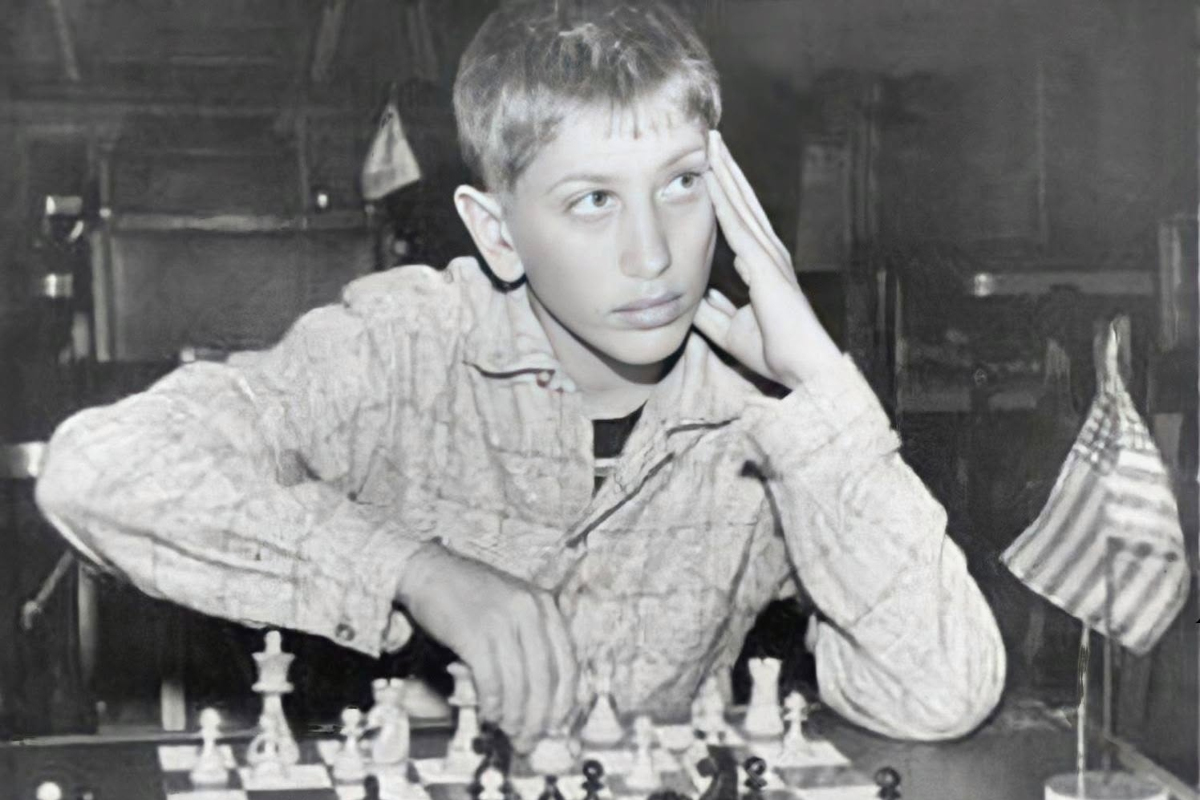
Bobby Fischer appears on the cover of Chess Life for the first time (20 July 1956)
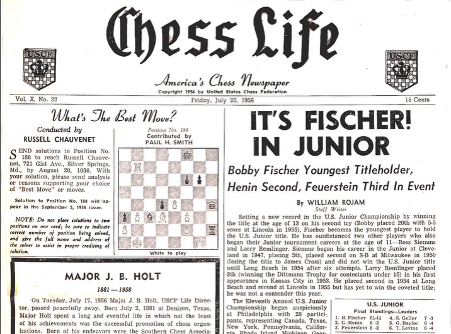
Cover of Chess Life on 20 July 1956
For some years now, I have been collecting historical chess newspapers - not physical copies (my shelves would object), but online archives that are freely available online. Interested readers can find a list of my collection on my homepage at https://littlecapa.com/historical-chess-mags/.
While browsing through these archives, one repeatedly comes across treasures that bring a smile to the face of any chess historian. One of these magazines is Chess Life, the official publication of the United States Chess Federation (USCF). In 1956, Chess Life was still published as a fortnightly newspaper - "America's Chess Newspaper", as it called itself. A single issue cost 15 cents.
Select the year 1956 in the USCF archive and open page 105 - the issue of Friday, 20 July 1956 - and you will see the cover shown above.
A 13-year-old boy from Brooklyn had just won the 11th U.S. Junior Championship - and the American chess world would no longer be the same.
The tournament
 This compact course is designed specifically for practical play. Instead of overwhelming you with endless theory, it focuses on the critical lines, typical plans, and recurring tactical ideas.
Looking for an opening that gets your opponents thinking on move one? Grandmaster Andy Woodward has relied on 1.b3 for years in blitz and bullet, using it to defeat strong masters and grandmasters who underestimated its hidden venom. While many players dismiss the opening as harmless, they often find themselves caught in unfamiliar positions, tactical traps, and uncomfortable middlegames. This compact course is designed specifically for practical play. Instead of overwhelming you with endless theory, it focuses on the critical lines, typical plans, and recurring tactical ideas that matter most when the clock is ticking.
Free video sample: Introduction
Free video sample: King's Indian Setup
The 11th U.S. Junior Championship took place at the Franklin Chess Club in Philadelphia from 1 to 7 July 1956. Twenty-eight participants from across North America fought for the title.
Bobby Fischer won with a score of 8½–1½, a clear improvement on his result the previous year (1955 in Lincoln: 20th place with 5–5).
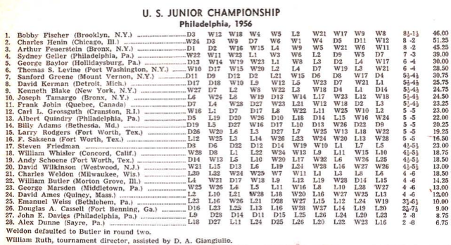
Final standings of the 1956 U.S. Junior Championship
No game from the tournament appears in the issue of 20 July 1956. They were included four weeks later, in the issue of 20 August 1956. The following game is therefore probably the first published game by Fischer. It is noteworthy that Fischer was already playing the Najdorf Variation of the Sicilian Defence at the age of 13.
What came next
 Chess is a concrete game. There is no way around training your calculation skills. Improve your visualization, pattern recognition and learn calculation techniques such as reciprocal thinking with this course.
Calculation is at the heart of practical chess. Every chess concept builds on proper calculation technique. Therefore, all chess players should continuosly train the fundamental techniques, concepts and patterns this course will present. The goal isn't only to teach you to calculate, but to give you the tools and insights to keep improving long after the final lesson.
Free sample video: Introduction
Free sample video: Quiet Moves
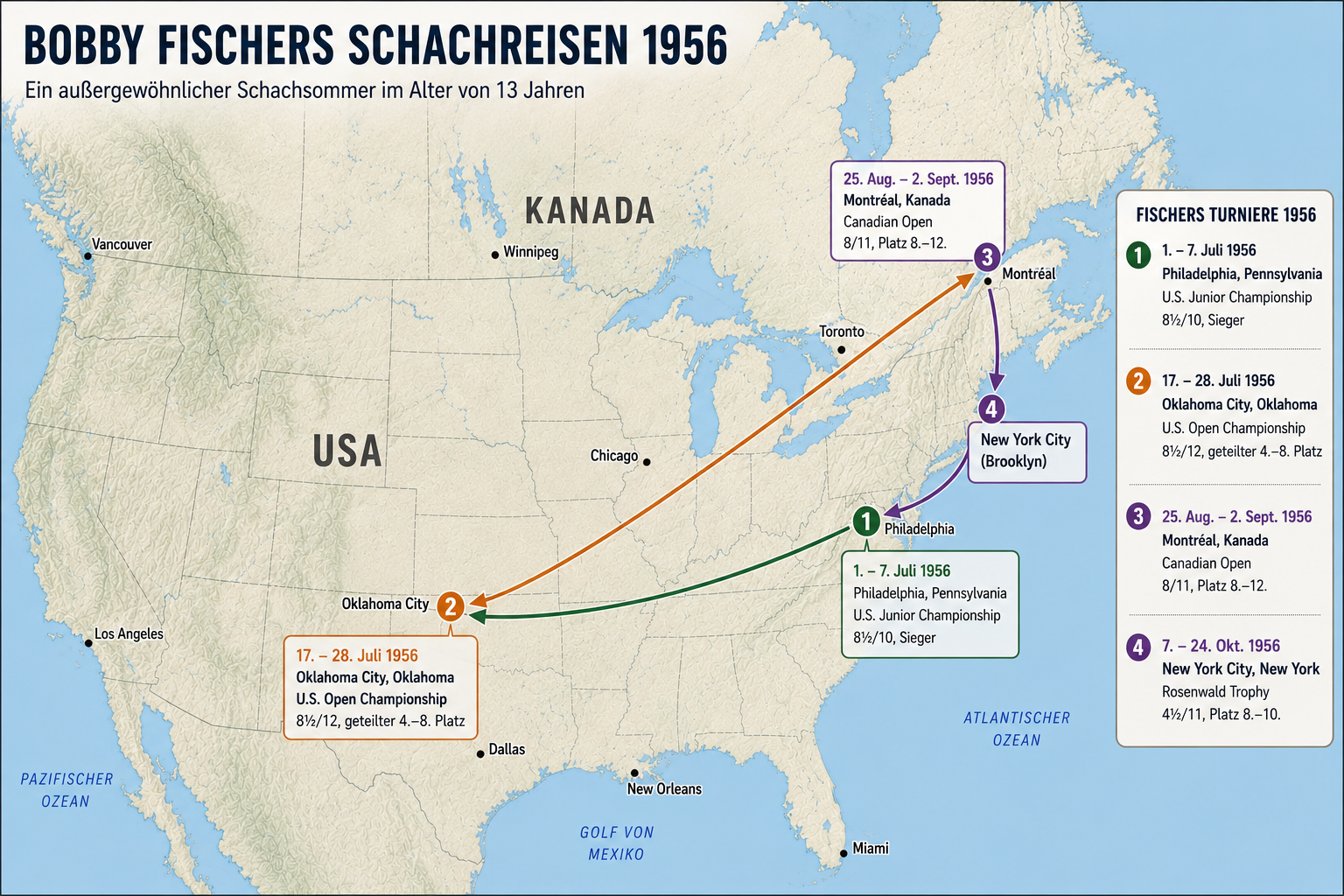
AI-generated map of Fischer's tournament summer of 1956
The summer of 1956 was a busy one. Fischer's junior triumph was followed, with hardly any break, by the US Open Championship in Oklahoma City from 17 to 28 July - the 13-year-old scored 8½–3½ and finished tied for 4th-8th place, without suffering a single defeat.
Bobby then travelled to Canada, where he played the Canadian Open in Montreal from 25 August to 2 September. He finished in 8th-12th place, only one point behind the winners Evans and Lombardy.
In the autumn of 1956 (7-24 October 1956), Fischer played in the Rosenwald Trophy tournament – an invitational event for the twelve best players in the USA. His final result of 4½/11 (8th-10th place) was not spectacular, but it was impressive for a 13-year-old boy. In addition, he played a game against Donald Byrne in that tournament, which the chess world has since reverently called "The Game of the Century". Interested readers can find that game here.
From that moment on, Fischer took off. In the winter of 1957/58 he won the US Championship for the first time with 10½–2½ and became the youngest US Champion of all time. This qualified him for the 1958 Interzonal Tournament in Portorož, where, at the age of 15, he secured qualification for the 1959 Candidates Tournament among world-class grandmasters.
The cover of 20 July 1956 was the beginning of it all.
Miscellaneous
When researching an article, one repeatedly finds information that does not make it into the article itself, but is nevertheless very interesting. That was the case this time as well.
The organising chess club - the Franklin Chess Club in Philadelphia - still exists today. Information about the club can be found on its Facebook page.
When I looked at Fischer's chess summer of 1956, I initially had the impression that he was already neglecting school at that time. But that was not entirely correct. The summer holidays in New York schools then ran from the end of June until shortly after Labour Day (the first Monday in September). Fischer therefore made perfect use of the 1956 summer holidays for chess tournaments. Only for the Rosenwald Trophy in October must he have been excused from school.
Finally, here is a puzzle to solve. To the left of the Fischer article, the following diagram is shown.
Problem by Russell Chauvenet and Paul H. Smith in Chess Life of 20 July 1956
I struggled badly with this position. It is easy to see what does not work, for example: 1.Qxg6 Rh1+ 2.Kc2 Qxf2+ 3.Be2 Qxe2#. I must admit that I only found the correct solution (1.Qxg6 Rh1+ 2.Bf1 Rxf1+ 3.Kc2 Qxf2 4.Kd3 and White will escape the checks) with computer assistance.
Sources
No other World Champion was more infamous both inside and outside the chess world than Bobby Fischer. On this DVD, a team of experts shows you the winning techniques and strategies employed by the 11th World Champion.
Grandmaster Dorian Rogozenco delves into Fischer’s openings, and retraces the development of his repertoire. What variations did Fischer play, and what sources did he use to arm himself against the best Soviet players? Mihail Marin explains Fischer’s particular style and his special strategic talent in annotated games against Spassky, Taimanov and other greats. Karsten Müller is not just a leading international endgame expert, but also a true Fischer connoisseur.