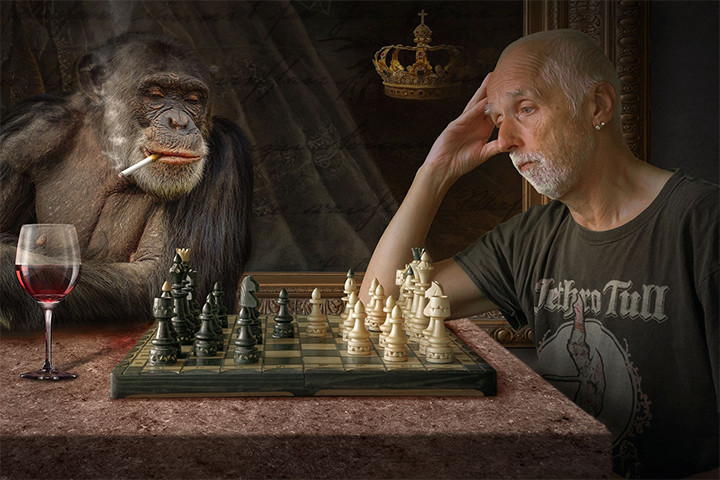
7/8/2020 – This provoking title has some truth in it. Humanbenchmark.com specializes in measuring human brain abilities with games and cognitive tests. One of their exercises states that chimpanzees consistently outperform humans — the Chimpanzee Test. Interestingly enough, some games are strongly related to chess. For pattern recognition, the “Visual Memory Test” is helpful, while for online chess purposes the “Aim Trainer” might do the trick.
new: ChessBase Magazine 225
Chess Festival Prague 2025 with analyses by Aravindh, Giri, Gurel, Navara and others. ‘Special’: 27 highly entertaining miniatures. Opening videos by Werle, King and Ris. 10 opening articles with new repertoire ideas and much more. ChessBase Magazine offers first-class training material for club players and professionals! World-class players analyse their brilliant games and explain the ideas behind the moves. Opening specialists present the latest trends in opening theory and exciting ideas for your repertoire. Master trainers in tactics, strategy and endgames show you the tricks and techniques you need to be a successful tournament player! Available as a direct download (incl. booklet as pdf file) or booklet with download key by post. Included in delivery: ChessBase Magazine #225 as “ChessBase Book” for iPad, tablet, Mac etc.!
YOUR PERSONAL CHESS COACH - Whether you’re taking your first steps into the world of club chess, or already playing at a tournament level: with FRITZ, you can train more efficiently, intelligently and with a more personalised approach than ever before. FRITZ is more than just a chess engine – it’s a training revolution! Whether you’re taking your first steps into the world of club chess, or already playing at a tournament level: with FRITZ, you can train more efficiently, intelligently and with a more personalised approach than ever before.
This is a full repertoire after 1.e4 e5 2.Nf3 focussing on the Evans Gambit as the main weapon.
€59.90
Brain games
The idea for this whole article was born when I was watching the newest video of the most famous YouTuber out there — Pewdiepie.
You don't have to watch this video to understand the purpose of this article
The title of the video is provoking and has clickbait potential (the title isn’t “Are you smarter than a chimp?” any more, I wonder why. Maybe the word “chimp” is considered offensive?).
Anyway, every human wants to be smarter than a chimpanzee. What could this test be about? How smart are chimpanzees? Could I be dumber than a chimpanzee? How serious should I take all of this?
The test is not new and has been around for a while already.
Chimpanzee Ai, doing some tests on the computer in the year 2000!
The chimpanzee test uses the so called “working memory”, a mix of pattern and numerical sequence recognition. I believe that chess players have an easier time with this test than the average human (or chimpanzee).
A little mind trick is included, from a psychological perspective, when you read the text next to the game on the website:
This is a test of working memory, made famous by a study that found that chimpanzees consistently outperform humans on this task.
In the study, the chimps consistently outperformed humans, and some chimps were able to remember 9 digits over 90% of the time.
This test is a variant of that concept, that gets increasingly difficult every turn, starting at 4 digits, and adding one every turn. If you pass a level, the number increases. If you fail, you get a strike. Three strikes and the test is over.
So now we are aware of the fact that any result under nine points is considered a failure. Not only a failure, but as the test already states, we might be dumber than a chimpanzee. With this in the back of our head, we perform better and achieve stronger results than normal, in my opinion.
This is the test I was referring to earlier. It even has squared shapes to be remembered, like the chessboard we are so familiar with. I am a patzer but was able to move up to level 15 after a couple of tries nonetheless. Once this level is reached, it gets pretty rough.
I would love to see how titled chess players perform in this test. Any volunteers?
The website was kind enough to add some tolerance to mistakes. If you click on three wrong squares, you lose. This is a nice feature, because you tend to “misclick” pretty often if you’re in a hurry!
Talking about misclicking, here is another test to prevent it from happening:
I doubt this test can improve your mouse aiming and clicking quality, but who knows? One of the fastest clicking chess grandmasters in the world, Andrew Tang a.k.a, "Pengiungim1", recently made a YouTube video on how skilled he is with a similar-looking game called AimBooster.
The “Penguin” showing off some of his insane mouse skills
Andrew Tang is considered one of the best “bullet” chess players out there — but he is even stronger in “hyper-bullet”, the 30-second variation of this game!
Arne KaehlerArne Kaehler, a creative mind who is passionate about board games in general, was born in Hamburg and learned to play chess at a young age. By teaching chess to youth teams and creating chess-related videos on YouTube, Arne was able to expand this passion and has even created an online course for anyone who wants to learn how to play chess. Arne writes for the English and German news sites, but focuses mainly on content for the ChessBase media channels.
YOUR PERSONAL CHESS COACH - Whether you’re taking your first steps into the world of club chess, or already playing at a tournament level: with FRITZ, you can train more efficiently, intelligently and with a more personalised approach than ever before.
How grandmasters win without fireworks: GM Jan Markos shows you 11 very practical tips from "How to play in a lost position" to "Be patient like Carlsen" that will improve your tournament chess.
The Nimzo-Indian has stood the test of time for over a century: Still a top choice for elite players today, from Magnus Carlsen to Praggnanandhaa, it remains one of Black's most reliable ways to fight for real chances against 1.d4 2.c4 3.Nc3.
1.c4 e5 2.Nc3 Bb4!? is an opening idea well worth considering. Black immediately threatens to double the pawns on c3 in the style of the Trompowski or Sicilian Grand Prix attack.
Italian Game Powerbase 2026 is a database and contains 8571 top class games from Mega 2026 and the Correspondence Database 2026, of which 479 are annotated.
Videos: Nico Zwirs discusses the Sicilian with 2…e6 3.d4 cxd4 4.Qxd4 Nc6 5.Qe3 Nf6 6.Nc3. Mihail Marin examines Sindarov’s 6.Ne5 in the Queen’s Pawn Defence. Plus the ‘Lucky bag’ featuring 41 analyses by Berg, Ftacnik, Gupta and many others.
€14.90
We use cookies and comparable technologies to provide certain functions, to improve the user experience and to offer interest-oriented content. Depending on their intended use, analysis cookies and marketing cookies may be used in addition to technically required cookies. Here you can make detailed settings or revoke your consent (if necessary partially) with effect for the future. Further information can be found in our data protection declaration.
Pop-up for detailed settings
We use cookies and comparable technologies to provide certain functions, to improve the user experience and to offer interest-oriented content. Depending on their intended use, cookies may be used in addition to technically required cookies, analysis cookies and marketing cookies. You can decide which cookies to use by selecting the appropriate options below. Please note that your selection may affect the functionality of the service. Further information can be found in our privacy policy.
Technically required cookies
Technically required cookies: so that you can navigate and use the basic functions and store preferences.
Analysis Cookies
To help us determine how visitors interact with our website to improve the user experience.
Marketing-Cookies
To help us offer and evaluate relevant content and interesting and appropriate advertisement.