3/18/2025 – The third round of the FIDE Women's Grand Prix in Cyprus featured hard-fought games, with high accuracy scores across the board. Anna Muzychuk secured the only decisive result, defeating Nana Dzagnidze in a queen endgame that lasted 83 moves - the longest game of the tournament so far. The remaining matches ended in well-contested draws, reflecting the competitive nature of the event. Zhu Jiner maintained her tournament lead with 2½/3 points to her name. | Photos: FIDE / Mark Livshitz
new: Fritz 20
Your personal chess trainer. Your toughest opponent. Your strongest ally. FRITZ 20 is more than just a chess engine – it is a training revolution for ambitious players and professionals. Whether you are taking your first steps into the world of serious chess training, or already playing at tournament level, FRITZ 20 will help you train more efficiently, intelligently and individually than ever before.
YOUR PERSONAL CHESS COACH - Whether you’re taking your first steps into the world of club chess, or already playing at a tournament level: with FRITZ, you can train more efficiently, intelligently and with a more personalised approach than ever before. FRITZ is more than just a chess engine – it’s a training revolution! Whether you’re taking your first steps into the world of club chess, or already playing at a tournament level: with FRITZ, you can train more efficiently, intelligently and with a more personalised approach than ever before.
Instead of forcing you to memorise endless lines, Raja focuses on clear plans, typical ideas, and attacking motifs that you can apply in your own games without delay. A short, focused, and practical repertoire.
€39.90
A. Muzychuk beats Dzagnidze
Press release by FIDE
The third round of the FIDE Women's Grand Prix Cyprus was played on Monday's afternoon at Hilton Nicosia. The ceremonial first move was performed by His Excellency Liu Yantao, the Chinese Ambassador, who opened the game for Zhu Jiner, and by His Excellency Mr. Manish, the Indian Ambassador, who played for Harika Dronavalli on the same board.
With accuracy scores in the high nineties across most games, the round featured many fighting draws, proving that this will be a closely contested event.
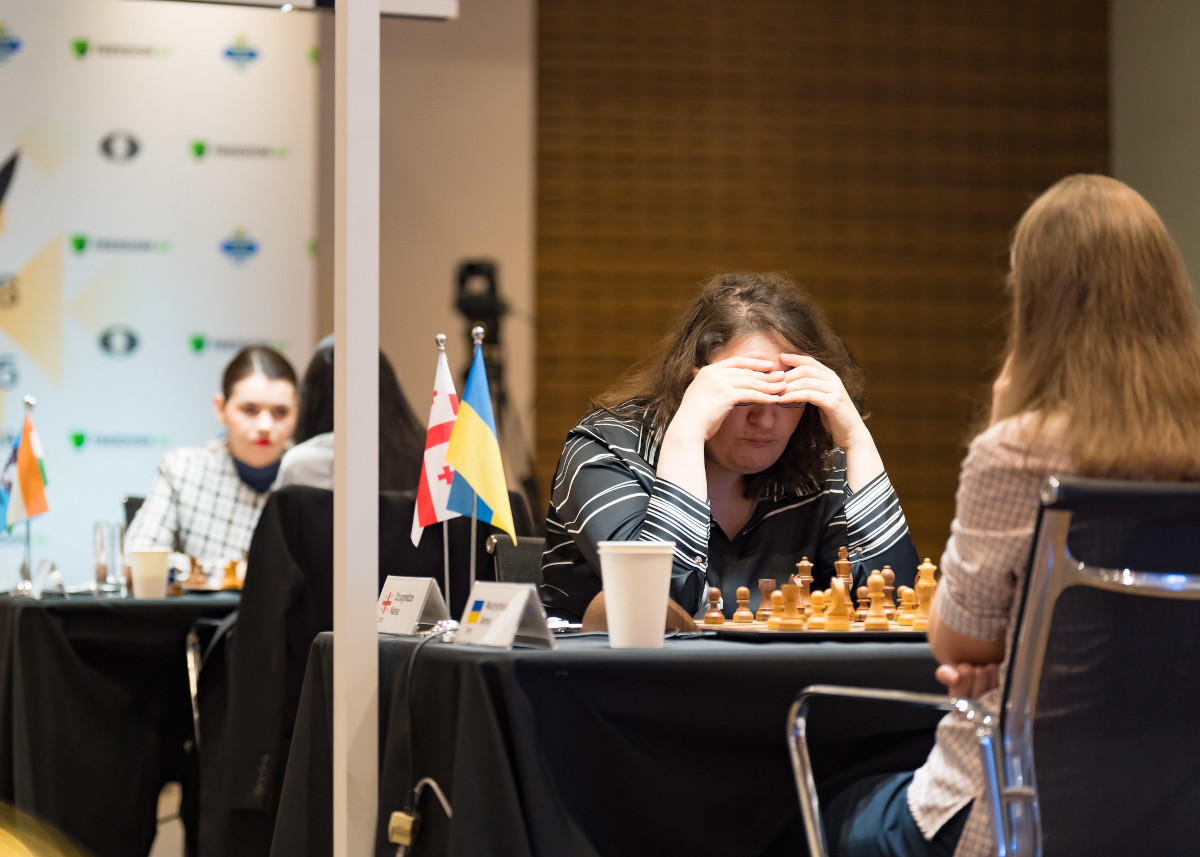
The only decisive result of the round was Anna Muzychuk's victory over Nana Dzagnidze, ending in checkmate on move 83 - the longest game of the tournament so far.
In this Fritztrainer: “Attack like a Super GM” with Gukesh we touch upon all aspects of his play, with special emphasis on how you can become a better attacking player.
The Ambassadors of China and India played the first moves in the game between Zhu Jiner and Harika Dronavalli
Divya Deshmukh ½-½ Aleksandra Goryachkina
Despite having faced each other only four times, Goryachkina has been a tough opponent for Divya, winning three games and drawing one. However, Divya has made substantial progress in recent months and, playing with white, she was eager to improve her record.
Goryachkina defended with the Berlin Variation in the Ruy Lopez, one of her regular setups with black. Both players had obviously done their homework as they blitzed out twelve moves of theory.
Suddenly, Divya slowed down, spending nearly forty minutes on her fourteenth move!
Possibly fearing some complications, the young Indian went for a solid continuation with a massive trade of pieces. The resulting rook and opposite-coloured bishops endgame was completely equal and after further simplifications a draw was agreed on move 42. The 99% accuracy game score is a testament to the no-risk approach taken by both players.
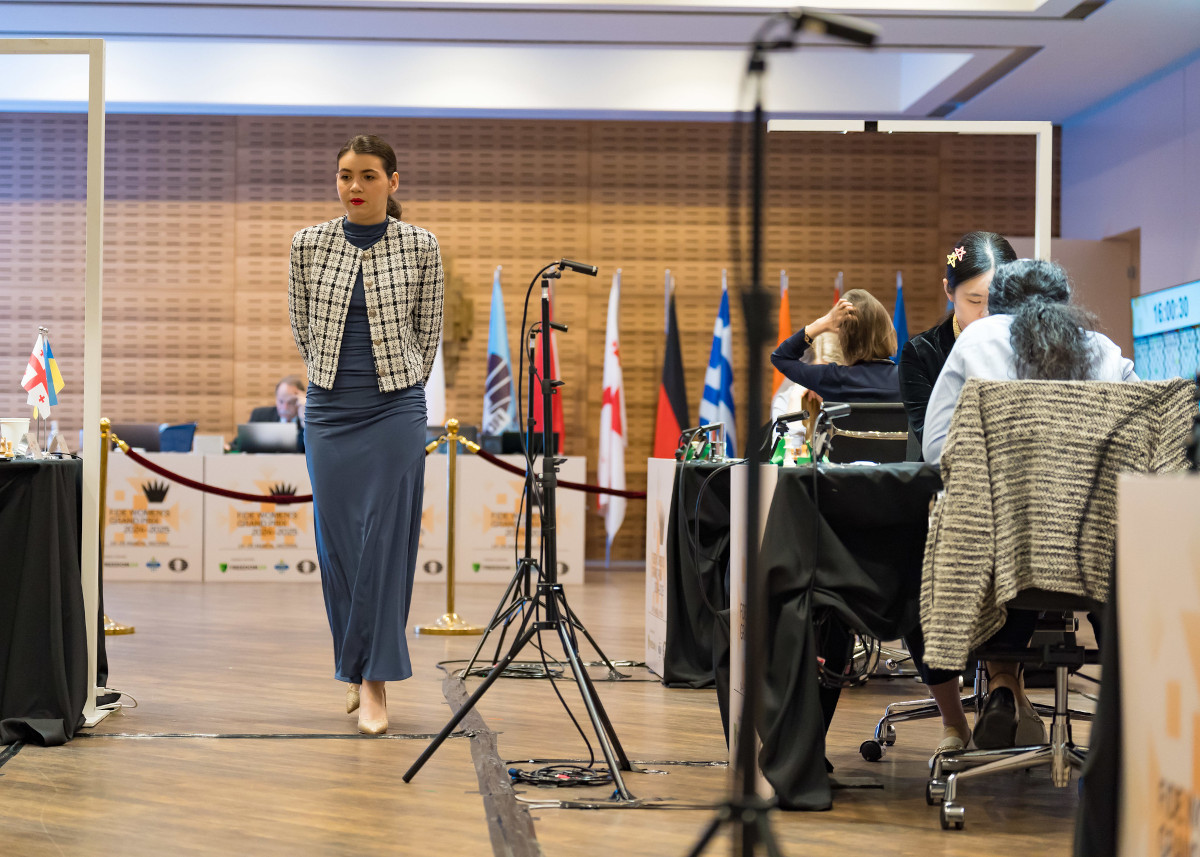
Aleksandra Goryachkina taking a stroll
Stavroula Tsolakidou ½-½ Mariya Muzychuk
The Greek International Master is rapidly becoming a fan favourite. All her games are exciting, and today's encounter was no exception. In two previous classical games, Stavroula had already defeated Mariya Muzychuk, while the other ended in a draw.
After a close shave yesterday against Harika, Stavroula opened with 1.d4 and went for the very new 9.Rg1 in the Semi-Slav Anti-Moscow Gambit.
Visibly surprised, Mariya spent nearly fifteen minutes figuring out her response. Although it took her some time, to her credit, Mariya nailed all of the twenty difficult computer moves, while Stavroula was blitzing out her own preparation.
Tsolakidou was very impressed with her opponent's play. She said in the post-game interview:
I prepared all the lines at home with my coach. It's amazing that Mariya was able to find all the computer defensive moves, but my coach did warn me to be prepared for this scenario.
In this video course, experts (Pelletier, Marin, Müller and Reeh) examine the games of Judit Polgar. Let them show you which openings Polgar chose to play, where her strength in middlegames were, or how she outplayed her opponents in the endgame.
Muzychuk achieved an impressive 100% accuracy score: she played a complicated game like a top-level computer, finding her way to a draw in the complications. Check out the Stavroula's interview for mind-boggling lines.
Zhu Jiner ½-½ Harika Dronavalli
Having faced each other on six occasions, with six draws recorded, this matchup would prove to be very equal and the 98% accuracy score confirmed this prediction.
Facing Harika's Winawer French, the leader of the tournament advanced her h-pawn "à la Kasparov". Harika reacted correctly with the precise manoeuvre 9…b6, trading off the light squared bishops and subsequently the queens on the a6-f1 diagonal.
The resulting endgame had the bishop vs knight imbalance, but both players kept it close to the vest with absolutely no mistakes, and a draw was agreed on move 41. With this result, Zhu Jiner keeps the lead going into the fourth round.
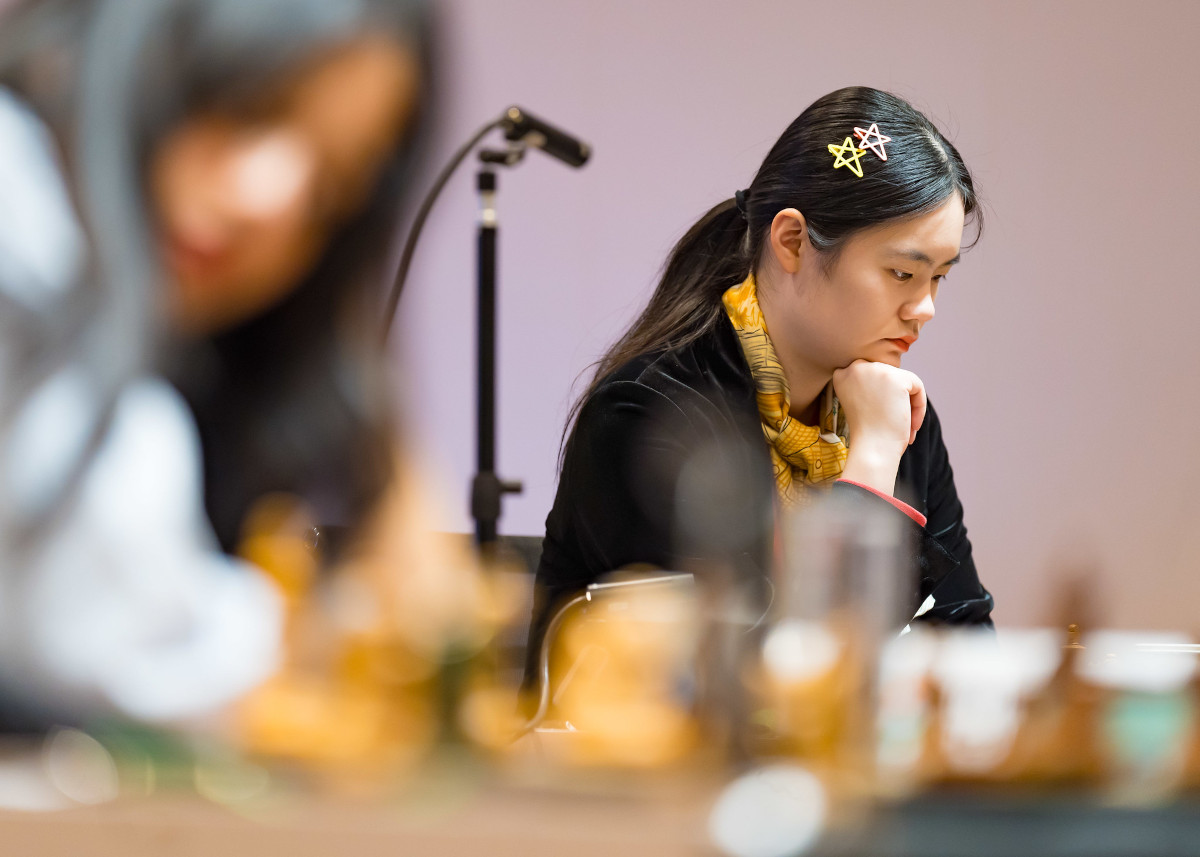
Zhu Jiner is the tournament's sole leader
Olga Badelka ½-½ Elisabeth Paehtz
This was the first time that IM Olga Badelka faced GM Elisabeth Paehtz in classical chess.
The game opened as an English Defence and remained quite balanced until Badelka launched a fierce kingside pawn storm. True to classical principles, Paehtz counterattacked in the centre by sacrificing a couple of pawns for active piece counterplay.
At one moment, Badelka had three extra pawns, but Paehtz's activity was immense, based mainly on her active dark-squared bishop in the middle of the board, which ultimately allowed her to force a perpetual check.
Olga explained in her post-game interview:
The game was tremendously complicated. In fact, I was very worried about the safety of my own king.
This course will enhance your understanding of the King’s Indian Defence. Perfect for anyone looking to improve their opening strategy, reduce mistakes, and develop a winning game plan.
Although she missed some small opportunities in her calculations, Olga was satisfied with the draw and the chance to play against the best female players in the world.
Anna Muzychuk 1-0 Nana Dzagnidze
A classic matchup! Anna and Nana have played no less than twenty-six classical games against each other, with a total score of seven wins for Dzagnidze, three wins for Muzychuk and sixteen draws. These two players know each other in and out!
The Georgian GM decided to abandon her favourite defence, the Najdorf Sicilian, in favour of the rare O'Kelly Variation, in an attempt to take her opponent "out of the book".
After three or four minutes of thought, Anna Muzychuk returned the favour by playing 3.Be2 instead of one of the more popular moves, and after only seven moves the position was totally new, with no major game references in the databases.
Commentator WGM Anastasiya Karlovich explained on the live stream:
Knowing Anna, who is such a hard-working person, and normally prepares for so many hours the day before the game, during the morning, she checks everything! She probably spent so much time preparing all the options, but I don't think 2…a6 was one of them.
As the game progressed, the position, with a Marozcy pawn structure, was mostly equal, although it was always Muzychuk who was pressing. In the ending, Dzagnidze had to defend a queen ending a pawn down, a draw according to the engines - but still accuracy was needed.
Moment of the day
After defending the ending correctly for more than 50 moves, Dzagnidze blundered right at the end. It has to be said that both players were nearly out of time, essentially only playing with the 30-second increment.
In this position, Dzagnidze played 83…Kg8, which loses after 84.f5! Qh1 as now there is checkmate with 85.Qe8+ Kg7 86.f6#
The correct move, which would have still held the draw, was 83…Kf8!, avoiding the queen check on e8 in the previous variation. Now if 84.f5 Dzagnidze would have to find 84…Qg1 or 84…Qc2 (diagram), the only two moves that secure the draw, by opening up the perpetual check on c1 and c6 when White captures the h7-pawn.
From Mating with a queen; a rook; two bishops; a knight and a bishop; to the basics of pawn endgames – here you will gain the necessary know-how to turn your endgame advantages into victories!
A very difficult sequence to find in a vacuum, while playing on 30-second increments and after having fought for five hours!
Michael RahalBorn in England in 1970, Michael Rahal is an International Master and a FIDE trainer. Currently living in Barcelona (Spain), Michael is fluent in English and Spanish and has been coaching chess players of all ages and levels for more than 25 years. More recently he has developed his career as a chess broadcaster, covering both online and on-site many top events on Playchess and the ICC, including a leg of the recent FIDE Grand Prix. You can also follow him on Youtube where more than 10.000 subscribers enjoy his instructive chess videos.
YOUR PERSONAL CHESS COACH - Whether you’re taking your first steps into the world of club chess, or already playing at a tournament level: with FRITZ, you can train more efficiently, intelligently and with a more personalised approach than ever before.
The Nimzo-Indian has stood the test of time for over a century: Still a top choice for elite players today, from Magnus Carlsen to Praggnanandhaa, it remains one of Black's most reliable ways to fight for real chances against 1.d4 2.c4 3.Nc3.
1.c4 e5 2.Nc3 Bb4!? is an opening idea well worth considering. Black immediately threatens to double the pawns on c3 in the style of the Trompowski or Sicilian Grand Prix attack.
Italian Game Powerbase 2026 is a database and contains 8571 top class games from Mega 2026 and the Correspondence Database 2026, of which 479 are annotated.
Videos: Nico Zwirs discusses the Sicilian with 2…e6 3.d4 cxd4 4.Qxd4 Nc6 5.Qe3 Nf6 6.Nc3. Mihail Marin examines Sindarov’s 6.Ne5 in the Queen’s Pawn Defence. Plus the ‘Lucky bag’ featuring 41 analyses by Berg, Ftacnik, Gupta and many others.
If you're looking for a dynamic alternative to the Slav, Queen's Gambit Declined, or other mainstream systems, the Chigorin Defence offers exactly what modern tournament players need.
€34.90
We use cookies and comparable technologies to provide certain functions, to improve the user experience and to offer interest-oriented content. Depending on their intended use, analysis cookies and marketing cookies may be used in addition to technically required cookies. Here you can make detailed settings or revoke your consent (if necessary partially) with effect for the future. Further information can be found in our data protection declaration.
Pop-up for detailed settings
We use cookies and comparable technologies to provide certain functions, to improve the user experience and to offer interest-oriented content. Depending on their intended use, cookies may be used in addition to technically required cookies, analysis cookies and marketing cookies. You can decide which cookies to use by selecting the appropriate options below. Please note that your selection may affect the functionality of the service. Further information can be found in our privacy policy.
Technically required cookies
Technically required cookies: so that you can navigate and use the basic functions and store preferences.
Analysis Cookies
To help us determine how visitors interact with our website to improve the user experience.
Marketing-Cookies
To help us offer and evaluate relevant content and interesting and appropriate advertisement.