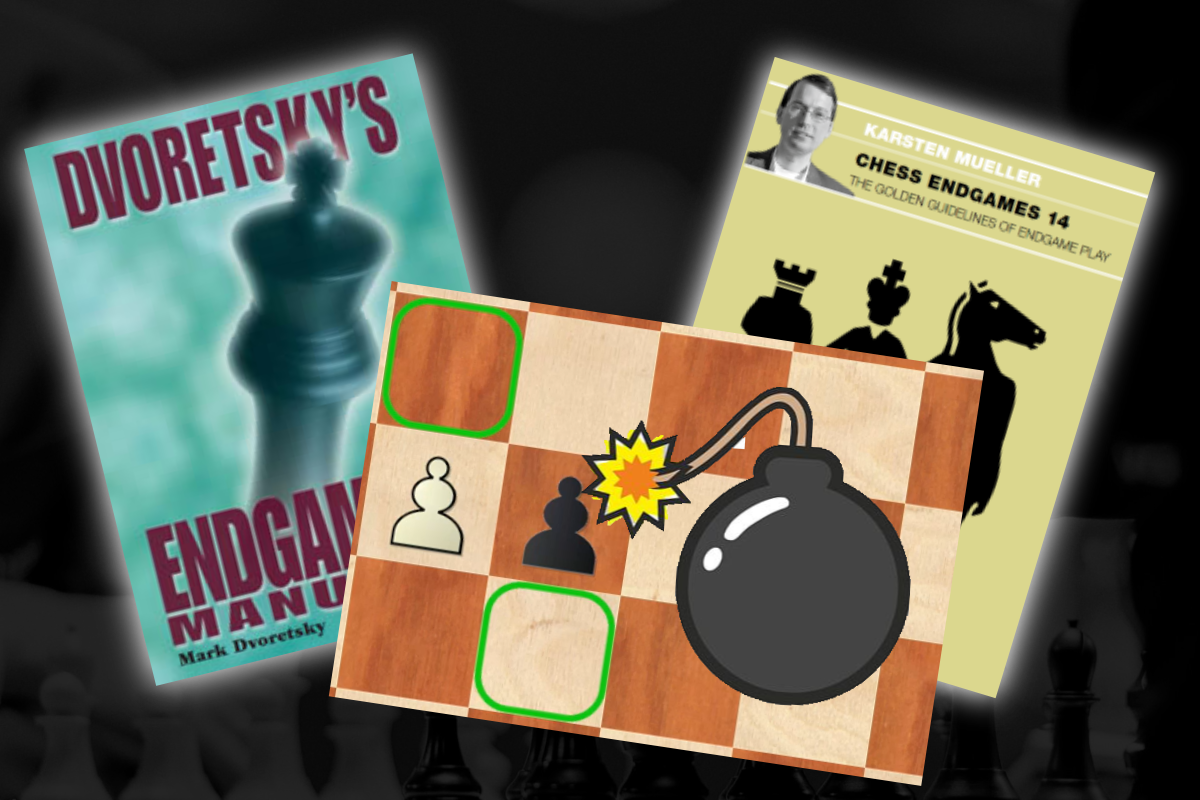
8/23/2022 – Studying endgame theory can seem like one of those necessary evils, and about as fun as watching paint dry, but sometimes it is all about the teacher. Teachers such as GM Karsten Mueller or Mark Dvoretsky make all the difference, bringing magic and wonder into the lessons. Enjoy this shared moment of discovery.
new: Fritz 20
Your personal chess trainer. Your toughest opponent. Your strongest ally. FRITZ 20 is more than just a chess engine – it is a training revolution for ambitious players and professionals. Whether you are taking your first steps into the world of serious chess training, or already playing at tournament level, FRITZ 20 will help you train more efficiently, intelligently and individually than ever before.
All endgame DVDs by Karsten Müller in one package! More than 70 hours of instruction! from "Basic knowledge for beginners" (volume 1) to "Practical Rook Endgames" (volume 8) to the ever-popular "Golden Guidelines of Endgame Play" (volume 14).
Even more power forFritz. Even more Chess knowledge for you.
€89.90
Endgame study has always seemed more like a necessary poison than a desirable choice, yet each attempt to really get into it, chock full of good will and self-motivating pep talks, fell short. Somehow the exercise never managed to really rid me of the impression of taking some bitter medicine, and at some stage I would let myself be lured by the siren song of more exciting things.
The most successful teacher until now, for me, had been GM Mueller, who needs no introduction to ChessBase readers, with his wonderful DVDs, but while they offer a very painless path, I realized I needed a more collected study and the mental imprint it provides.
Rules of thumb are the key to everything when you are having to set the correct course in a complex endgame. In this final DVD of his series on the endgame, our endgame specialist introduces you to the most important of these rules of thumb.
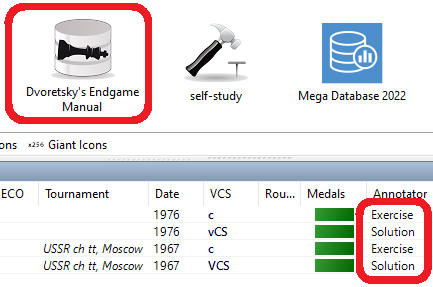
In Yet Another Attempt to Become a Chess God (plagiarized from one of my self-motivating pep talks to myself), I took up Dvoretsky's Endgame Manual, the ChessBase version. This may sound like just a plug, but really it is more than that. This ChessBase edition was designed to be consumed/read/studied in ChessBase using its myriad tools as well as dual entries for each exercise. For example. the first entry is the plain position with instructions and the second entry will be the same but with the solution and analysis.
Although the great trainer published many books, this is generally considered his magnus opus, and I now see why. It isn't because he explains each theme and lesson in crystal clear prose with no way for you not to understand, since others have achieved this too and it would be ridiculous to claim otherwise. No, what really stands out are the specific examples and exercises he chooses.
This is something I haven't seen anyone mention really. They not only can show clarity, they are all almost magic in their depth and beauty. Let me give you an example, since a picture is worth a thousand words.
Teaching with wonder
The chapter on mined squares first starts with the necessary theory and explanations. Here is a standard position illustrating the concept:
Both c5 and e6 are mined squares. Whichever side moves to their mutual mined square will lose after the rival does the same. For example, if Black moves Kc5, then White replies Ke6 and Black is lost. The reverse is true if White moves first to Ke6 and Black replies Kc5. Ok, simple enough. (For the record, this position is winnable for the side to move first, but let's leave that aside for the moment.)
Then our illustrious teacher uncorks the following position as an 'illustrative' example:
At first glance one thing may have you scratching your head as it did mine. What on earth does this position have to do with mined squares??
The solution is that White extends a brilliant and unassuming trap with 1. Bd1+ and Black falls right into it with 1...Kh4?? 2. Bg4!! h5
And here White played 3.Kf5!! and after the forced ...hxg4 4. hxg4 all is clear:
The trap is sprung and we now see Black on the wrong side of a mined square situation. Genius!
Russian International Master Mark Dvoretsky is perhaps the most respected chess instructor in the world today. His latest work, Dvoretsky’s Endgame Manual, is sure to become a classic on one of the most difficult and subtile phases in chess. It covers all the most important positions required for endgame mastery, from elementary king-and-pawn endings to complex rook or queen endgames that have baffled even top grandmasters.
When you see that sort of seemingly impossible transformation as a means to reinforce a lesson, you are not only left with a sense of wonder, but your mental inhibitions are removed as you now yearn for more such examples.
The power of the exercises also shines through as they all seem to turn into the illustrative examples given before. Consider this situation from the final throes of a game excerpt he shows us between Alekhine and Yates:
In this position Alekhine played 1. Kf2! and Black resigned since 1...Kxe5 2. Kf3 is won. Now let's take a look at one of the exercises.
Again how this position and exercise ties into a lesson on mined squares is not immediately apparent. What is more, it is not about 'Black plays and wins' or the sort. Dvoretsky warns his student: "This exercise is rather difficult. You must judge whether Black ought to go into the pawn endgame."
So much like a game we are shown the position before the possible simplification, to judge whether Black should go into the pawn endgame at all.
Well, it turns out that five moves into the main line of the solution we reach this situation:
Scroll up and look at that Alekhine vs Yates position one again. Look familiar? As a result the solution is found very easily: 1... Kh7! 2. Kxg4 Kh6 and Black wins.
You can try your hand at the full exercises here and see my failures and successes as well as what I saw
Personally, this entire experience has been quite a revelation, and if you have been on the fence on the topic of studying endgames beyond the minimum to not outright embarrass yourself at the board, I can promise you there will be joy and pleasure in the process as well.
Now, a fair warning: while Dvoretsky's lessons and examples may all be crystal clear, breathtaking and engaging, they are not easy. However, they are also as rewarding as they are challenging. While I can wholeheartedly recommend Dvoretsky's Endgame Manual, don't hesitate to opt for a less arduous choice such as GM Mueller's Chess Endgames series.
Albert SilverBorn in the US, he grew up in Paris, France, and after college moved to Rio de Janeiro, Brazil. He had a peak rating of 2240 FIDE, and was a key designer of Chess Assistant 6. In 2010 he joined the ChessBase family as an editor and writer at ChessBase News. He is also a passionate photographer with work appearing in numerous publications, and the content creator of the YouTube channel, Chess & Tech as well as the author of Typing Tomes, a powerful typing program.
YOUR PERSONAL CHESS COACH - Whether you’re taking your first steps into the world of club chess, or already playing at a tournament level: with FRITZ, you can train more efficiently, intelligently and with a more personalised approach than ever before.
How grandmasters win without fireworks: GM Jan Markos shows you 11 very practical tips from "How to play in a lost position" to "Be patient like Carlsen" that will improve your tournament chess.
The Nimzo-Indian has stood the test of time for over a century: Still a top choice for elite players today, from Magnus Carlsen to Praggnanandhaa, it remains one of Black's most reliable ways to fight for real chances against 1.d4 2.c4 3.Nc3.
1.c4 e5 2.Nc3 Bb4!? is an opening idea well worth considering. Black immediately threatens to double the pawns on c3 in the style of the Trompowski or Sicilian Grand Prix attack.
Italian Game Powerbase 2026 is a database and contains 8571 top class games from Mega 2026 and the Correspondence Database 2026, of which 479 are annotated.
Videos: Nico Zwirs discusses the Sicilian with 2…e6 3.d4 cxd4 4.Qxd4 Nc6 5.Qe3 Nf6 6.Nc3. Mihail Marin examines Sindarov’s 6.Ne5 in the Queen’s Pawn Defence. Plus the ‘Lucky bag’ featuring 41 analyses by Berg, Ftacnik, Gupta and many others.
€14.90
We use cookies and comparable technologies to provide certain functions, to improve the user experience and to offer interest-oriented content. Depending on their intended use, analysis cookies and marketing cookies may be used in addition to technically required cookies. Here you can make detailed settings or revoke your consent (if necessary partially) with effect for the future. Further information can be found in our data protection declaration.
Pop-up for detailed settings
We use cookies and comparable technologies to provide certain functions, to improve the user experience and to offer interest-oriented content. Depending on their intended use, cookies may be used in addition to technically required cookies, analysis cookies and marketing cookies. You can decide which cookies to use by selecting the appropriate options below. Please note that your selection may affect the functionality of the service. Further information can be found in our privacy policy.
Technically required cookies
Technically required cookies: so that you can navigate and use the basic functions and store preferences.
Analysis Cookies
To help us determine how visitors interact with our website to improve the user experience.
Marketing-Cookies
To help us offer and evaluate relevant content and interesting and appropriate advertisement.