

Jon Speelman: Georgian castles and Episcopal rulings

by Jonathan Speelman
8/3/2025 – In his latest column, Jon Speelman turns his attention to rook endgames from the Women's World Cup in Batumi, including key moments from Divya Deshmukh's games in the semifinals and the final. Alongside recent examples, he revisits a bishop-themed gem from decades past. With interactive diagrams and video commentary, readers are invited to solve critical positions and reflect on the subtleties of high-level technique and calculation. | Photo: Anna Shtourman

Your personal chess trainer. Your toughest opponent. Your strongest ally.
FRITZ 20 is more than just a chess engine – it is a training revolution for ambitious players and professionals. Whether you are taking your first steps into the world of serious chess training, or already playing at tournament level, FRITZ 20 will help you train more efficiently, intelligently and individually than ever before. 

Bishops doing their thing

[Note that Jon Speelman also looks at the content of the article in video format, here embedded at the end of the article.]

Okay, the punning isn't stratospheric this time, but we're looking at some rook endings at the Women's World Cup in Batumi and a couple of games in which bishops do their thing - one recent and one from a quarter of a century ago.

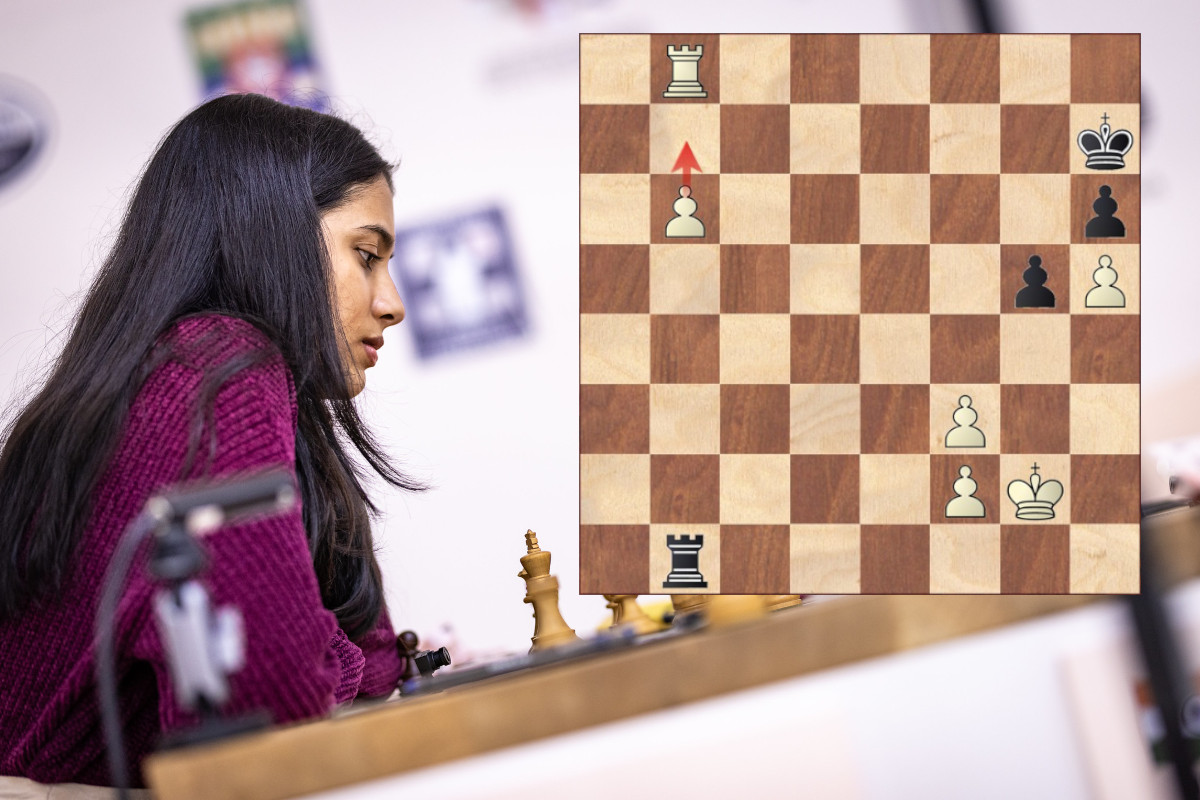
We start with this diagram from the semifinal, and the question is: should eventual champion Divya Deshmukh (White) play b6-b7?

She didn't either now or after first playing h4-h5, but instead went for Rb8-b7+ and when I checked with an engine, there was actually one moment at which Black could have drawn. And the answer is that you absolutely should play b6-b7 if it's winning because with the black king tied to g7 and h7 and only the rook defending if there is a win it should be absolutely clean.

If you do play b6-b7 either this move or next, then it's not difficult to get to this position, and it might be worthwhile now to look for the clean kill.

As a supplementary question, White might have decided to exchange on g5. What is Black's only move in this position to hold a draw?
Divya Deshmukh, Humpy Koneru

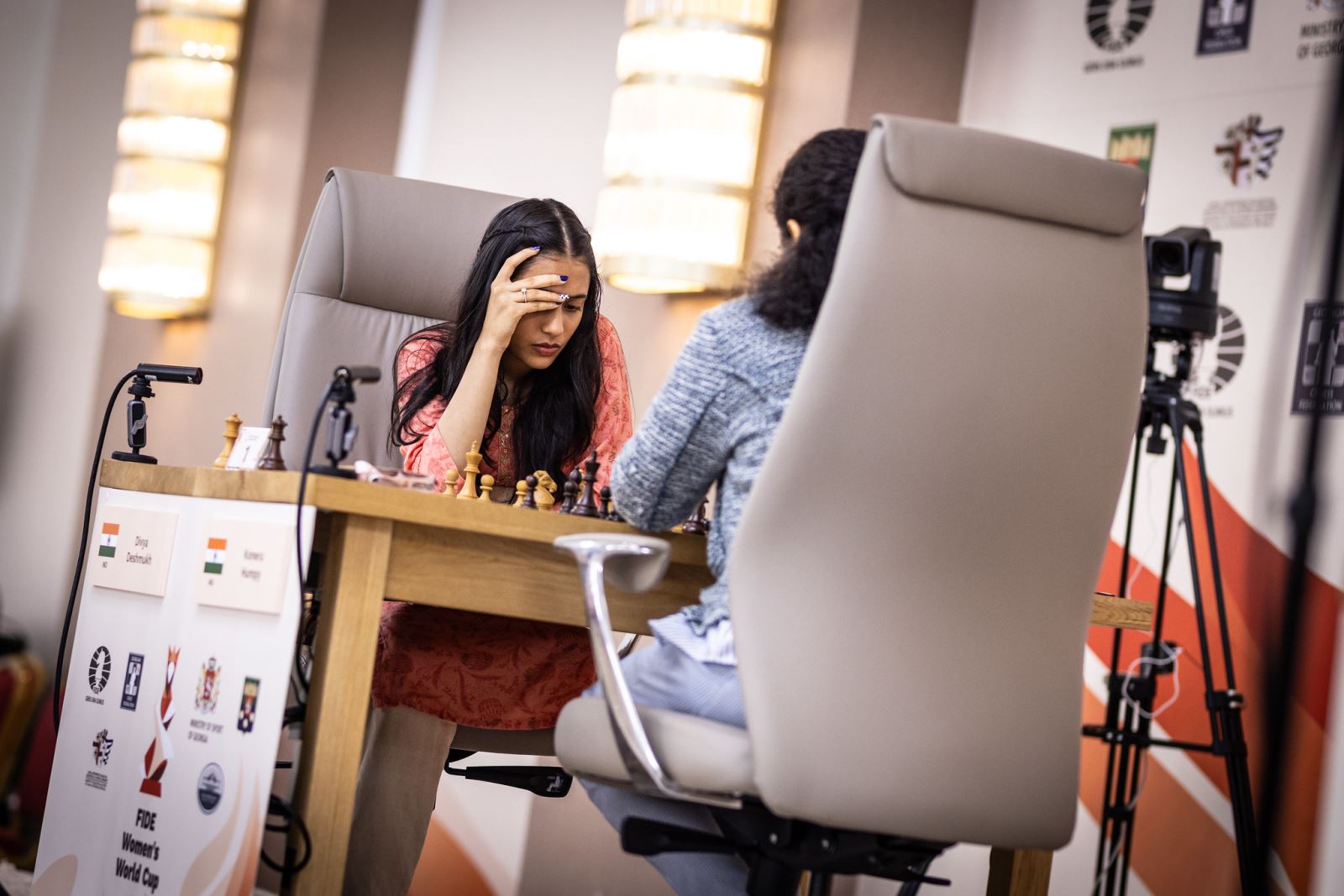
The tense tiebreaker between Divya Deshmukh and Humpy Koneru at the Women's World Cup in Batumi | Photo: Anna Shtourman

The remaining games appear in the pgn file, and I'm adding a couple of questions from there.

Black has just played 17...Qa8-f3 to which White replied 18.Bf4

  1. What was the answer to this?
  2. What alternatives can you suggest to Bf4? (Really difficult, just see if you've got any ideas)

Here I played 16.Ba3 Nb4. Can you see my idea?

Select an entry from the list to switch between games



Experts examine the games of Max Euwe. Let them show you which openings Euwe chose to play, where his strength in middlegames were, which tactical abilities he had or how he outplayed his opponents in the endgame.
Max Euwe became the fifth World Chess Champion after beating Alexander Alekhine in the 1935 World Championship match. A maths teacher by profession, Euwe remained an amateur throughout his life, but was still the best chess player in the Netherlands, and one of the world's best players. Euwe holds the record for the most Dutch national championships, with twelve. After winning the World Championship, Euwe was also the world's best player for a while. He lost the title again in 1937 in the rematch against Alexander Alekhine.
Free video sample: Openings


Links


Jonathan Speelman, born in 1956, studied mathematics but became a professional chess player in 1977. He was a member of the English Olympic team from 1980–2006 and three times British Champion. He played twice in Candidates Tournaments, reaching the semi-final in 1989. He twice seconded a World Championship challenger: Nigel Short and then Viswanathan Anand against Garry Kasparov in London 1993 and New York 1995.