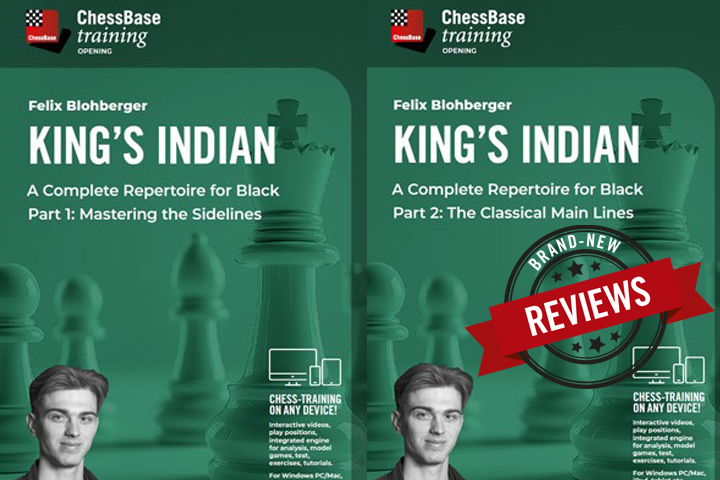
4/25/2026 – The two-part FritzTrainer series "King’s Indian – A Complete Repertoire for Black" by Grandmaster Felix Blohberger is devoted to one of the most dynamic and at the same time complex openings in modern chess: the King’s Indian Defence. Lukas Köpl examines the series with regard to its structure, content, didactic quality and practical relevance.
new: Fritz 20
Your personal chess trainer. Your toughest opponent. Your strongest ally. FRITZ 20 is more than just a chess engine – it is a training revolution for ambitious players and professionals. Whether you are taking your first steps into the world of serious chess training, or already playing at tournament level, FRITZ 20 will help you train more efficiently, intelligently and individually than ever before.
GM Blohberger presents a complete two-part repertoire for Black: practical, clear, and flexible – instead of endless theory, you’ll get straightforward concepts and strategies that are easy to learn and apply. The King’s Indian Defence has been one of the most dynamic and popular responses to 1.d4 for decades. Legends such as Garry Kasparov, Bobby Fischer, and Hikaru Nakamura have employed it at the highest level – and it continues to fascinate today, as it offers Black not only solidity but also rich attacking and counterattacking opportunities. Its special advantage: the King’s Indian is a universal system, equally effective against 1.d4, 1.c4, and 1.Nf3. Grandmaster Felix Blohberger, multiple Austrian Champion and experienced second, presents a complete two-part repertoire for Black. His approach: practical, clear, and flexible – instead of endless theory, you’ll get straightforward concepts and strategies that are easy to learn and apply.
Free video sample: Introduction
Free video sample: London System
YOUR PERSONAL CHESS COACH - Whether you’re taking your first steps into the world of club chess, or already playing at a tournament level: with FRITZ, you can train more efficiently, intelligently and with a more personalised approach than ever before.
€49.90
The video series produced by ChessBase aims to build a complete yet practical repertoire for Black against 1.d4 and related move orders. Blohberger presents not only variations, but above all strategic concepts and typical middlegame plans. This didactic focus sets the series apart from many traditional opening works, which are often characterised by an overwhelming amount of theoretical variations.
1. Structure and didactic design
The two-part video course is divided into two volumes that are clearly separated by theme.
Part 1: Mastering the Sidelines
The first part is primarily devoted to the so-called sidelines. These include systems in which White deviates early from the classical main lines—such as through alternative move orders, early flank operations or fianchetto setups.
GM Blohberger presents a complete two-part repertoire for Black: practical, clear, and flexible – instead of endless theory, you’ll get straightforward concepts and strategies that are easy to learn and apply. The King’s Indian Defence has been one of the most dynamic and popular responses to 1.d4 for decades. Legends such as Garry Kasparov, Bobby Fischer, and Hikaru Nakamura have employed it at the highest level – and it continues to fascinate today, as it offers Black not only solidity but also rich attacking and counterattacking opportunities. Its special advantage: the King’s Indian is a universal system, equally effective against 1.d4, 1.c4, and 1.Nf3. Grandmaster Felix Blohberger, multiple Austrian Champion and experienced second, presents a complete two-part repertoire for Black. His approach: practical, clear, and flexible – instead of endless theory, you’ll get straightforward concepts and strategies that are easy to learn and apply.
Free video sample: Introduction
Free video sample: London System
A particular emphasis is placed on the increasingly popular g3 systems. Blohberger shows how Black can reliably reach a King’s Indian setup regardless of the exact move order.
The didactic advantage of this structure is obvious: players are first familiarised with the less complex deviations before turning to the more theoretically demanding main lines. This approach allows them to develop an understanding of typical ideas against less critical setups, which can then be applied when tackling the critical variations in which these ideas are put to the test.
Part 2: The Classical Main Lines
The second part deals with the main lines of the King’s Indian Defence. These include, among others:
GM Blohberger presents a complete two-part repertoire for Black: practical, clear, and flexible – instead of endless theory, you’ll get straightforward concepts and strategies that are easy to learn and apply. The King’s Indian Defence has long been one of the most dynamic and popular responses to 1.d4. Champions like Garry Kasparov, Bobby Fischer, and Hikaru Nakamura have used it at the highest level – and it continues to thrive today because it gives Black not only a solid foundation but also rich attacking and counterattacking opportunities. Its great advantage: the King’s Indian is a universal system, equally effective against 1.d4, 1.c4, and 1.Nf3. Grandmaster Felix Blohberger, multiple Austrian Champion and experienced second, presents a complete two-part repertoire for Black. His approach is practical, clear, and flexible – no endless theory, but instead understandable concepts and strategies you can apply right away.
Free video sample: Introduction
Free video sample: Early h4
This structure is standard and allows for a modular study of the King’s Indian Defence, from the sidelines through to the main lines.
A standout feature of the series is its didactic focus. Blohberger repeatedly emphasises typical ideas and strategic motifs, such as:
the need to generate counterplay
flexible central reactions with …e5 or …c5
This focus distinguishes the course from many classical opening works. While traditional literature often presents long chains of variations, Blohberger concentrates on comprehensible concepts. This is achieved very well throughout the course and creates a strong sense of continuity.
It is precisely this practice-oriented emphasis, with consistent plans, ideas and motifs, that places the focus on clear strategic guidelines rather than on pure theory.
For learners, this has two advantages:
The ideas can be transferred more easily to similar positions.
The acquired knowledge remains more stable in the long term and occurs frequently.
YOUR EASY ACCESS TO OPENING THEORY: Whether you want to build up a reliable and powerful opening repertoire or find new opening ideas for your existing repertoire, the Opening Encyclopaedia covers the entire opening theory on one product. YOUR EASY ACCESS TO OPENING THEORY
Be well prepared with the new Opening Encyclopaedia 2026! Whether you want to build up a reliable and powerful opening repertoire or find new opening ideas for your existing repertoire, the Opening Encyclopaedia covers the entire opening theory on one product and is the ideal start for your opening training. Many new articles enrich the current theory with new or revisited ideas. The Encyclopaedia can help you learn openings quickly and give you a head start on your next opponent. Each article contains explanations and annotated games illustrating typical plans to deepen your understanding.
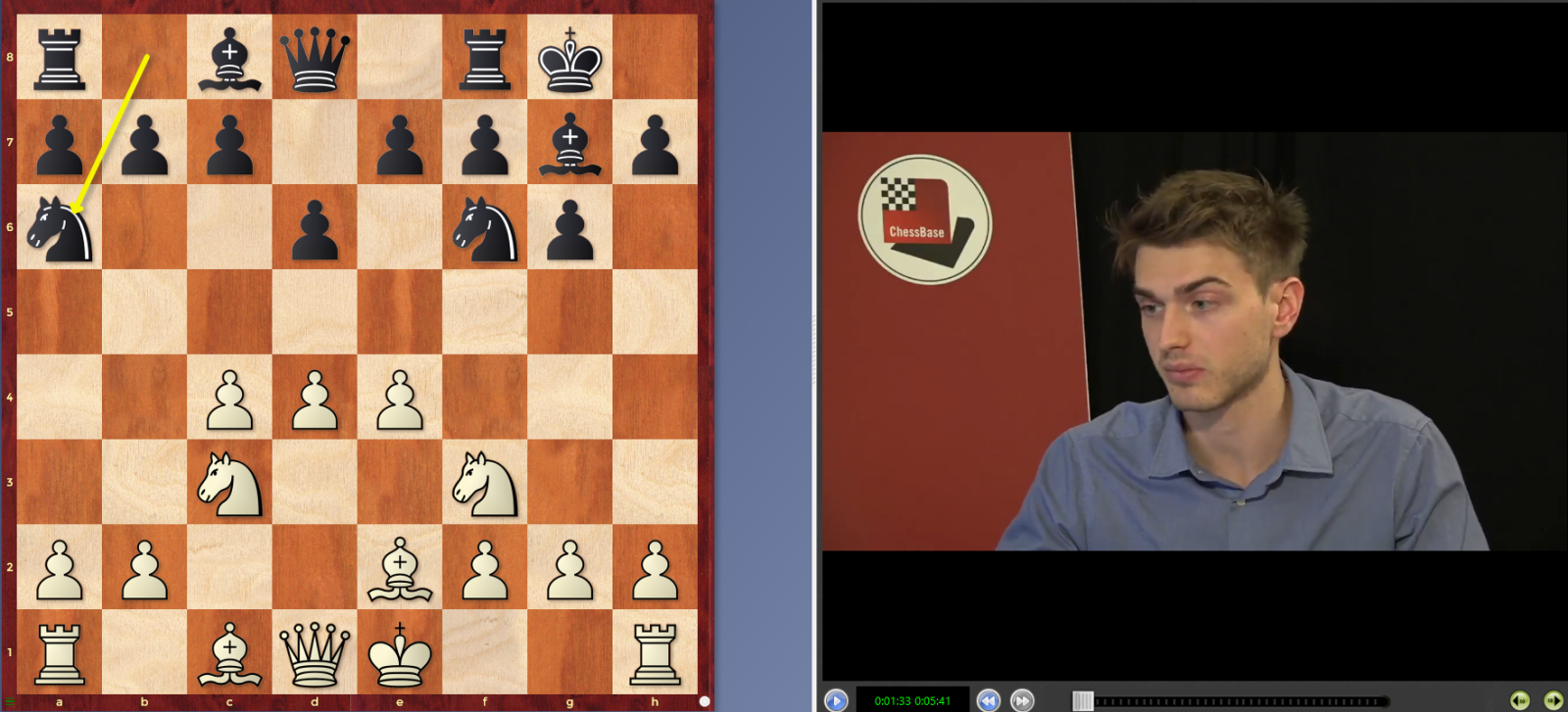
The strategic core of the repertoire is based on a modern setup with the knight move …Na6. This approach has become increasingly popular in recent years, while, to my knowledge, Black’s side has long lacked a comprehensive update in this line. Blohberger closes this gap with his repertoire.
The move fulfils several strategic functions:
It prepares flexible pawn breaks such as …e5 or …c5.
It enables alternative plans with …c6 and …b5.
It avoids some heavily analysed main lines.
This flexibility is a key advantage of the repertoire presented. While classical King’s Indian manuals often recommend rather rigid lines, Blohberger’s approach opens up several strategic options. Players who employ the King’s Indian with …Nbd7 can often benefit here, as many ideas—especially in the fight against e4 via …Nbd7–c5 or, in Blohberger’s course, …Na6–c5—lead to comparable structures.
For practical tournament players, this means: They can orient their play more around typical structures and have to memorise fewer concrete variations.
However, it should be noted that the King’s Indian Defence nowadays relies on very precise play, and the study of variations—especially critical lines—cannot be entirely avoided.
Practical orientation instead of theoretical overload
In this course, Grandmaster Felix Blohberger delivers a complete opening repertoire for White, centred around the flexible move 1.Nf3.
Looking for a versatile and strategic opening repertoire that doesn’t rely on memorising endless variations? In this course, Grandmaster Felix Blohberger delivers a complete opening repertoire for White, centred around the flexible move 1.Nf3. Whether you’re a club player or a seasoned competitor, this course offers a solid yet dynamic approach that adapts to various playing styles and opponents.
Video sample: Introduction
Video sample: Grunfeld - Sidelines
A recurring theme of the repertoire is the deliberate move away from purely theoretical compendiums. Many classical works on the King’s Indian contain thousands of variations and are intended more as reference manuals. For club players, this can be overwhelming.
Blohberger, on the other hand, pursues a practice-oriented approach:
clear repertoire recommendations
clear structure
focus on typical pawn structures.
The video lessons therefore convey less in the way of isolated variations and instead focus on strategic patterns. This is particularly valuable in an opening such as the King’s Indian Defence. The resulting middlegames are often highly complex and cannot be mastered through knowledge of variations alone.
Another didactic element lies in the systematic presentation of recurring motifs. Among the most important are:
kingside attack
flexible central play
pawn breaks and timing
This thematic presentation makes it easier for the viewer to recognise typical types of positions and broadens the target audience.
3. Target group
In my view, the video course is primarily aimed at:
ambitious club players
tournament players with a solid foundation
players looking for a dynamic repertoire for Black.
Beginners can also benefit, but should already possess a basic understanding of hypermodern opening principles.
The series is particularly well suited for players who do not only want to learn variations, but also wish to develop a deeper strategic understanding and are willing to invest the necessary time.
4. Strengths and weaknesses of the course
Die wichtigsten Vorteile des Videokurses lassen sich in mehreren Punkten zusammenfassen.
clear repertoire structure
strategic focus
modern repertoire choice
good didactic presentation
Despite its many strengths, it should be noted that the King’s Indian Defence is fundamentally a demanding opening. Its theoretical standing has long been considered critical, as modern engines in particular often find so-called “squeezing positions” in which Black has to defend an inferior middlegame or endgame. Although Blohberger has made an excellent contribution, certain weaknesses remain, which become increasingly relevant at club level.
considerable training effort due to highly concrete lines in critical variations
the need for practical experience due to complex types of positions
critical positions are often slightly worse with limited winning chances
Conclusion
With his two-part FritzTrainer series on the King’s Indian Defence, Felix Blohberger presents a modern and practice-oriented training program for one of the most complex openings in chess.
The course stands out above all for:
clear strategic guidelines
a flexible repertoire structure
practical choice of variations
clear and accessible didactic presentation.
The emphasis on strategic patterns rather than pure memorisation of variations makes the series a valuable resource for ambitious tournament players. However, practical coherence in critical lines often depends heavily on concrete ideas, which raises the learning curve and makes the course more suitable for stronger tournament players—who, however, should clearly benefit from Blohberger’s analysis.
Overall, the author succeeds in delivering a course that is both theoretically sound and practically applicable—a combination that is far from common in modern opening training.
Overall evaluation: ★★★★ 4/5
Positive ✔ State-of-the-art theory at grandmaster level with numerous innovations ✔ Clear didactic structure
✔ Emphasis on understanding typical positions ✔ Extensive supplementary material with model games, training positions and exercises
Negative X At times very extensive for absolute beginners to the King’s Indian Defence
About the author
Felix Blohberger is not only a grandmaster—he is also a multiple Austrian national champion and a key member of the Austrian national team. He earned the grandmaster title at just 19 and brings a wealth of experience both as a competitive player and as a second to top-level players.
Kingsindian Powerbase 2023 ist eine Datenbank und enthält insgesamt 11307 Partien aus der Mega 2023 bzw. der Correspondence Database 2022, davon sind 883 kommentiert. Die 883 ausgewählten kommentierten Partien bieten unglaublich viel hochklassiges Studienmaterial. Topspieler wie Andreikin (2 kommentierte Partien), Aronian (1), Bologan (3), Carlsen (1), Caruana (1), Ding Liren (2), Duda (1), Eljanov (1), Firouzja (1), Gelfand (2), Giri (8), Kasimdzhanov (3), Kramnik (2), Le Quang Liem (1), Mamedyarov (1), Navara (1), Ponomariov (1), Radjabov (6), So (3), Vidit (1), Vitiugov (1), Wojtaszek (3) haben ihre Partien analysiert, dazu kommen Kommentare der Königsindisch-Experten wie Hazai (221), Krasenkow (118), Stohl (103). Insgesamt sind es 11307 Partien, wobei der Ratingschnitt mindestens 2600 beträgt (außer Partien mit Kommentare sowie der Spezialisten Radjabov, Demchenko, van Wely, Jones und Nakamura).
Lukas KöplLukas Köpl, born in 1989, is a passionate club and tournament player who has been successfully working as a chess coach for over 15 years with an active coaching and referee licence. His wider field of expertise includes journalistic work for chess magazines and publishers, as well as active club and youth work. As a chess player, he has represented several clubs in various leagues over the years.
YOUR PERSONAL CHESS COACH - Whether you’re taking your first steps into the world of club chess, or already playing at a tournament level: with FRITZ, you can train more efficiently, intelligently and with a more personalised approach than ever before.
The Nimzo-Indian has stood the test of time for over a century: Still a top choice for elite players today, from Magnus Carlsen to Praggnanandhaa, it remains one of Black's most reliable ways to fight for real chances against 1.d4 2.c4 3.Nc3.
1.c4 e5 2.Nc3 Bb4!? is an opening idea well worth considering. Black immediately threatens to double the pawns on c3 in the style of the Trompowski or Sicilian Grand Prix attack.
Italian Game Powerbase 2026 is a database and contains 8571 top class games from Mega 2026 and the Correspondence Database 2026, of which 479 are annotated.
Videos: Nico Zwirs discusses the Sicilian with 2…e6 3.d4 cxd4 4.Qxd4 Nc6 5.Qe3 Nf6 6.Nc3. Mihail Marin examines Sindarov’s 6.Ne5 in the Queen’s Pawn Defence. Plus the ‘Lucky bag’ featuring 41 analyses by Berg, Ftacnik, Gupta and many others.
If you're looking for a dynamic alternative to the Slav, Queen's Gambit Declined, or other mainstream systems, the Chigorin Defence offers exactly what modern tournament players need.
€34.90
We use cookies and comparable technologies to provide certain functions, to improve the user experience and to offer interest-oriented content. Depending on their intended use, analysis cookies and marketing cookies may be used in addition to technically required cookies. Here you can make detailed settings or revoke your consent (if necessary partially) with effect for the future. Further information can be found in our data protection declaration.
Pop-up for detailed settings
We use cookies and comparable technologies to provide certain functions, to improve the user experience and to offer interest-oriented content. Depending on their intended use, cookies may be used in addition to technically required cookies, analysis cookies and marketing cookies. You can decide which cookies to use by selecting the appropriate options below. Please note that your selection may affect the functionality of the service. Further information can be found in our privacy policy.
Technically required cookies
Technically required cookies: so that you can navigate and use the basic functions and store preferences.
Analysis Cookies
To help us determine how visitors interact with our website to improve the user experience.
Marketing-Cookies
To help us offer and evaluate relevant content and interesting and appropriate advertisement.