.jpeg)

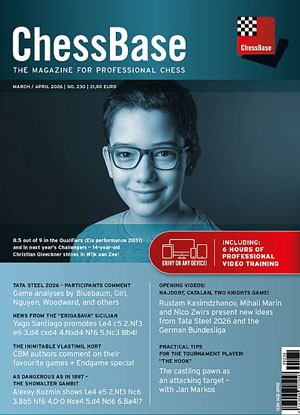
With its 230th issue, ChessBase Magazine continues a success story that now spans several decades. The long-established training and information format combines analyses of recent tournaments, current opening theory, strategic instruction and a wide range of training material in a single multimedia package. The concept remains unchanged: a balanced mix of top-level chess, systematic training and contributions that reflect the broader culture of the game.
Three sections stand out in this issue. First, the analyses of recent games from the international elite. Second, a strategic article by Jan Markos devoted to the “hook” motif. And third, a notable endgame section by Karsten Müller, dedicated to the memory of Grandmaster Vlastimil Hort, who passed away last year. The combination of topical material, clear instructional value and historical perspective gives this issue particular substance.
ChessBase Magazine has long followed a well-established structure that covers all aspects of chess training:
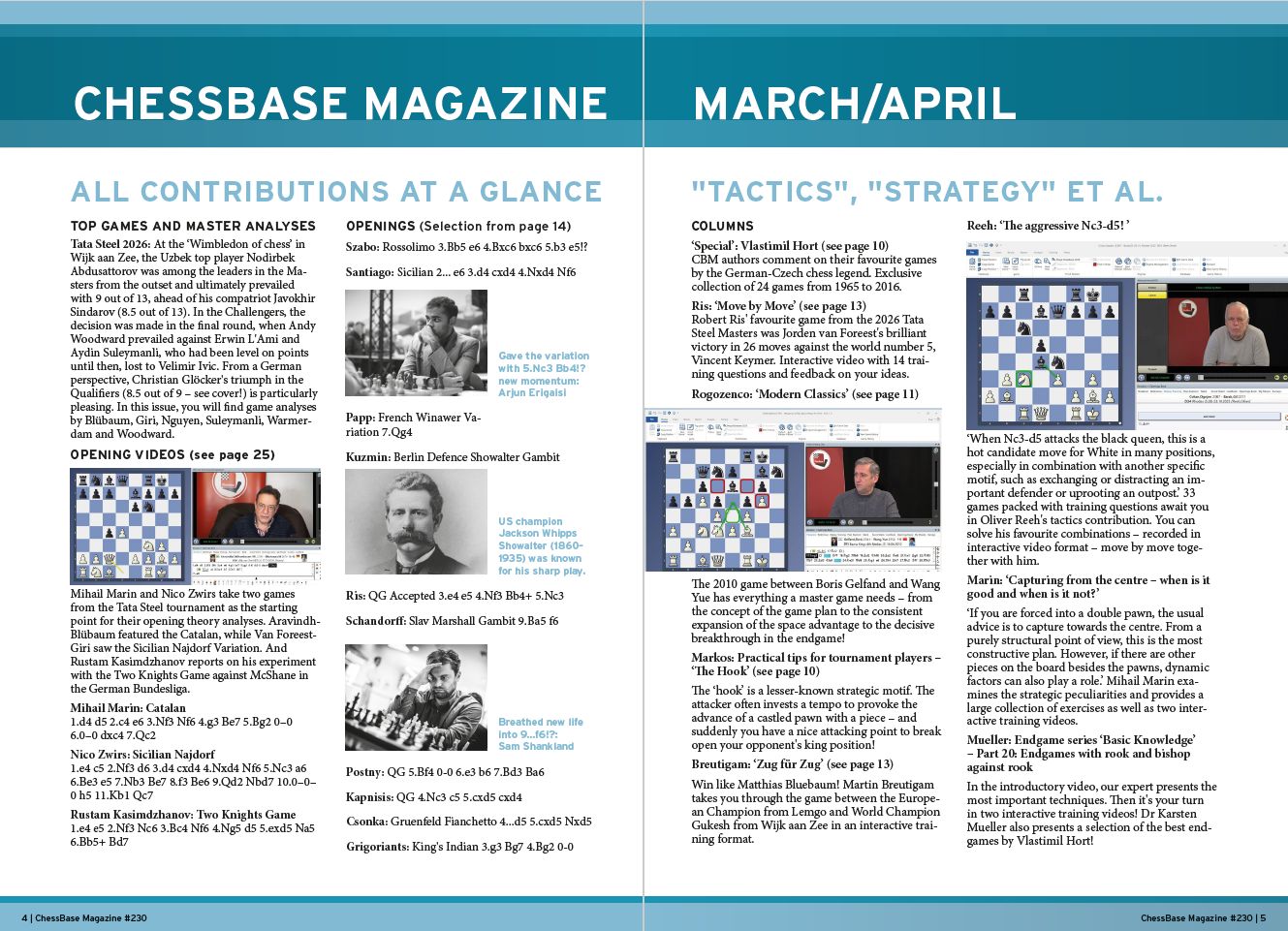
At the heart of the issue is, among other things, material from the Tata Steel Chess Tournament in Wijk aan Zee, which has been one of the key events on the international chess calendar for decades. The annotated games give the reader direct insight into the decision-making processes of today’s top players.
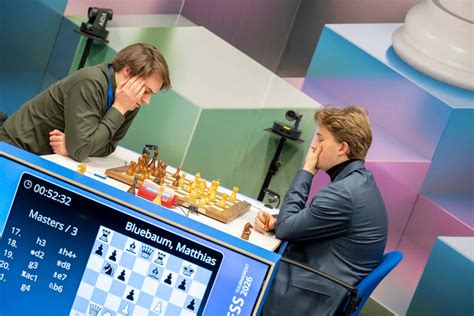
World Championship candidate Matthias Blübaum defeated Germany’s number one at Tata Steel. | Photo: Nils Rohde
Particularly instructive are the analyses by Matthias Blübaum, who annotates his win with Black against Germany’s number one, Vincent Keymer. In doing so, he underlines that his place in the Candidates Tournament—secured with a victory over that very same opponent—is anything but accidental. What I found especially appealing here is how clearly the game shows that a “hook” is not automatically a path to an advantage. This ties in neatly with Jan Markos’s article on the motif in the middlegame training section.
The many annotated games have always been one of the greatest strengths of ChessBase Magazine. They are not presented as dry theoretical material, but as transparent thought processes that can be followed move by move. That makes them enjoyable to study—whether for serious training or simply as engaging reading.
The endgame section by Karsten Müller has long been one of the instructional highlights of every issue of ChessBase Magazine. This time is no exception.
The article is dedicated to Grandmaster Vlastimil Hort, who passed away recently and was one of the defining figures of European chess for decades. Alongside his successful career as a tournament player, Hort was especially renowned as a commentator and communicator of the game. I had my first encounters with chess through the outstanding duo of Hort and Pfleger, which gives this contribution a distinctly personal and emotional dimension.
Müller combines this tribute to Hort with an in-depth analysis of selected endgame positions. Once again, he demonstrates his particular ability to link concrete calculation with general endgame principles.
Typical of Müller’s approach is the combination of three elements:
The result is a contribution that is both historically interesting and of clear instructional value.
Anyone looking for training material for an entire month, but without the time to work through books, will find that ChessBase Magazine, published every two months, offers a wealth of well-structured content for personal study or for use in club training. Depending on one’s ambitions, available time and playing strength, readers can draw more or less from its extensive material, while staying engaged and continuing to improve in a targeted way.
Overall assessment: ★★★★★ 5/5
✔ high-quality master-level analyses of recent top tournaments
✔ impressive opening contributions, ranging from surprise ideas to main lines
✔ a fine tribute to the chess legacy of Vlastimil Hort
✔ extensive material for individual and club training