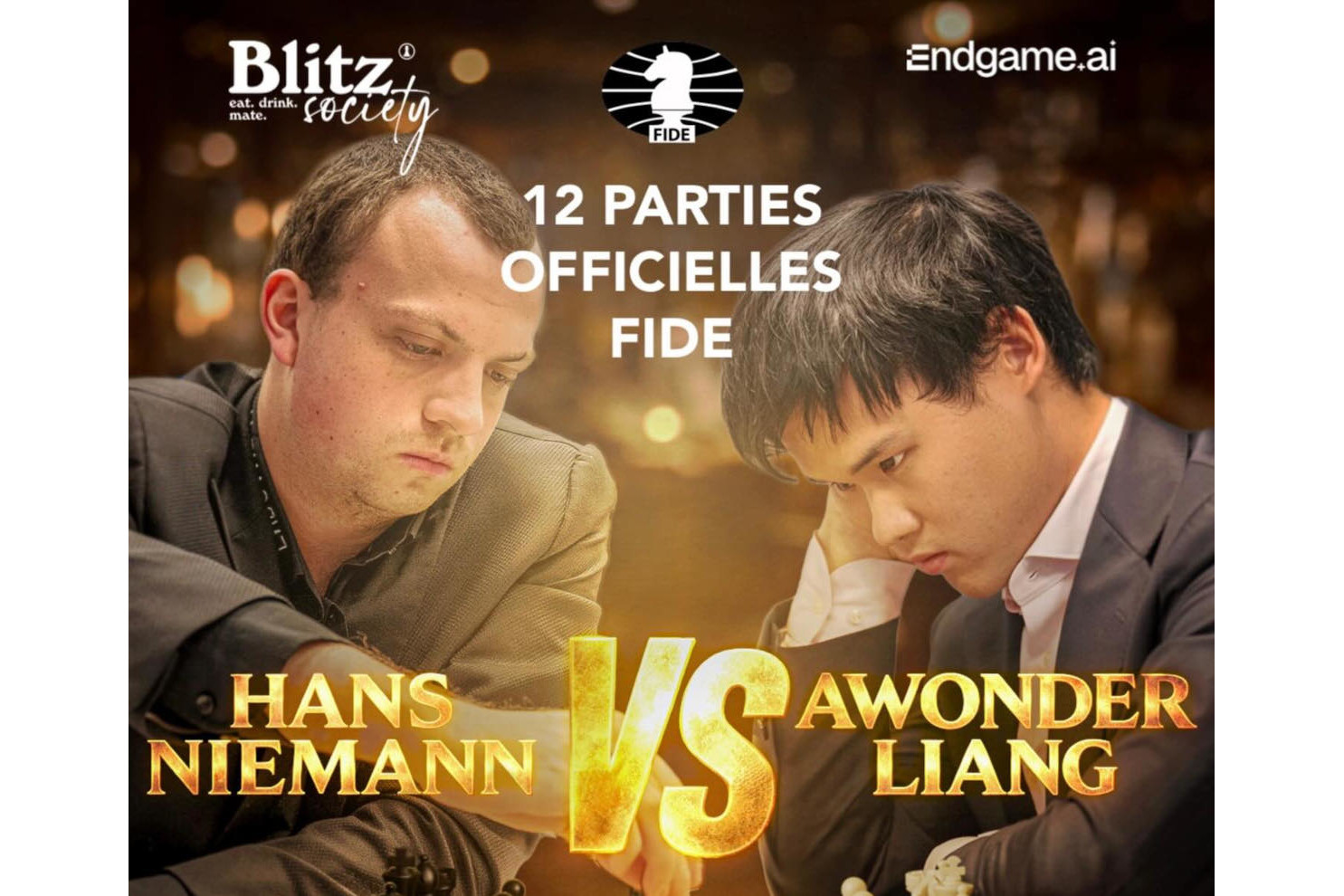
Niemann leads 5-3 with four games to go
After four days of play in Paris, the 12-game match between Hans Niemann and Awonder Liang enters its final phase with the score in Niemann's favour.
The encounter, staged at the Blitz Society from 10 to 15 April, brings together two US grandmasters in a classical showdown at a time when much of the chess world's attention is directed towards the Candidates Tournaments in Cyprus. The match is played at a 60+30 time control, with two games per day, placing a clear emphasis on stamina and consistency across a tightly packed schedule.
Eight games have now been completed, with six ending in draws and Niemann scoring the two wins so far. His first success came in game three, where a single endgame mistake by Liang proved decisive. In what had been a balanced struggle, Liang lost control.
Due to the outside passer on the a-file, Black needs to be very careful in this position. However, he can keep the balance with moves such as 62...Rd1 or 62...Rg3. Liang went for 62...Ra3?? instead, allowing 63.Nc4 Rb3 64.Ne3
Liang resigned, since Ne3-d5 is coming, winning the knight.
Twice more did Liang erred in endgames, failing to make the most of clearly favourable positions in games two and seven, where he was unable to turn his advantage into a full point.
With 2 minutes on the clock here, Liang failed to find the winning 65.Rh1, threatening checkmate on h8. After 65...Kg8, for example, White has 66.e6, and 66...c1Q (diagram below) can be replied by 67.Rxc1 since 67...Rxc1 fails to 68.Rd8#
 Grandmaster Dr. Karsten Müller, one of the world’s leading endgame experts, guides you step by step through everything you need to know in this second volume.
Picture this: you’ve outplayed your opponent move by move, you’re clearly better – and then the endgame slips into a draw, simply because you lacked the crucial theoretical knowledge. That is exactly where this course comes in. Without solid endgame skills, there’s no way forward. Rook endgames are most essential: they occur more often than any other type of endgame, and often make the difference between victory and half a point. If you master them, you’ll confidently convert your advantages into wins!
Free video sample: Introduction
Free video sample: Bodycheck
None of this appeared on the board, though, as Liang played 65.Rf7+? in the first diagrammed position, and missed the same trick two moves later. The game ended in a 76-move draw.
The second decisive result arrived in game eight, again going Niemann's way. Liang, playing white, opted for a Catalan Opening but misplayed the early middlegame, drifting into a worse position without clear compensation. Niemann reacted precisely, gradually increasing the pressure and leaving no room for counterplay. His conversion was direct and efficient, culminating in a 31-move victory that extended his lead with four games remaining.
With the match entering its final two days, scheduled for Tuesday and Wednesday, Liang faces the task of closing the gap in a format that leaves limited room for recovery.
Beyond the sporting contest, the match also carries a charitable element, with the loser committed to donating $10,000. The quality and competitiveness of the games have drawn attention, with Levon Aronian publicly praising the match on X:
The match between my fellow Americans Hans Niemann and Awonder Liang is very exciting and I love the format: two short classical games a day, rated, winner takes it all! The tenacity of Hans is world-class, while Awonder, by outplaying him, is showing that he is capable of anything.
I feel that the fact that it's played in Paris, somehow brings chess back to the era of Café de la Regence, La Bourdonnais, Anderssen and Morphy.
In an economy where 30 players are fighting for 10 invitational spots, this is a way to go. Bravo!
All games
Top trainers strongly recommend regular study of well-explained classical games to improve your understanding of chess in the long term. 33 modern classics are explained in details on this video course.