The article examines allegations that US chess grandmaster Hikaru Nakamura cheated during a 2023 online blitz tournament, where he achieved an extraordinary 45.5 out of 46 game winning streak. Statistical evidence criticized by former world champion Vladimir Kramnik suggested the streak was improbable without cheating, but a research team led by Shiva Maharaj, Nicholas Polson, and Vadim Sokolov found a 99.6% probability that Nakamura did not cheat using Bayesian analysis and historical performance data.
Key Findings
 Why memorising endless theory might not be the best path - and how an idea-based repertoire can change your game.
In today’s fast-paced chess world, especially online, where blitz and rapid games dominate, the traditional approach of grinding through lines of opening theory can feel overwhelming, and even unnecessary. The real challenge? Striking the right balance in your opening preparation. How deep should you go? Where do you stop? This course is built on the timeless wisdom of my legendary coach, Chebanenko, who designed opening repertoires for his “lazy” students - not lazy in attitude, but smart in approach. His philosophy? Don’t memorise. Understand.
The researchers accounted for Nakamura’s strength versus his opponents, discovering the streak had less than a 3% chance of occurring purely by rating odds, but Bayesian analysis factoring in an estimated cheating prevalence (as low as 1 in 10,000 online games) made Nakamura’s innocence overwhelmingly likely—up to 99.6%.
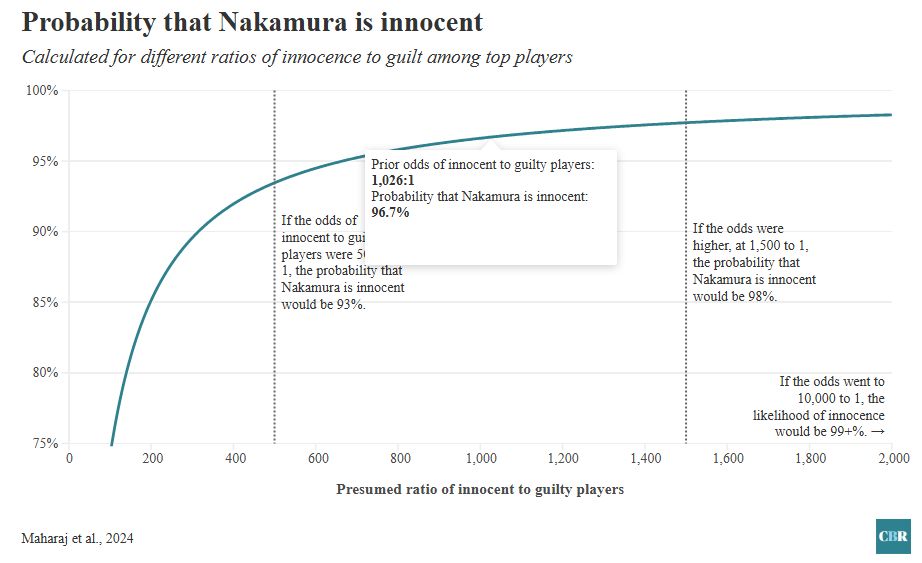
The analysis revealed the importance of initial assumptions—if cheating were much more frequent, the probability of innocence would decrease but remain high (about 98% with a 1-in-1,500 prevalence).
Statistical Pitfalls
Kramnik’s argument exemplified the "prosecutor’s fallacy," confusing the rarity of the streak with evidence of guilt when in fact an unlikely event does not imply wrongdoing. The article cautions against "cherry-picking" data and emphasizes following the likelihood principle; conclusions should rely only on observed evidence, not on how or why certain data is highlighted.
Cromwell’s rule is referenced, reminding readers never to assign absolute certainty (0% or 100%) in probability analysis, as unknown factors may always exist.
Conclusion
The research concludes that Nakamura’s winning streak is best explained by his exceptional skill and a real but rare statistical occurrence, not by cheating. It urges careful, critical interpretation of statistical evidence to avoid damaging reputations based on flawed reasoning.
The full article by Minika Brown can be read in the Chicago Booth Review.
On this DVD a team of experts looks closely at the secrets of Karpov's games. In more than 7 hours of video, the authors examine four essential aspects of Karpov's superb play.