12/29/2024 – The World Championship match between Gukesh Dommaraju and Ding Liren demonstrated how important it can be to catch your opponent on the wrong foot in the opening. In her 60-minute course, Svitlana Demchenko shows how this can be achieved with both colours and very little theory. | Photos: Nils Rohde
new: Fritz 20
Your personal chess trainer. Your toughest opponent. Your strongest ally. FRITZ 20 is more than just a chess engine – it is a training revolution for ambitious players and professionals. Whether you are taking your first steps into the world of serious chess training, or already playing at tournament level, FRITZ 20 will help you train more efficiently, intelligently and individually than ever before.
YOUR PERSONAL CHESS COACH - Whether you’re taking your first steps into the world of club chess, or already playing at a tournament level: with FRITZ, you can train more efficiently, intelligently and with a more personalised approach than ever before. FRITZ is more than just a chess engine – it’s a training revolution! Whether you’re taking your first steps into the world of club chess, or already playing at a tournament level: with FRITZ, you can train more efficiently, intelligently and with a more personalised approach than ever before.
The premiere chess database with over 11.7 million games
€229.90
Multiple-time Canadian champion Svitlana Demchenko regularly appears as a guest on ChessBase reporter Arne Kähler's series Svitlana's Smart Moves and has already created several FritzTrainers. In their latest collaboration, the established duo focuses on easily prepared openings designed not to align with the opponent's repertoire but rather to surprise them.
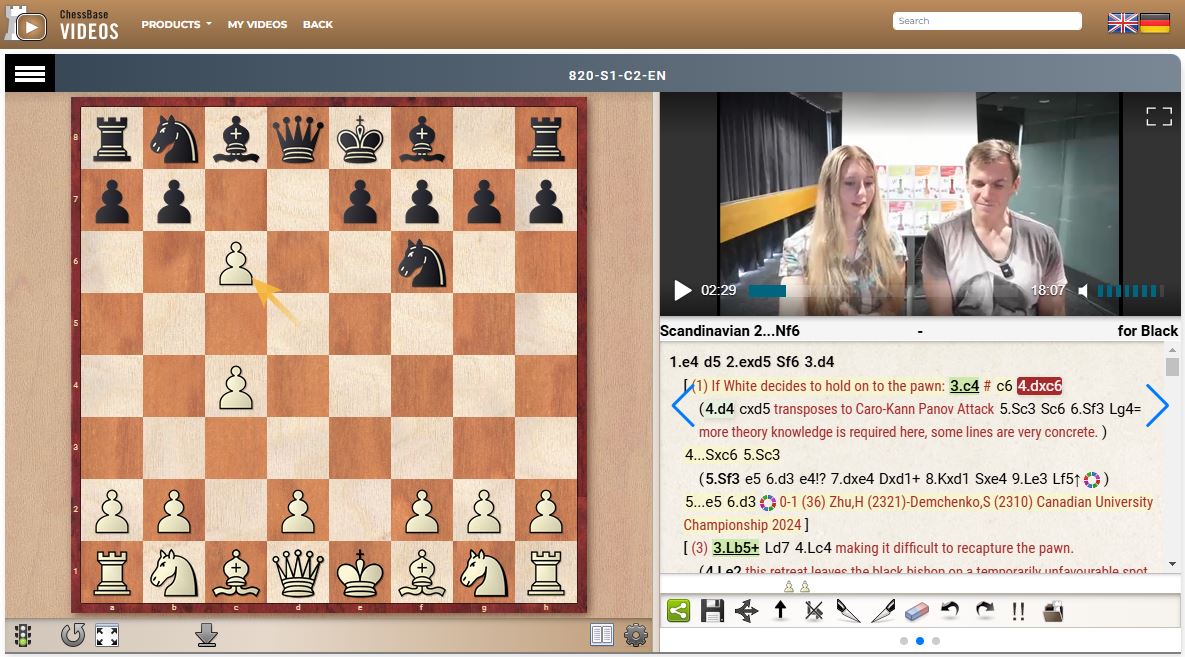
The first surprise weapon introduced is the Portuguese Variation of the Scandinavian Defence, a choice that could catch many White players off guard. This line features the following position, with a pawn sacrifice on c6:
This 60-minute course is a selection of exciting and practical openings that are both easy to learn and enjoyable to play.
The Canadian WIM promises many exciting and dynamic games with this variation. Black sacrifices a pawn to gain control of the centre, and advancing the pawn to e4 with a quick queen exchange, transitioning into an advantageous endgame, is often possible. If White tries an early check with the bishop on b5, Demchenko advises blocking with the light-squared bishop, which can then be exchanged or repositioned to g4 or f5. Should White quickly return the pawn with Nc3, solid and playable positions emerge.
Although Black may face slightly inferior positions in some lines, the author relies on better knowledge of the resulting structures, which can be an advantage with frequent use. In most cases, White is likely to be surprised and must tread carefully to avoid falling behind.
Players who enjoy wild positions will find this variation appealing - provided White decides to engage with it...
Queen’s Gambit with Black
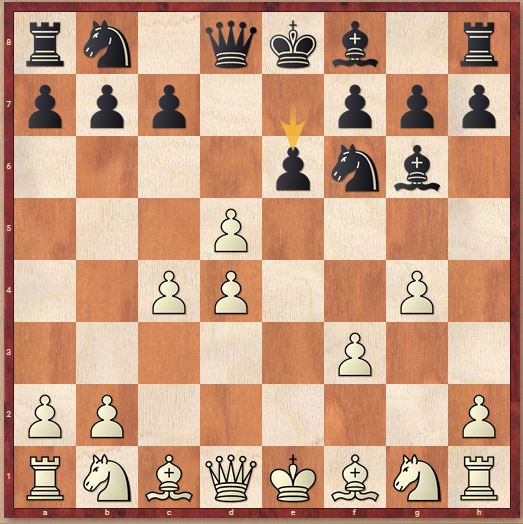
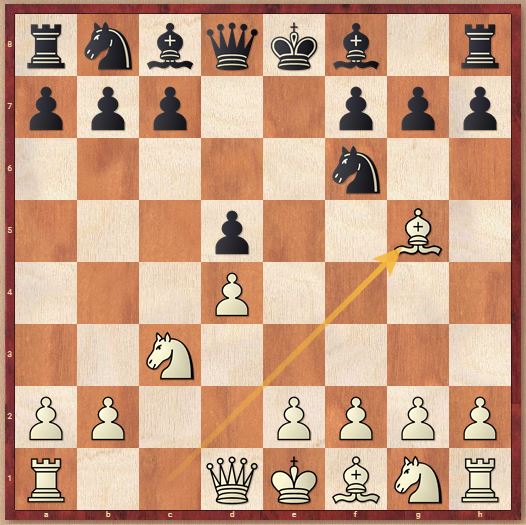
For players who, like the author, find the pin of the knight on f6 by White's light-squared bishop in the Queen's Gambit annoying, Demchenko recommends the line 1.d4 d5 2.c4 e6 3.Nc3 h6. This early move sidesteps theoretical debates, ensuring that White's bishop will not appear on g5. The videos provide numerous tips for different White setups, such as opting for ...Ne7 and ...Bf5 in the Exchange Variation to exchange the remaining light-squared bishop, often stationed on d3.
The Scotch Gambit with White
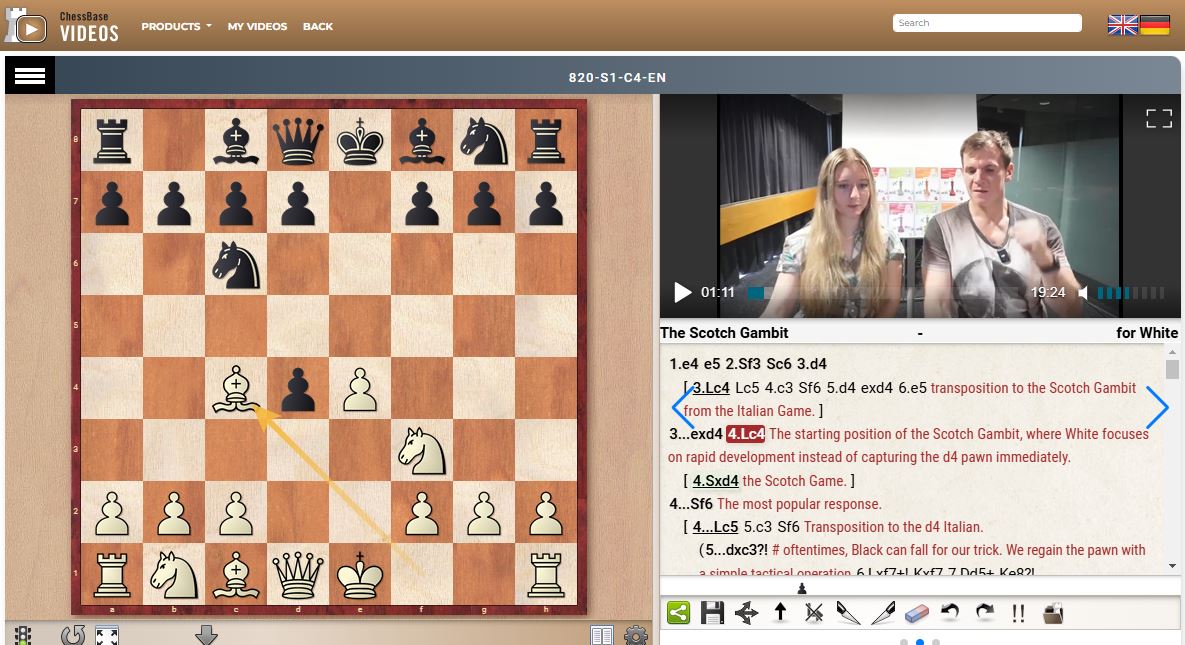
Take the initiative immediately with the Scotch Gambit.
As with most gambits, White aims for rapid piece development. Black faces the dilemma of either holding onto the pawn on d4 or sacrificing it. If Black opts for the latter, they often find themselves in cramped positions. Regardless, Black must calculate carefully to avoid the deadly tactics typical of this gambit. Correct play can even lead to transitions into Italian Game structures, ensuring variety.
This DVD focuses on several types of material imbalances, such as Rook vs 2 Pieces, Queen vs 2 Rooks, and Queen vs Pieces.
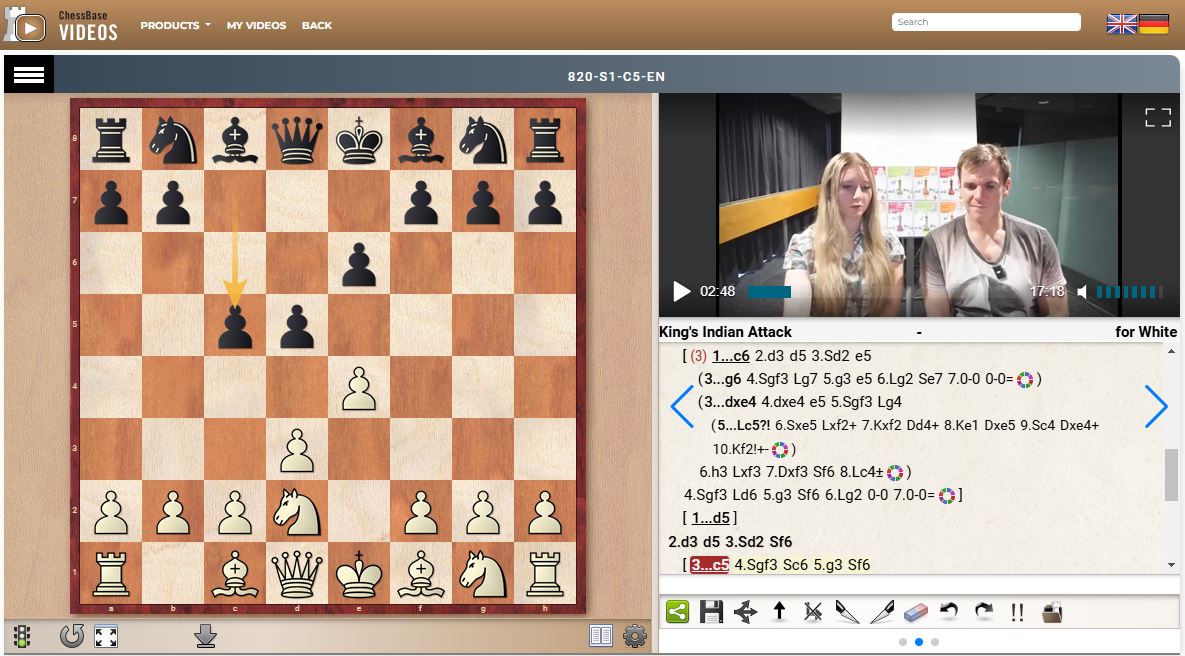
Finally, the author explores the King's Indian Attack as a flexible solution for e4 players who wish to avoid sharp theoretical debates in the Caro-Kann, Sicilian, or French Defences. The plan involves playing e4, d3, g3, Bg2, Nf3, and castling kingside to build a reversed King's Indian setup. This strategy is particularly suitable for players who already use the King’s Indian Defence as Black. A rich legacy supports this approach, with legends like Bobby Fischer and Tigran Petrosian favouring it. Reviewing their games, along with more modern examples, can be highly beneficial.
A useful tip: Against the French Defence, White should play an early d3 to enable Nd2, avoiding a queen exchange after a central pawn exchange. The same idea applies to the Caro-Kann.
Conclusion
With over 70 minutes of video playtime, exceeding the promised 60, plus additional material, Svitlana Demchenko offers a wealth of inspiring lines in these quarter-hour videos. The repertoire is especially suited to ambitious amateurs who enjoy attacking and are willing to sacrifice material. These openings are excellent for surprising unprepared opponents, particularly when tournament preparation time and energy are limited. Those who discover new favourite variations for regular play can dive deeper with supplementary materials. The author herself is already planning more advanced video courses.
The author
WIM Svitlana Demchenko, born in 2003, is a Ukrainian-born Canadian chess player. She has been a multiple-time Canadian girls' champion and a two-time North American girls' champion in various age categories. Since 2018, Svitlana has been a member of the Canadian Women's Olympiad team and has represented Canada at the Women's World Cup.
Stefan LiebigStefan Liebig, born in 1974, is a journalist and co-owner of a marketing agency. He now lives in Barterode near Göttingen. At the age of five, strange pieces on his neighbour’s shelf aroused his curiosity. Since then, the game of chess has cast a spell over him. Flying high in the NRW youth league with his home club SV Bad Laasphe and several appearances in the second division team of Tempo Göttingen were highlights for the former youth South Westphalia champion.
YOUR PERSONAL CHESS COACH - Whether you’re taking your first steps into the world of club chess, or already playing at a tournament level: with FRITZ, you can train more efficiently, intelligently and with a more personalised approach than ever before.
1.c4 e5 2.Nc3 Bb4!? is an opening idea well worth considering. Black immediately threatens to double the pawns on c3 in the style of the Trompowski or Sicilian Grand Prix attack.
Italian Game Powerbase 2026 is a database and contains 8571 top class games from Mega 2026 and the Correspondence Database 2026, of which 479 are annotated.
Videos: Nico Zwirs discusses the Sicilian with 2…e6 3.d4 cxd4 4.Qxd4 Nc6 5.Qe3 Nf6 6.Nc3. Mihail Marin examines Sindarov’s 6.Ne5 in the Queen’s Pawn Defence. Plus the ‘Lucky bag’ featuring 41 analyses by Berg, Ftacnik, Gupta and many others.
If you're looking for a dynamic alternative to the Slav, Queen's Gambit Declined, or other mainstream systems, the Chigorin Defence offers exactly what modern tournament players need.
Michael Kotyk presents a complete repertoire after 1.e4 e5, built around creative ideas, surprising move orders, and practical weapons designed to catch your opponents off guard.
€69.80
€59.90
We use cookies and comparable technologies to provide certain functions, to improve the user experience and to offer interest-oriented content. Depending on their intended use, analysis cookies and marketing cookies may be used in addition to technically required cookies. Here you can make detailed settings or revoke your consent (if necessary partially) with effect for the future. Further information can be found in our data protection declaration.
Pop-up for detailed settings
We use cookies and comparable technologies to provide certain functions, to improve the user experience and to offer interest-oriented content. Depending on their intended use, cookies may be used in addition to technically required cookies, analysis cookies and marketing cookies. You can decide which cookies to use by selecting the appropriate options below. Please note that your selection may affect the functionality of the service. Further information can be found in our privacy policy.
Technically required cookies
Technically required cookies: so that you can navigate and use the basic functions and store preferences.
Analysis Cookies
To help us determine how visitors interact with our website to improve the user experience.
Marketing-Cookies
To help us offer and evaluate relevant content and interesting and appropriate advertisement.




.jpeg)