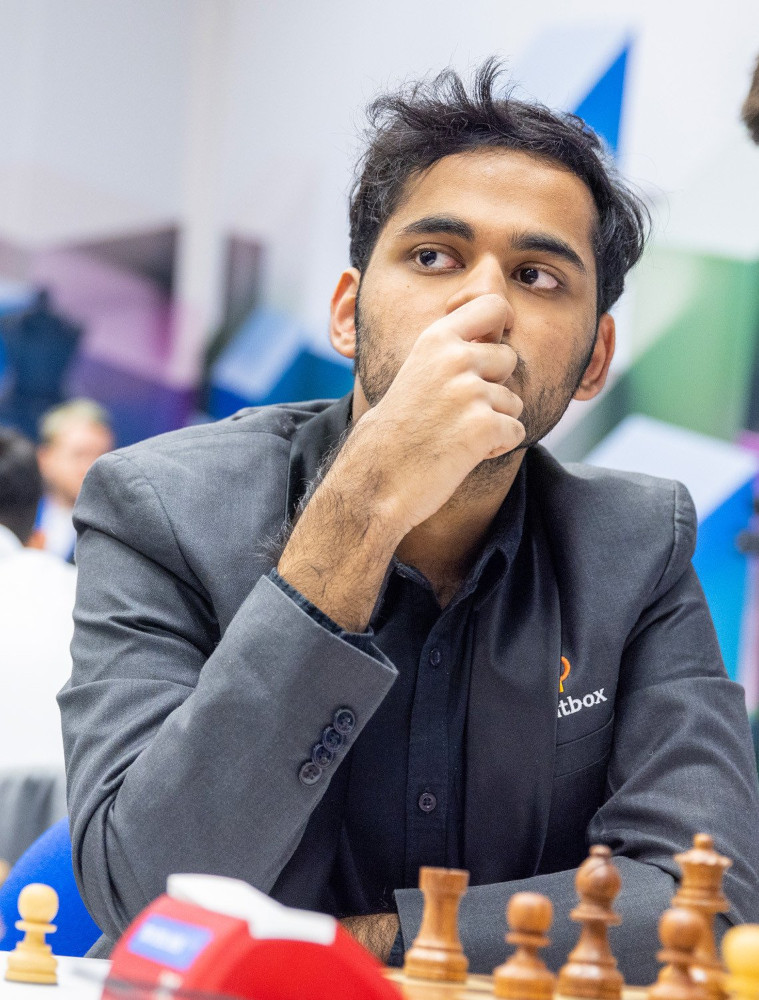
2/1/2023 – Arjun Erigaisi reached an extremely difficult endgame against Levon Aronian in the third round of the Tata Steel Masters. Many players would have collapsed, but the 19-year-old is a tough nut to crack. He held his own and managed to draw the game. After the game, you could see Arjun and Levon analysing the game, but it was all just too complex to figure out without an engine. IM Sagar Shah spent a lot of time going to the depth of the position and now shares the findings with you. Do check out the analysis to unlock the secrets of a complex knight versus bishop endgame. | Photo: Lennart Ootes
new: Fritz 20
Your personal chess trainer. Your toughest opponent. Your strongest ally. FRITZ 20 is more than just a chess engine – it is a training revolution for ambitious players and professionals. Whether you are taking your first steps into the world of serious chess training, or already playing at tournament level, FRITZ 20 will help you train more efficiently, intelligently and individually than ever before.
YOUR PERSONAL CHESS COACH - Whether you’re taking your first steps into the world of club chess, or already playing at a tournament level: with FRITZ, you can train more efficiently, intelligently and with a more personalised approach than ever before. FRITZ is more than just a chess engine – it’s a training revolution! Whether you’re taking your first steps into the world of club chess, or already playing at a tournament level: with FRITZ, you can train more efficiently, intelligently and with a more personalised approach than ever before.
In almost every chess game there comes a moment when you just can’t go on without tactics. You must strike to not giving away the advantage you have worked for the whole game.
€39.90
A complex knight versus bishop endgame
In the third round of the Tata Steel Masters 2023, Arjun Erigaisi landed in a difficult endgame against Levon Aronian. It was so complex that even though both sides had only one minor piece and three pawns, Aronian could not find a win.
I was commentating live on this game and during my commentary I was unable to understand what was the clear path to victory. So I woke up the next day and spent four hours studying this position closely. I would like to present my learnings below. First I would like to explain the endgame, and then you can check the replayable board for all the analysis, or you can play the YouTube video, or you can go to ChessRanga and try your hand at solving the positions in an interactive format.
In over 4 hours in front of the camera, Karsten Müller presents to you sensations from the world of endgames - partly reaching far beyond standard techniques and rules of thumb - and rounds off with some cases of with own examples.
The engines claim that this position is winning for Black. But how?
This is one of those positions where there are so many possibilities for each side that it is extremely difficult to analyse move by move. The good news for Aronian (Black) was that he reached this position where he had ample time on the clock, and after six more moves he would get an additional 15 minutes.
While time was plenty in Wijk Aan Zee, energy is not! When you are in the fifth hour of play, you are often unable to calculate with the same accuracy as you could in the first couple of hours. But let us just imagine if you were to reach the above position in your game. How would you tackle the task of trying to play for a win?
What I did was that I spent around an hour analysing different variations. Once I did that, I realized that there were a few positions which were critical to understand. Once I understood what was happening in those positions, it became easier to avoid errors as Black and to find ways to win. Let’s have a look at three important positions.
Please note: In most of the lines, White gives up the g-pawn with g4 hxg4 because he doesn’t want Black to come with his bishop and win the g-pawn and have his h and g-pawns intact.
This position is a drawn position. Why? Because the knight and the pawn on e6 create a barrier for the black king to approach towards the e6-pawn. At the same time, White’s king handles the black a-pawn. This is the scenario that White is aiming for to draw the game.
If Black were to get this position, then he is winning. That’s because White is in a zugzwang. The king is coming to b6 and there is no way for White to stop it.
This one was a very nice zugzwang position that I discovered. Black’s last move could be Bg5-h4 or Bh4-g5 depending on where the bishop is. And now White is lost because the knight cannot let the a-pawn run. So he can go Na4, but then Kf5-f4 wins. If instead Kd6, then Kf5 once again wins, as the White king is too far away and cannot stop the a-pawn. The above position is also winning for Black.
Once you have understood these three positions, you will realize that it is not so difficult for Black to win. I would call this schematic thinking. You think what position you want to reach and then work out the moves to reach it. But I can tell you that along the way there are many tricks and the position is not as static as one would imagine! A lot of calculation is also involved. Just to give you an example:
Aronian blundered in this position by playing Kd8. This allowed Nd5 and the game was drawn. But imagine in the above position if Aronian had instead played Ke8, then he was still winning. That’s because after Nd5, Black still has Bf6+! And the key point here is that after Kd6 a4 e7 Bxe7 Nxe7 a3, there is no Nc6 check, which would have happened if the king were on d8, and would go back to b4 and stopping the a-pawn.
It’s variations like these which strongly suggest that the position is sharp and requires accurate calculation. But at the same time, if you don’t know where you want to reach, then it’s very difficult to calculate as there are too many branches. This is the reason why I would call this endgame an extremely difficult one.
Sagar ShahSagar is an International Master from India with two GM norms. He loves to cover chess tournaments, as that helps him understand and improve at the game he loves so much. He is the co-founder and CEO of ChessBase India, the biggest chess news portal in the country. His YouTube channel has over a million subscribers, and to date close to a billion views. ChessBase India is the sole distributor of ChessBase products in India and seven adjoining countries, where the software is available at a 60% discount. compared to International prices.
YOUR PERSONAL CHESS COACH - Whether you’re taking your first steps into the world of club chess, or already playing at a tournament level: with FRITZ, you can train more efficiently, intelligently and with a more personalised approach than ever before.
1.c4 e5 2.Nc3 Bb4!? is an opening idea well worth considering. Black immediately threatens to double the pawns on c3 in the style of the Trompowski or Sicilian Grand Prix attack.
Italian Game Powerbase 2026 is a database and contains 8571 top class games from Mega 2026 and the Correspondence Database 2026, of which 479 are annotated.
Videos: Nico Zwirs discusses the Sicilian with 2…e6 3.d4 cxd4 4.Qxd4 Nc6 5.Qe3 Nf6 6.Nc3. Mihail Marin examines Sindarov’s 6.Ne5 in the Queen’s Pawn Defence. Plus the ‘Lucky bag’ featuring 41 analyses by Berg, Ftacnik, Gupta and many others.
If you're looking for a dynamic alternative to the Slav, Queen's Gambit Declined, or other mainstream systems, the Chigorin Defence offers exactly what modern tournament players need.
Michael Kotyk presents a complete repertoire after 1.e4 e5, built around creative ideas, surprising move orders, and practical weapons designed to catch your opponents off guard.
€69.80
€59.90
We use cookies and comparable technologies to provide certain functions, to improve the user experience and to offer interest-oriented content. Depending on their intended use, analysis cookies and marketing cookies may be used in addition to technically required cookies. Here you can make detailed settings or revoke your consent (if necessary partially) with effect for the future. Further information can be found in our data protection declaration.
Pop-up for detailed settings
We use cookies and comparable technologies to provide certain functions, to improve the user experience and to offer interest-oriented content. Depending on their intended use, cookies may be used in addition to technically required cookies, analysis cookies and marketing cookies. You can decide which cookies to use by selecting the appropriate options below. Please note that your selection may affect the functionality of the service. Further information can be found in our privacy policy.
Technically required cookies
Technically required cookies: so that you can navigate and use the basic functions and store preferences.
Analysis Cookies
To help us determine how visitors interact with our website to improve the user experience.
Marketing-Cookies
To help us offer and evaluate relevant content and interesting and appropriate advertisement.












 In the third round of the Tata Steel Masters 2023, Arjun Erigaisi landed in a difficult endgame against Levon Aronian. It was so complex that even though both sides had only one minor piece and three pawns, Aronian could not find a win.