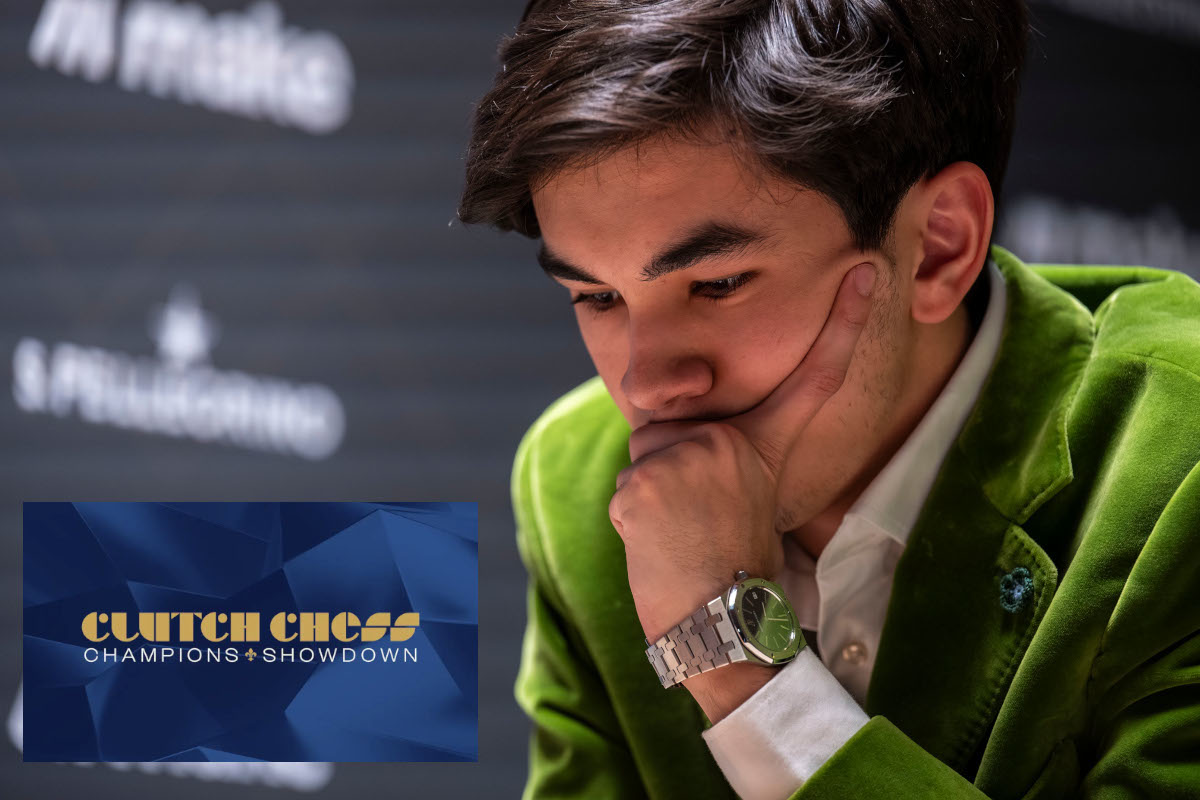
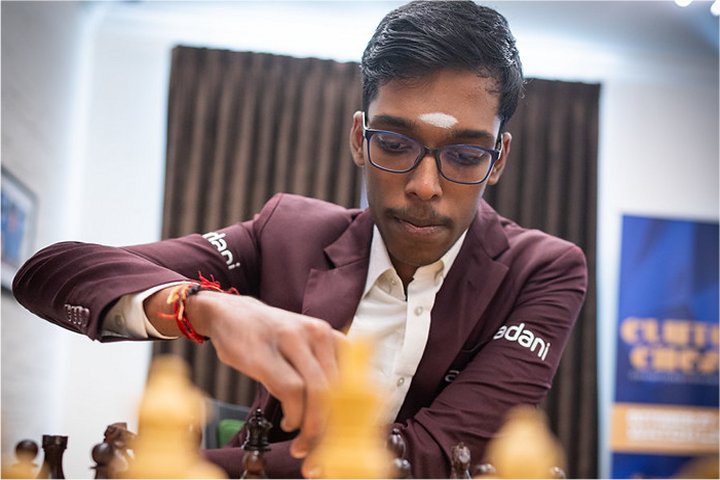
10/29/2026 – The Clutch Chess tournament in Saint Louis did not get off to a good start for Praggnanandhaa Rameshbabu, currently ranked seventh in the world and the lowest seed in the four-player field, behind Hikaru Nakamura, Fabiano Caruana and Javokhir Sindarov. On the first day, Praggnanandhaa scored just 2 out of a possible 6 points and finished bottom of the standings. Things went better on day two, however, as he collected 9 out of a possible 12 points to take the lead. | Photo: Lennart Ootes / Saint Louis Chess Club
new: Fritz 20
Your personal chess trainer. Your toughest opponent. Your strongest ally. FRITZ 20 is more than just a chess engine – it is a training revolution for ambitious players and professionals. Whether you are taking your first steps into the world of serious chess training, or already playing at tournament level, FRITZ 20 will help you train more efficiently, intelligently and individually than ever before.
YOUR PERSONAL CHESS COACH - Whether you’re taking your first steps into the world of club chess, or already playing at a tournament level: with FRITZ, you can train more efficiently, intelligently and with a more personalised approach than ever before. FRITZ is more than just a chess engine – it’s a training revolution! Whether you’re taking your first steps into the world of club chess, or already playing at a tournament level: with FRITZ, you can train more efficiently, intelligently and with a more personalised approach than ever before.
The Hyper-Accelerated dragon is fast, from the very first moves, your bishop heads to g7, seizes the long diagonal, and turns into the most feared piece on the board.
It rewards players who love initiative and clear attacking plans.
€69.90
From last place to first place
Clutch Chess requires strong nerves. The tournament lasts three days, with six rapid games played each day and only short breaks between rounds. There is also a lot of money at stake, both in the tournament as a whole and in every individual game. The tournament winner receives $125,000 in prize money, while each win earns a bonus of $1,000 on day 1, $2,000 on day 2 and $3,000 on day 3. There is no bonus for a draw, but instead money is added to a jackpot, which the tournament winner receives in addition to the $125,000. After two days, the jackpot has already reached $19,000.
Praggnanandhaa's tournament so far shows how important it is to have luck on your side in such a format. On the first day, in the very first game of the tournament, he had the better position for a long time with White against Sindarov, but then spoiled an opposite-coloured bishop endgame in time trouble after a brief blackout, despite it being one of those positions that you are "not supposed" to lose.
This endgame is drawn, but while looking for winning chances Praggnanandhaa played 47.g4??. With only a few seconds left on the clock, he had probably overlooked that after 47...hxg448.Kg3 Kh5 49.Be6 Be1+, Black holds on to the g-pawn and wins the h-pawn. In the game, Praggnanandhaa did not play 48.Kg3 and instead chose 48.Bf7, but lost on time while making the move.
From then on, not much went Praggnanandhaa's way. He scored only two draws from his next four games and also suffered two further defeats. Only in the sixth and final game of the day did he finally score his first win, against Caruana.
Things went better on day two: Praggnanandhaa won the opening game against Sindarov, who failed to find the best defence in a complicated heavy-piece endgame. But in the second game against Sindarov, Praggnanandhaa had white in a King's Indian and was comprehensively outplayed.
"I really like playing the King's Indian. Of course, I always come out of the opening worse, but I'm quite good at finding tactical tricks", Sindarov said afterwards in good spirits.
How grandmasters win without fireworks: GM Jan Markos shows you 11 very practical tips from "How to play in a lost position" to "Be patient like Carlsen" that will improve your tournament chess. Most chess books teach you what to think about. This series teaches you what to actually do when the clock is running and the result is on the line. Compiled from GM Jan Markos's acclaimed "Practical Tips for the Tournament Player" column in ChessBase Magazine, Volume 1 covers the decisions every tournament player faces before the position ever gets complicated: how you use your time, how you handle pressure, and how you think when the stakes are real.
Free Video Sample: How to use your time effectively
In the third game of the day, Praggnanandhaa had white against Hikaru Nakamura, and at first it looked as though he would lose a second game in a row. Nakamura had clear winning chances in an endgame with an extra pawn, but in the end it was Praggnanandhaa who won, with a considerable amount of luck.
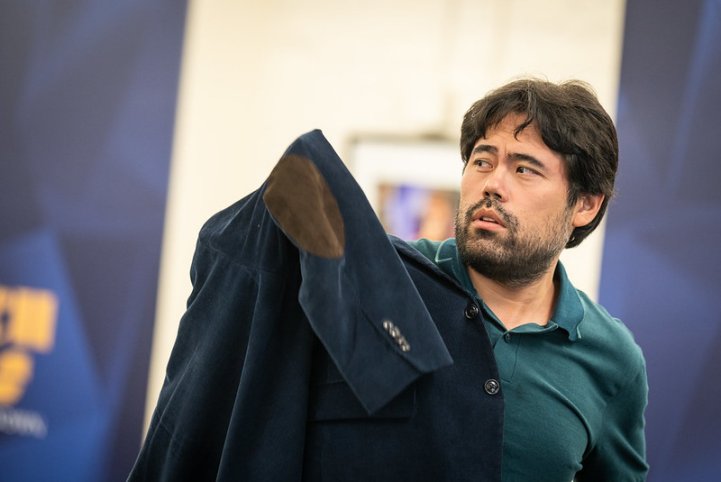
"I was completely winning, but then I lost my head", Nakamura said after the game.
Hikaru Nakamura in conversation with Maurice Ashley
Master your middlegame with the complete strategy series – now available as a bundle at a reduced price. Take your chance to save and improve! Master your middlegame with the complete strategy series – now available as a bundle at a reduced price. Take your chance to save and improve!
That gave Praggnanandhaa momentum, and he won the second game against Nakamura convincingly.
Day two did not go well for Hikaru Nakamura | Photo: Lennart Ootes
With a win over Caruana in game five, Praggnanandhaa then made it three victories in a row, so a draw against Caruana in the sixth and final game of the day was enough for him to take the lead in the standings, not least because each win was worth two points on day two rather than one, as on opening day.
Praggnanandhaa in conversation with Maurice Ashley
In this video course, experts including Dorian Rogozenco, Mihail Marin, Karsten Müller and Oliver Reeh, examine the games of Boris Spassky. Let them show you which openings Spassky chose to play, where his strength in middlegames were and much more.
Standings after day 2
Graphic: Saint Louis Chess Club
The standings after the second day show how quickly fortunes can change in the Clutch Chess tournament: after day one, Nakamura led ahead of Sindarov, Caruana and Praggnanandhaa.
Standings after day 1
Graphic: Saint Louis Chess Club
After day two, the order is almost exactly reversed: Praggnanandhaa leads, Caruana and Sindarov share second and third place, and Nakamura is at the bottom of the standings.
But nothing has been decided yet, because on the third and final day of the tournament each win is worth three points, while a draw is still worth only one. With some luck and strong nerves, each of the four participants can therefore still score 18 points and win the tournament.
Fabiano Caruana explains why and how any of the four players can still win the tournament
Most players prefer to attack rather than defend. But what is the correct way to do it? GM Dr Karsten Müller has compiled many rules and motifs to guide you, along with sharpening your intuition for the exceptions.
Johannes FischerJohannes Fischer was born in 1963 in Hamburg and studied English and German literature in Frankfurt. He now lives as a writer and translator in Nürnberg. He is a FIDE-Master and regularly writes for KARL, a German chess magazine focusing on the links between culture and chess. On his own blog he regularly publishes notes on "Film, Literature and Chess".
10/29/2026 – Clutch Chess: Champions Showdown is a high-profile rapid tournament gathering four elite competitors. Javokhir Sindarov, who is set to challenge Gukesh Dommaraju for the World Championship title next month, joins Fabiano Caruana, Hikaru Nakamura and Praggnanandhaa Rameshbabu in a three-day battle. The competition runs from 27 to 29 October and follows a "clutch" structure of three double round-robins, where results become progressively more valuable with each round-robin. | Follow the action live starting at 18.00 CET (13.00 ET, 22.30 IST) | Photo: Lennart Ootes
10/26/2026 – The Clutch Chess: Champions Showdown event returns to Saint Louis on 27–29 October, with Fabiano Caruana, Hikaru Nakamura, Praggnanandhaa Rameshbabu and Javokhir Sindarov (pictured) competing in an 18-game rapid tournament. The four elite GMs will play three double round-robins, with victories worth progressively more points over the three days. A jackpot funded by drawn games further adds entertainment value to the competition. | Photo: Nils Rohde / ChessBase
The Elephant Gambit (1.e4.e5 2.Nf3 d5!?) has never really been given the attention it deserves. It is a very useful surprise weapon. Let us list the advantages of playing this particular opening: 1) Shock value 2) It is very aggressive. Black can take over the initiative early. 3) Many tricky lines 4) Unorthodox. Black is basically taking the game to the opponent as early as move two. Not many openings do that! It's a perfect opening for young players and club players to adopt. Let Andrew Martin select a repertoire for you on this 60 mins, which, if used with discretion, will rack up the points. I am sure that you will enjoy this unusual tour of the Elephant Gambit.
YOUR PERSONAL CHESS COACH - Whether you’re taking your first steps into the world of club chess, or already playing at a tournament level: with FRITZ, you can train more efficiently, intelligently and with a more personalised approach than ever before.
Keep it simple. Stay objective. Watch the clock. Sometimes take the risk. GM Loek van Wely explains the ten principles that decide real games. They aren’t about theory. They’re about what you do at the board when it counts.
2026 Chess Olympiad with analyses by Abdusattorov, Donchenko, Duda, So and many more – ‘Rooks love open files’: Tactics training with Oliver Reeh – ‘Don’t underestimate it’: Caruana’s blitz weapon 1.e4 e5 2.d3 – Total Video playing time: over 6 hours!
Most players don’t lack the urge to attack, they just strike at the wrong moment, and GM Sipke Ernst shows you which signals tell you to go for the king and which tell you to choose another plan.
How grandmasters win without fireworks: GM Jan Markos shows you 11 very practical tips from "How to play in a lost position" to "Be patient like Carlsen" that will improve your tournament chess.
The Nimzo-Indian has stood the test of time for over a century: Still a top choice for elite players today, from Magnus Carlsen to Praggnanandhaa, it remains one of Black's most reliable ways to fight for real chances against 1.d4 2.c4 3.Nc3.
1.c4 e5 2.Nc3 Bb4!? is an opening idea well worth considering. Black immediately threatens to double the pawns on c3 in the style of the Trompowski or Sicilian Grand Prix attack.
In this 60-minute video course you’ll learn how to use the Austrian Defence as a practical weapon for Black!
€9.90
We use cookies and comparable technologies to provide certain functions, to improve the user experience and to offer interest-oriented content. Depending on their intended use, analysis cookies and marketing cookies may be used in addition to technically required cookies. Here you can make detailed settings or revoke your consent (if necessary partially) with effect for the future. Further information can be found in our data protection declaration.
Pop-up for detailed settings
We use cookies and comparable technologies to provide certain functions, to improve the user experience and to offer interest-oriented content. Depending on their intended use, cookies may be used in addition to technically required cookies, analysis cookies and marketing cookies. You can decide which cookies to use by selecting the appropriate options below. Please note that your selection may affect the functionality of the service. Further information can be found in our privacy policy.
Technically required cookies
Technically required cookies: so that you can navigate and use the basic functions and store preferences.
Analysis Cookies
To help us determine how visitors interact with our website to improve the user experience.
Marketing-Cookies
To help us offer and evaluate relevant content and interesting and appropriate advertisement.

















.jpeg)