12/1/2011 – Most players can sum up their knowledge of the bishop against knight struggle as favorable for the bishop with open lines, while closed positions favor the knight. In the new, highly affordable "60 minute" series, only available for download, GM Adrian Mikhalchishin teaches how to recognize which piece is the stronger, and how to play the attacker or defender.
new: Fritz 20
Your personal chess trainer. Your toughest opponent. Your strongest ally. FRITZ 20 is more than just a chess engine – it is a training revolution for ambitious players and professionals. Whether you are taking your first steps into the world of serious chess training, or already playing at tournament level, FRITZ 20 will help you train more efficiently, intelligently and individually than ever before.
The premiere chess database with over 11.7 million games
€229.90
Bishop against Knight in 60 minutes
Review by Albert Silver
Someone comes up to you and offers a one-on-one private lecture with a top trainer for just ten Euros. That is very much the proposition in the new “60-minute” series by ChessBase, taking advantage of their new Chessbase Shop in a system very much akin to Steam or other digital media distributors.
These lectures are not only more immediately palatable, lasting roughly an hour in all (the DVD courses usually contain several hours of material), but are also in a much more affordable format. After all, it is barely the price of a movie ticket. The contrast with the DVD courses is all the truer as these new bite-size lessons are available in digital format only, and have been designed so that they can be downloaded in a minimum of time.
To get it, you only have to set up an account at the Chessbase Shop, make your purchase, and then click on My Downloads in your account to receive your program. No longer do you have to wait for the item to ship, sometimes from overseas. Also, you never need worry about a disc getting scratched or losing it. If you erased the files and want to see them again, you can just access your account and re-download them.
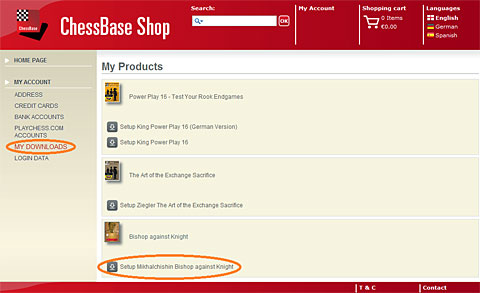
The digital products bought at the ChessBase Shop are available via one's account
There are a variety of subjects covered, and there is no question the collection will grow very quickly. This was my first foray into this format, and the one that caught my eye was “Bishop against Knight in 60 minutes” by GM Adrian Mikhalchishin.
A look at the contents
The download was quite fast, and the first thing I did was take a look at the contents. The lecture is divided into ten videos, which actually total closer to 75 minutes per my mental tally, so far so good.
The first lecture is thirteen minutes long, and is a loss of his against Zaichik before either became a full grandmaster. Note, that the games chosen are not all his, and one will also be shown examples of play from Karpov, Smyslov, Fischer, and Petrosian among others.
In his game against Zaichik, he starts with some interesting comments on the differing schools of thought on the struggle of the bishop over the knight and vice-versa, and then proceeds to showing how he lost.
GM Mikhalchishin explians why the bishop is not the monster it first appears to be,
and how to recognize such situations in the future.
The game is quite well-chosen, and it is clear it had a deep effect on him as he spent time trying to understand just how and why he had misjudged his position so badly. He had a huge bishop with wide open lines, that he managed to plant on the ultra-centralized square d4, yet his optimism was misplaced as he was looking at it far too superficially. He then explains what his errors were, how he could have played better, and what basic rules and guidelines apply in that position.
This effective approach is used throughout and all the game excerpts he shows have clear-cut rules for the student to absorb and apply, so as to understand when the knight is stronger than the bishop, and vice-versa, but how to exploit it from both the attacker’s and defender’s point of view.
The final sample in the lecture
All-in-all, I found the lecture very objective, and well-paced. The examples were all pertinent, and each one reinforced important guidelines for the student to take away. For the quality and quantity of material, the price is hard to beat, and I will certainly be viewing others.
Albert SilverBorn in the US, he grew up in Paris, France, and after college moved to Rio de Janeiro, Brazil. He had a peak rating of 2240 FIDE, and was a key designer of Chess Assistant 6. In 2010 he joined the ChessBase family as an editor and writer at ChessBase News. He is also a passionate photographer with work appearing in numerous publications, and the content creator of the YouTube channel, Chess & Tech as well as the author of Typing Tomes, a powerful typing program.
You will learn how Black's dynamic piece activity and structural counterplay more than compensate for White's extra tempo in the colour-reversed setups.
In this course, you’ll learn how to take the initiative against the London and prevent White from comfortably playing their usual system by playing 1.d4 Nf6 2.Bf4 Nh5.
London System Powerbase 2026 is a database and contains in all 11 285 games from Mega 2026 and the Correspondence Database 2026, of which 282 are annotated.
The London System Powerbook 2026 is based on more than 410 000 games or game fragments from different opening moves and ECO codes; what they all have in common is that White plays d4 and Bf4 but does not play c4.
In this course, Grandmaster Elisabeth Pähtz presents the London System, a structured and ambitious approach based on the immediate Bf4, leading to rich and dynamic positions.
Opening videos: Open Spanish (Sipke Ernst) and Classical Sicilian (Nico Zwirs). Endgame Special by Igor Stohl: ‘Short or long side’ – where should the defending king be placed in rook endgames? ‘Lucky bag’ with 35 master analyses.
YOUR EASY ACCESS TO OPENING THEORY: Whether you want to build up a reliable and powerful opening repertoire or find new opening ideas for your existing repertoire, the Opening Encyclopaedia covers the entire opening theory on one product.
€169.90
We use cookies and comparable technologies to provide certain functions, to improve the user experience and to offer interest-oriented content. Depending on their intended use, analysis cookies and marketing cookies may be used in addition to technically required cookies. Here you can make detailed settings or revoke your consent (if necessary partially) with effect for the future. Further information can be found in our data protection declaration.
Pop-up for detailed settings
We use cookies and comparable technologies to provide certain functions, to improve the user experience and to offer interest-oriented content. Depending on their intended use, cookies may be used in addition to technically required cookies, analysis cookies and marketing cookies. You can decide which cookies to use by selecting the appropriate options below. Please note that your selection may affect the functionality of the service. Further information can be found in our privacy policy.
Technically required cookies
Technically required cookies: so that you can navigate and use the basic functions and store preferences.
Analysis Cookies
To help us determine how visitors interact with our website to improve the user experience.
Marketing-Cookies
To help us offer and evaluate relevant content and interesting and appropriate advertisement.