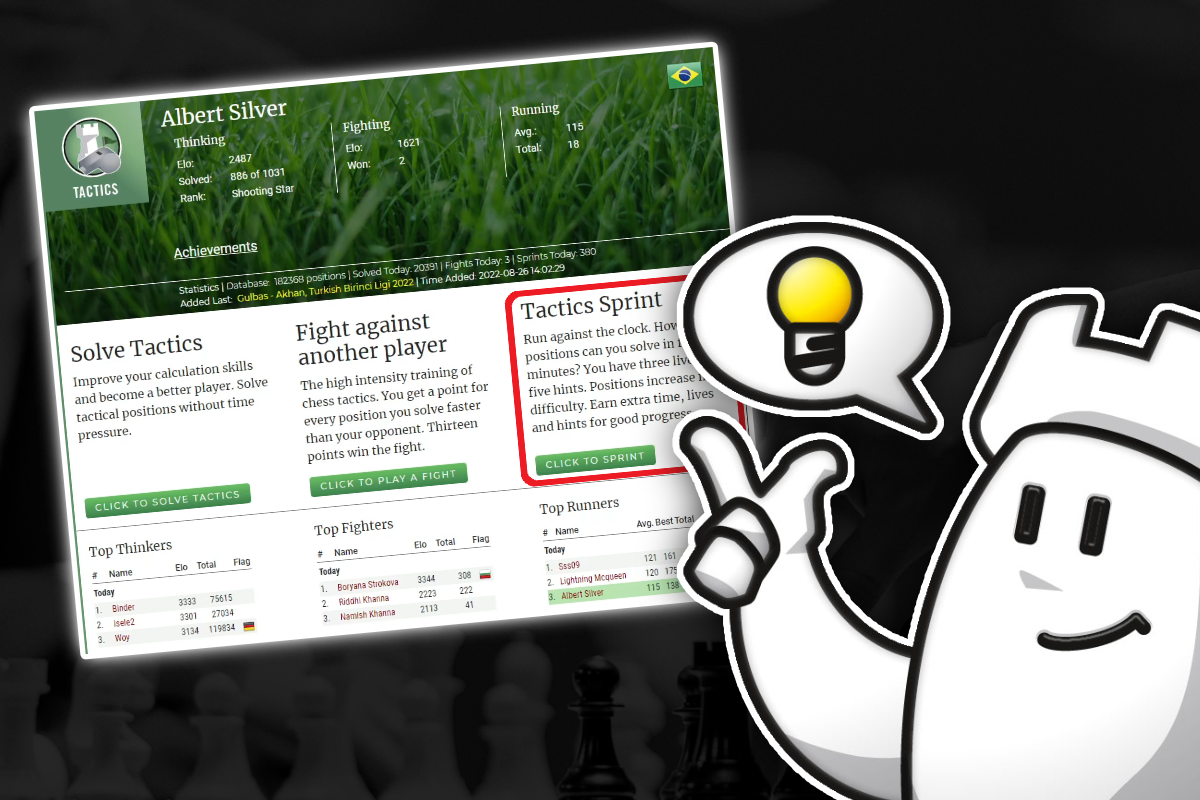
8/31/2022 – There are many ways to train tactics, from methodical themes, to deep positions, and while all have their place in a player's arsenal of training tools, there is one that specifically targets speed of recognition and play: the Tactics Sprint. If you feel like you want a method to improve your ability to see and play tactics in minimal time see this intro with video!
new: Fritz 20
Your personal chess trainer. Your toughest opponent. Your strongest ally. FRITZ 20 is more than just a chess engine – it is a training revolution for ambitious players and professionals. Whether you are taking your first steps into the world of serious chess training, or already playing at tournament level, FRITZ 20 will help you train more efficiently, intelligently and individually than ever before.
At the airport, in the hotel or at home on your couch: with the new ChessBase you always have access to the whole ChessBase world: the new ChessBase video library, tactics server, opening training App, the live database with eight million games, Let’s Check and web access to playchess.com
In this video course experts examine the games of Bent Larsen. Let them show you which openings Larsen chose, where his strength in middlegames were, how he outplayed his opponents in the endgame & you’ll get a glimpse of his tactical abilities!
€39.90
As a returning student of the game, all areas are being covered from middlegame to the endgame, but none of them have felt quite as baleful as the tactics, in which the time to solution has been quite lethargic at times. In an effort to shake things up, I decided to revisit the function in the ChessBase Tactics web app called Tactics Sprint.
Although I know it and have described it, I never actually used it beyond those needed moments. However, in an effort to 'shake things up', I began playing with this Speedy Gonzales trainer and got a renewed appreciation for it, what it is good for and what it is not, and will be including it in my rotation.
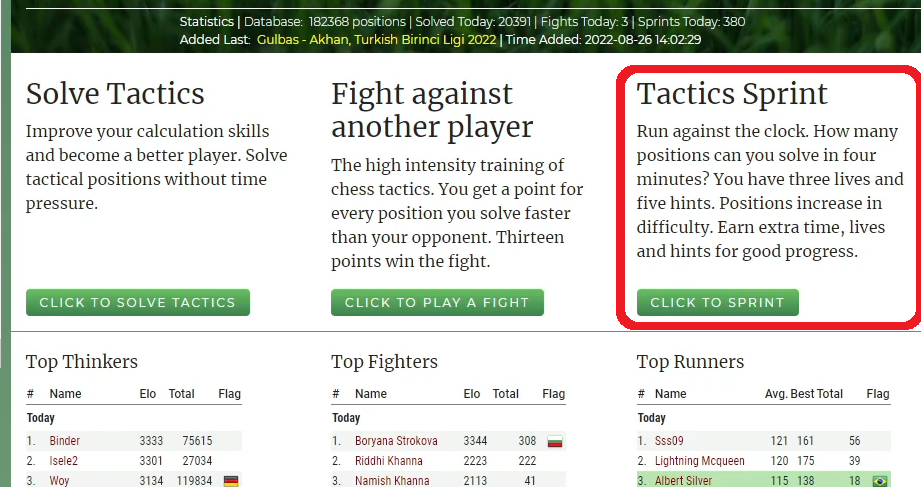
When you open the Tactics web app you have three options: the classic Tactics trainer, the Fight Club option (you duel with other players to solve positions) and the Tactics Sprint.
The Tactics Sprint comes with a set of rules that bear explaining: you start with four minutes, three lives and five hints, to solve as many as you can before the time runs out. The catch is that all three of those numbers are subject to change as you move ahead.
Three lives
For example, each position can be anywhere from a plain mate in one, which is how the series always starts, to tactics of varying complexity, especially after you break the 100-solved mark. Every time you get a move wrong, you lose a life. This can be a move in the middle of a solution too, one in which you had gotten the first three moves correct. However, you will be rewarded an extra life after a certain number of correct solutions, much like a video game in which you get an extra life after reaching a certain score. This is the same.
There is a second catch too though. If you run out of lives, with wrong solutions, no matter how much time you have left, it is game over.
Four minutes
This is by far the most misleading part of the run. Each correct move will gift you some extra time, so that even a run of 50 correct solutions can easily pass the 10-minute mark. I timed one run that ran 130-odd solved and the stopwatch said I had spent over 21 minutes. So be warned. The four minutes is just the minimum time you have, not a set-in-stone value for your sprint.
The aim of this course is to help you understand how to make tactical opportunities arise as well as to sharpen your tactical vision - these selected lectures will help to foster your overall tactical understanding.
Five hints
At the start of a run you are allowed as many as five hints, but this number will go up radically as you proceed ahead. These hints are not badges of shame, and in harder cases, don't hesitate to ask for one rather than eat up a minute of your time while your clock runs out. Of course, some hints will be straightforward ("move the rook"), while others can be a bit less so ("find the mate").
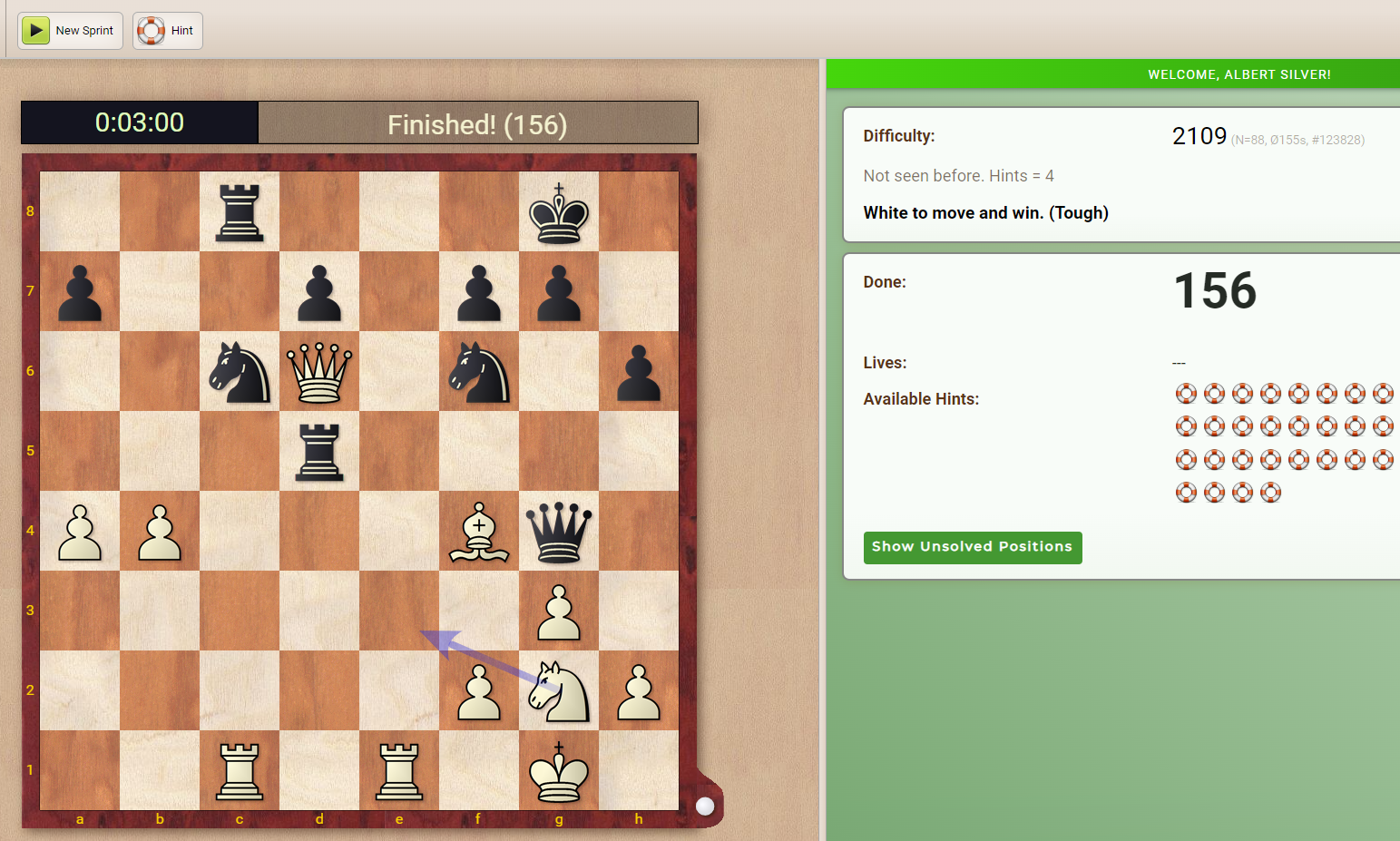
My personal best after a couple of dozen runs is 156, though in time no doubt this will improve.
What it is like
Every run starts with a series of mates in one after which it begins alternating with one-move tactics and then the diversity goes up. Although you will face combinations of varying difficulty, especially some lines can be tricky in their continuations, you are never quite free of a mate in one or other just to see if you are paying attention. At least that is how I jokingly think of them.
One thing is certain: although a full run can easily extend to 20 minutes or more, unlike a standard tactics study session, the intensity and adrenaline in a sprint is incomparable. The clock is always ticking, and you never ever lose sight of the fact that your time can run out, or a final misstep can cut it short. It is a fairly unique experience and definitely has a solid fun factor involved. I highly recommend it.
Albert SilverBorn in the US, he grew up in Paris, France, and after college moved to Rio de Janeiro, Brazil. He had a peak rating of 2240 FIDE, and was a key designer of Chess Assistant 6. In 2010 he joined the ChessBase family as an editor and writer at ChessBase News. He is also a passionate photographer with work appearing in numerous publications, and the content creator of the YouTube channel, Chess & Tech as well as the author of Typing Tomes, a powerful typing program.
YOUR PERSONAL CHESS COACH - Whether you’re taking your first steps into the world of club chess, or already playing at a tournament level: with FRITZ, you can train more efficiently, intelligently and with a more personalised approach than ever before.
The Nimzo-Indian has stood the test of time for over a century: Still a top choice for elite players today, from Magnus Carlsen to Praggnanandhaa, it remains one of Black's most reliable ways to fight for real chances against 1.d4 2.c4 3.Nc3.
1.c4 e5 2.Nc3 Bb4!? is an opening idea well worth considering. Black immediately threatens to double the pawns on c3 in the style of the Trompowski or Sicilian Grand Prix attack.
Italian Game Powerbase 2026 is a database and contains 8571 top class games from Mega 2026 and the Correspondence Database 2026, of which 479 are annotated.
Videos: Nico Zwirs discusses the Sicilian with 2…e6 3.d4 cxd4 4.Qxd4 Nc6 5.Qe3 Nf6 6.Nc3. Mihail Marin examines Sindarov’s 6.Ne5 in the Queen’s Pawn Defence. Plus the ‘Lucky bag’ featuring 41 analyses by Berg, Ftacnik, Gupta and many others.
If you're looking for a dynamic alternative to the Slav, Queen's Gambit Declined, or other mainstream systems, the Chigorin Defence offers exactly what modern tournament players need.
€34.90
We use cookies and comparable technologies to provide certain functions, to improve the user experience and to offer interest-oriented content. Depending on their intended use, analysis cookies and marketing cookies may be used in addition to technically required cookies. Here you can make detailed settings or revoke your consent (if necessary partially) with effect for the future. Further information can be found in our data protection declaration.
Pop-up for detailed settings
We use cookies and comparable technologies to provide certain functions, to improve the user experience and to offer interest-oriented content. Depending on their intended use, cookies may be used in addition to technically required cookies, analysis cookies and marketing cookies. You can decide which cookies to use by selecting the appropriate options below. Please note that your selection may affect the functionality of the service. Further information can be found in our privacy policy.
Technically required cookies
Technically required cookies: so that you can navigate and use the basic functions and store preferences.
Analysis Cookies
To help us determine how visitors interact with our website to improve the user experience.
Marketing-Cookies
To help us offer and evaluate relevant content and interesting and appropriate advertisement.