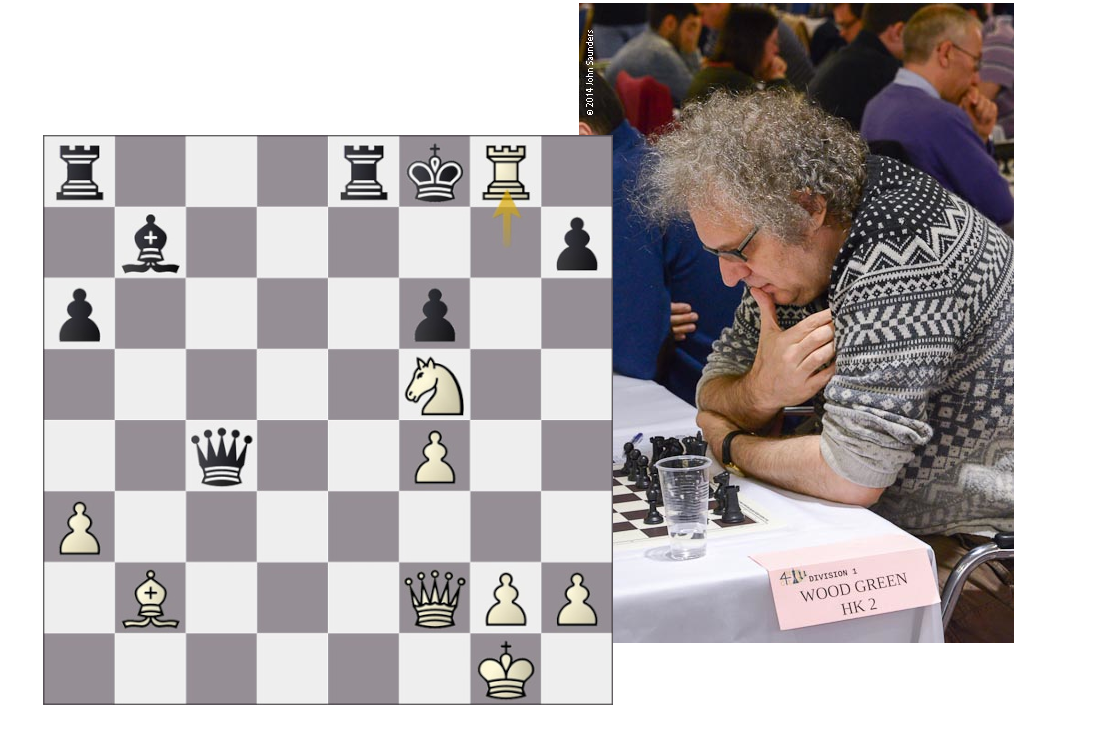
11/4/2025 – After a long break from competitive play, GM Jon Speelman returned to the board with three intense games in quick succession - each offering instructive lessons and a few painful oversights. In his latest column, he revisits the most critical moments from these battles, including a London League clash against Jonathan Parker and two 4NCL encounters, inviting readers to test their tactical vision and find the winning ideas that eluded him over the board. | Photo: John Saunders / 4NCL (2014)
new: Fritz 20
Your personal chess trainer. Your toughest opponent. Your strongest ally. FRITZ 20 is more than just a chess engine – it is a training revolution for ambitious players and professionals. Whether you are taking your first steps into the world of serious chess training, or already playing at tournament level, FRITZ 20 will help you train more efficiently, intelligently and individually than ever before.
YOUR PERSONAL CHESS COACH - Whether you’re taking your first steps into the world of club chess, or already playing at a tournament level: with FRITZ, you can train more efficiently, intelligently and with a more personalised approach than ever before. FRITZ is more than just a chess engine – it’s a training revolution! Whether you’re taking your first steps into the world of club chess, or already playing at a tournament level: with FRITZ, you can train more efficiently, intelligently and with a more personalised approach than ever before.
In this two-volume course GM Ganguly turns calculation into a trainable skill with a structured path for any level.
€39.90
Tough battles
[Note that Jon Speelman also looks at the content of the article in video format, here embedded at the end of the article.]
After months without any games at all (apart from an execrable blitz tournament), I played three in just over a week. All three featured very interesting positions and also blind spots, so I've decided to use them here, concentrating on the critical positions without worrying too much about the openings.
We start with a London League game against grandmaster Jonathan Parker. My team, Wood Green, are the Behemoths of the league, having won for many years in a row, though we did lose a match a couple of years ago against Hammersmith. The match against Parker's team, Cavendish, was fairly even at the top, but we were much stronger on the lower boards of the eight-game battle and won pretty easily. The fight against Hammersmith at the end of January, however, promises to be a real humdinger.
This was the critical position in which he played 19.Rae1. Can you see how I answered this and find the best move which gives him a big advantage? Obvious candidates are Rg5 and d6.
Can you see what I played here? Also, can you find my idea after the obvious reply and the somewhat surprising retreat which we both totally missed during the game?
Here, to my shame, I managed to talk myself out of the obvious attacking options and played the pathetic 31.Rge5? (which possibly deserves a ??), though I did still win in the end.
White's whole opening has been based on the idea of attacking g7, and I considered three lines but couldn't make any of them work:
31.Rxe8+ Rxe8 32.Rxg7+ Kf8!
31.Nf5 f6 32.Bxf6 Ncf6 33.Rxg7+ Kh8 34.Rxb7 Qc8 or, as my opponent pointed out in the post-mortem, ...Qd5.
31.Nf5 f6 32.Rxe8+ Rxe8 33.Rxg7+ Kf8 34.Rxb7 and maybe Qd5 or Rad8.
Try to find the several wins that my addled brain missed, and try to decide which of these you like most.
Select an entry from the list to switch between games
In this insightful video course, Grandmaster David Navara shares practical advice on when to calculate deeply in a position — and just as importantly, when not to. In this insightful video course, Grandmaster David Navara shares practical advice on when to calculate deeply in a position — and just as importantly, when not to.
Free sample video: Introduction
Free sample video: Invisible moves
Jonathan SpeelmanJonathan Speelman, born in 1956, studied mathematics but became a professional chess player in 1977. He was a member of the English Olympic team from 1980–2006 and three times British Champion. He played twice in Candidates Tournaments, reaching the semi-final in 1989. He twice seconded a World Championship challenger: Nigel Short and then Viswanathan Anand against Garry Kasparov in London 1993 and New York 1995.
YOUR PERSONAL CHESS COACH - Whether you’re taking your first steps into the world of club chess, or already playing at a tournament level: with FRITZ, you can train more efficiently, intelligently and with a more personalised approach than ever before.
How grandmasters win without fireworks: GM Jan Markos shows you 11 very practical tips from "How to play in a lost position" to "Be patient like Carlsen" that will improve your tournament chess.
The Nimzo-Indian has stood the test of time for over a century: Still a top choice for elite players today, from Magnus Carlsen to Praggnanandhaa, it remains one of Black's most reliable ways to fight for real chances against 1.d4 2.c4 3.Nc3.
1.c4 e5 2.Nc3 Bb4!? is an opening idea well worth considering. Black immediately threatens to double the pawns on c3 in the style of the Trompowski or Sicilian Grand Prix attack.
Italian Game Powerbase 2026 is a database and contains 8571 top class games from Mega 2026 and the Correspondence Database 2026, of which 479 are annotated.
Videos: Nico Zwirs discusses the Sicilian with 2…e6 3.d4 cxd4 4.Qxd4 Nc6 5.Qe3 Nf6 6.Nc3. Mihail Marin examines Sindarov’s 6.Ne5 in the Queen’s Pawn Defence. Plus the ‘Lucky bag’ featuring 41 analyses by Berg, Ftacnik, Gupta and many others.
€14.90
We use cookies and comparable technologies to provide certain functions, to improve the user experience and to offer interest-oriented content. Depending on their intended use, analysis cookies and marketing cookies may be used in addition to technically required cookies. Here you can make detailed settings or revoke your consent (if necessary partially) with effect for the future. Further information can be found in our data protection declaration.
Pop-up for detailed settings
We use cookies and comparable technologies to provide certain functions, to improve the user experience and to offer interest-oriented content. Depending on their intended use, cookies may be used in addition to technically required cookies, analysis cookies and marketing cookies. You can decide which cookies to use by selecting the appropriate options below. Please note that your selection may affect the functionality of the service. Further information can be found in our privacy policy.
Technically required cookies
Technically required cookies: so that you can navigate and use the basic functions and store preferences.
Analysis Cookies
To help us determine how visitors interact with our website to improve the user experience.
Marketing-Cookies
To help us offer and evaluate relevant content and interesting and appropriate advertisement.