The Trompowsky system first came to my attention in the opening game of the World Championship match between Magnus Carlsen and Sergey Karjakin (News blog WM Carlsen-Karjakin: Game No. 1 Draw | ChessBase). For a long time, it did not strike me as particularly dangerous. In particular, the move order 1.d4 d5 2.Bg5 seemed somewhat illogical and appeared to cause Black few difficulties.

International Master Robert Ris, well known from countless ChessBase videos and as a respected trainer of Dutch talents, has once again taken on the task of developing a complete (!) White repertoire based on this variation. The focus is on highly complex positions that modern engines almost invariably evaluate as 0.00. Anyone who feels comfortable navigating complicated types of positions will find this repertoire very suitable.
Ris makes it clear that the repertoire is intended primarily for faster time controls, but in my view it can be played without hesitation even in classical games—at least up to my level, and in fact beyond. The aim is to gain a deeper understanding of the resulting positions in order to outplay the opponent regardless of concrete move sequences. At a time when access to opening databases has never been easier, it is becoming increasingly important to have a solid grasp of “your” positions, rather than just memorizing main lines.
Trompowsky Powerbase 2025 is a database and contains a total of 8727 games from Mega 2025 and the Correspondence Database 2024, of which 316 are annotated.
The 316 selected annotated games offer outstanding material for study. Top Players such as Adhiban (3 annotated games), Gelfand (2), Hodgson (2), Anand (1), Andreikin (1), and Leko (1), have analysed their own games with additional annotations by Trompowsky experts like Stohl (33), Finkel (65), Postny (21), Avrukh (13) etc. The total comes to games with an average rating of at least 2526 (apart from games with annotations or played by Trompowsky experts).
Trompowsky Powerbook 2025 is based on 53,000 computer games from the engine room of playchess.com as well as 49,000 games from Mega and correspondence chess.
For this edition of the Trompowsky Powerbook an Elo average of at least 2441 was established. Thus 49000 games from Mega and from correspondence chess have met the entry threshold for the Powerbook, to which have been added 53 000 from the engine room of playchess.com.
Structure
The course is divided into two main sections: 1.d4 Nf6 and 1. d4 d5.
Free video samples:
Introduction
1.d4 Nf6 2.Ne4 h4 c5
With 1.d4 Nf6 we enter the classical Trompowsky. One of the main lines is to respond after 2…d5 with an early …dxc5. This leads, as already mentioned, to extremely chaotic positions such as the following:
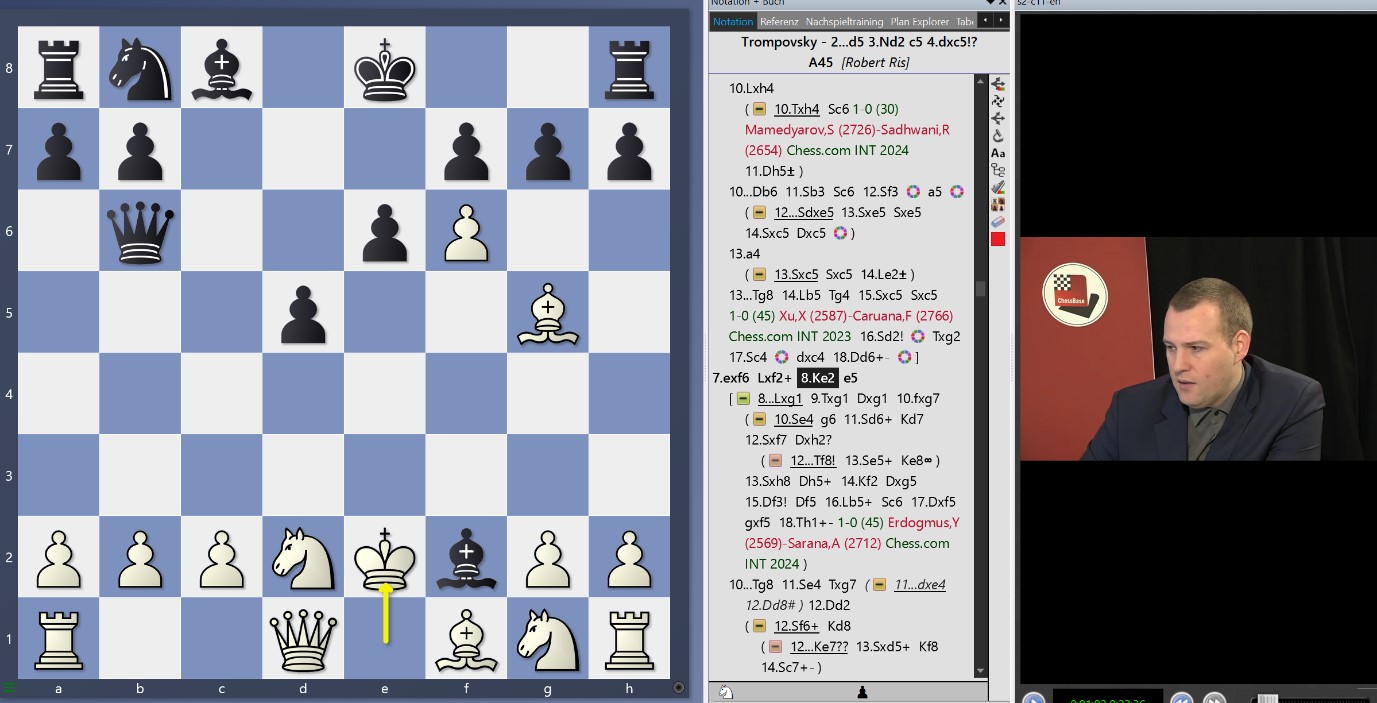
What a mess of pieces! Black has several options here. At first it looks like the knight on g1 is simply hanging, but then comes Rxg1!, distracting the queen, followed by fxg7 and Ne4, after which Black must play very precisely in order not to lose immediately. As you can see, it is worthwhile to study certain variations carefully. Ris also actively encourages practicing especially important positions and training games, so that in practical play you can gain a real advantage.
Free video sample: 1.d4 Nf6 2.Bg5 e6 3.e4 Be7/d5/c5
Another crazy position, which I do not want to withhold from you, arises after the move sequence 1.d4 d5 2.Bg5 f6. This line was long considered one of the best replies to the seemingly nonsensical 2.Bg5—especially after 3.Bh4 Nf7! this proves to be the case. Accordingly, 4.Bf4! is the move to play, after which Black, once again, has to be very precise.
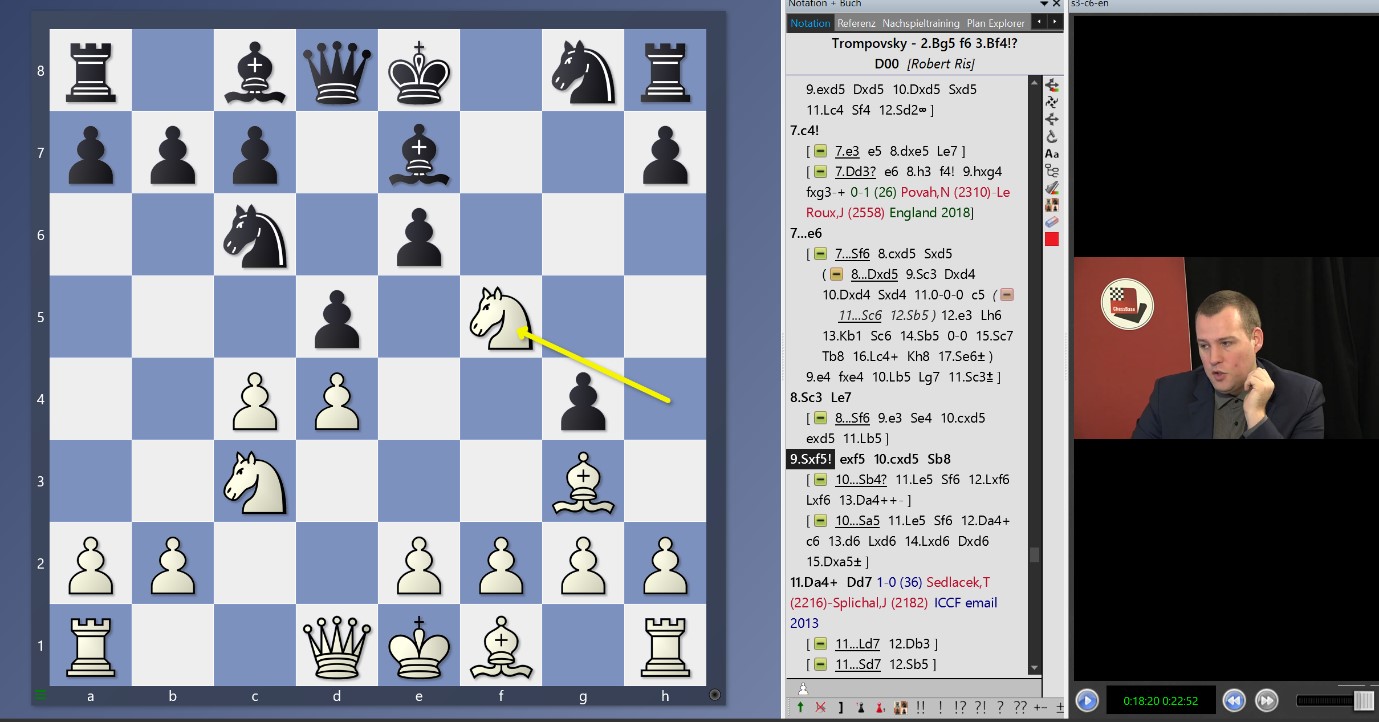
Soon after, this masterpiece of a position arises: White is forced to sacrifice the knight. However, after 9...exf5 10.cxd5 Nb8 he obtains sufficient compensation, since the black king is exposed and Black remains underdeveloped. I think these two positions show well what one can expect from this video course.
What I especially like is that it is a complete repertoire. This means that once you have learned everything, there are no lines left with which Black can sidestep. Even the transpositions to 1.d4 e6 2.e4, i.e. French structures, are covered. This demonstrates the thoroughness and the quality standards that Ris sets for himself and his courses. Against the French as well, he finds solutions for White in the Winawer Variation that guarantee exciting positions.
YOUR EASY ACCESS TO OPENING THEORY: Whether you want to build up a reliable and powerful opening repertoire or find new opening ideas for your existing repertoire, the Opening Encyclopaedia covers the entire opening theory on one product.
My recommendation for this repertoire is aimed at players who already have a solid main repertoire and would like to add some variety and surprise—though with the caution that it does indeed require quite a lot of work. This would also be my only negative point, since an alternative repertoire usually demands less time. However, the files and videos can also be used more as a reference work, because certain variations are played much more frequently than others, allowing you to focus your preparation accordingly.
Of course, there are once again interactive tests that let you check whether you have really learned everything thoroughly. The whole package is rounded off with carefully selected positions that Ris, as mentioned above, has chosen for practical play.
 Robert Ris (1988) is an International Master from The Netherlands, who nowadays is active mainly as an online chess trainer. For ChessBase he has recorded various training DVDs. In his Fast & Furious show on the PlayChess server sharp opening lines are explained sharp for a wider audience. On his personal website http://www.robertris.com you will find out more about his training services.
The free app from ChessBase! ChessBase Mobile has everything you need as a chess player on the go:
access your chess data in cloud databases - and 13 million games.
ChessBase Mobile has everything you need as a chess player on the go:
- Access the ChessBase online database - with more than 13 million games: search for players, positions, openings etc.
- Save your own games and analyses in cloud databases
- Synchronise your personal databases across all your devices
- Analyse your games with the built-in engine
- Live opening book: use the most comprehensive and up-to-date statistics for every opening position
- Access your opening repertoire in the cloud: create and edit your personal opening repertoire
- 300 opening overviews, with repertoire suggestions: get started with new systems!
- Practise opening variations with three modes.
- Advanced notation: add comments, symbols, variations, arrows and markings to your games
- Advanced sharing options: share games and positions via link, image, GIF, FEN or QR code
- PGN compatibility: upload and download games or databases as PGN files




.jpeg)