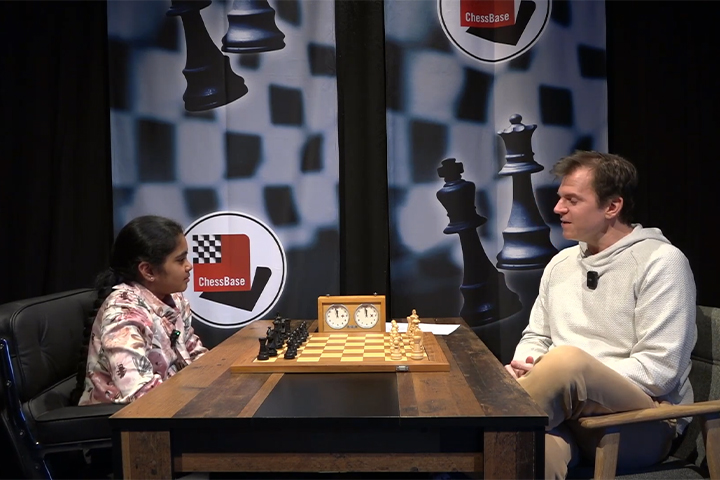
4/10/2026 – Bodhana Sivanandan comes across as an exceptionally calm, self-driven young talent whose love for chess seems to grow naturally from curiosity, beauty, and enjoyment rather than pressure or ego. In the interview, she talks about her admiration for Capablanca, her instinctive feel for endgames, and her practical approach to improvement, often learning simply by playing, spotting mistakes, and correcting them for next time. She also reflects with striking maturity on losses, fame, expectations, and long-term goals, showing that she prefers to focus on steady progress instead of forcing milestones or assumptions about the future. Overall, the conversation paints a picture of a rare chess prodigy who is already highly accomplished, yet remains grounded, thoughtful, and fully focused on becoming the best player she can be.
new: Fritz 20
Your personal chess trainer. Your toughest opponent. Your strongest ally. FRITZ 20 is more than just a chess engine – it is a training revolution for ambitious players and professionals. Whether you are taking your first steps into the world of serious chess training, or already playing at tournament level, FRITZ 20 will help you train more efficiently, intelligently and individually than ever before.
EXPAND YOUR CHESS HORIZONS Data, plans, practice – the new Opening Report In ChessBase there are always attempts to show the typical plans of an opening variation. In the age of engines, chess is much more concrete than previously thought. But amateurs in particular love openings with clear plans, see the London System. In ChessBase ’26, three functions deal with the display of plans. The new opening report examines which piece moves or pawn advances are significant for each important variation. In the reference search you can now see on the board where the pieces usually go. If you start the new Monte Carlo analysis, the board also shows the most common figure paths.
Even more power forFritz. Even more Chess knowledge for you.
€89.90
Bodhana Sivanandan Interview
Endgames, Mindset & Rapid Rise
In an interview with ChessBase, Arne Kaehler meets one of the most exciting young talents in world chess, Bodhana Sivanandan, whose rapid rise and calm mindset stand out just as much as her results. She speaks about her early fascination with the game, her admiration for José Raúl Capablanca, and how studying classical games helped her appreciate creativity beyond engine evaluations.
Despite comparisons to legends like Anatoly Karpov, Bodhana remains grounded, explaining that much of her improvement comes naturally through playing, recognizing mistakes, and learning from them rather than following rigid training structures.
What makes her particularly remarkable is her composure: she treats losses as learning opportunities, does not overthink time management, and approaches her ambitious goal of becoming the best player in the world with a surprisingly relaxed attitude.
She also reflects on key milestones, including her win against Peter Wells, which she achieved without even realizing its significance at the time. Inspired by role models like Judit Polgár, Bodhana is driven not by pressure, but by pure enjoyment of the game.
Overall, the interview reveals a rare combination of talent, intuition, and emotional balance—qualities that suggest Bodhana Sivanandan is not only one of England’s brightest prospects, but a player with the potential to shape the future of chess.
EXPAND YOUR CHESS HORIZONS Data, plans, practice – the new Opening Report In ChessBase there are always attempts to show the typical plans of an opening variation. In the age of engines, chess is much more concrete than previously thought. But amateurs in particular love openings with clear plans, see the London System. In ChessBase ’26, three functions deal with the display of plans. The new opening report examines which piece moves or pawn advances are significant for each important variation. In the reference search you can now see on the board where the pieces usually go. If you start the new Monte Carlo analysis, the board also shows the most common figure paths.
Arne KaehlerArne Kaehler, a creative mind who is passionate about board games in general, was born in Hamburg and learned to play chess at a young age. By teaching chess to youth teams and creating chess-related videos on YouTube, Arne was able to expand this passion and has even created an online course for anyone who wants to learn how to play chess. Arne writes for the English and German news sites, but focuses mainly on content for the ChessBase media channels.
3/12/2026 – A sustained run of strong tournament results has enabled Bodhana Sivanandan to secure the FIDE Master title after she crossed the 2300 rating threshold for the first time. The British prodigy, who recently turned 11, gained more than 200 rating points across appearances in the 4NCL, Graz Open and Cannes Chess Festival, consistently holding her own against titled opposition. | Photo: FIDE / Michal Walusza
2/19/2026 – By coincidence, ChessBase conducted an interview with Loek van Wely just a day after the passing of Jan Timman. Their Dutch rivalry at the board defined an era, yet beyond the battles they also shared memorable moments, such as representing their country together at the 1992 Olympiad in Manila. Although Van Wely’s peak years are behind him, he has remarkably maintained a 2600+ level and remains fiercely competitive. In the interview, he reveals how he sustains his strength, and reflects on politics, poker, and his work as a coach.
On this 60 mins video we are going to concentrate on a simple, very solid idea in the main line Scandinavian, which even Magnus Carlsen has used to win games. Black focusses on making his life easy in the opening and forces White to work very hard to get advantage – but it is doubtful if White can get an advantage. Club players are always on the lookout for effective, time-saving solutions and here we have just that. Accompany FIDE Senior Trainer and IM Andrew Martin on this 60 mins video. You can learn a new opening system in 60 mins and start to play it with confidence on the very same day!
You will learn how Black's dynamic piece activity and structural counterplay more than compensate for White's extra tempo in the colour-reversed setups.
In this course, you’ll learn how to take the initiative against the London and prevent White from comfortably playing their usual system by playing 1.d4 Nf6 2.Bf4 Nh5.
London System Powerbase 2026 is a database and contains in all 11 285 games from Mega 2026 and the Correspondence Database 2026, of which 282 are annotated.
The London System Powerbook 2026 is based on more than 410 000 games or game fragments from different opening moves and ECO codes; what they all have in common is that White plays d4 and Bf4 but does not play c4.
In this course, Grandmaster Elisabeth Pähtz presents the London System, a structured and ambitious approach based on the immediate Bf4, leading to rich and dynamic positions.
Opening videos: Open Spanish (Sipke Ernst) and Classical Sicilian (Nico Zwirs). Endgame Special by Igor Stohl: ‘Short or long side’ – where should the defending king be placed in rook endgames? ‘Lucky bag’ with 35 master analyses.
YOUR EASY ACCESS TO OPENING THEORY: Whether you want to build up a reliable and powerful opening repertoire or find new opening ideas for your existing repertoire, the Opening Encyclopaedia covers the entire opening theory on one product.
€169.90
We use cookies and comparable technologies to provide certain functions, to improve the user experience and to offer interest-oriented content. Depending on their intended use, analysis cookies and marketing cookies may be used in addition to technically required cookies. Here you can make detailed settings or revoke your consent (if necessary partially) with effect for the future. Further information can be found in our data protection declaration.
Pop-up for detailed settings
We use cookies and comparable technologies to provide certain functions, to improve the user experience and to offer interest-oriented content. Depending on their intended use, cookies may be used in addition to technically required cookies, analysis cookies and marketing cookies. You can decide which cookies to use by selecting the appropriate options below. Please note that your selection may affect the functionality of the service. Further information can be found in our privacy policy.
Technically required cookies
Technically required cookies: so that you can navigate and use the basic functions and store preferences.
Analysis Cookies
To help us determine how visitors interact with our website to improve the user experience.
Marketing-Cookies
To help us offer and evaluate relevant content and interesting and appropriate advertisement.