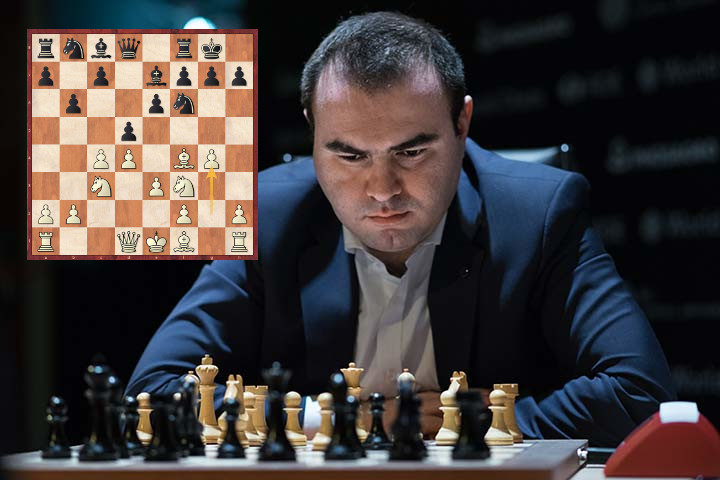

8/21/2022 – Pushing the g-pawn early in the game has become so common that when GM Jon Speelman watches Shakhriyar Mamedyarov play, he feels tempted to bet with himself when ‘the bayonet’ will be deployed. This week’s thematic column features a couple of classics (by Paul Keres and Alexei Shirov), an example from Mamedyarov’s practice and a remarkable win by Richard Pert from the British Championship. | Photo: Niki Riga
new: Fritz 20
Your personal chess trainer. Your toughest opponent. Your strongest ally. FRITZ 20 is more than just a chess engine – it is a training revolution for ambitious players and professionals. Whether you are taking your first steps into the world of serious chess training, or already playing at tournament level, FRITZ 20 will help you train more efficiently, intelligently and individually than ever before.
In this two-volume course GM Ganguly turns calculation into a trainable skill with a structured path for any level.
€39.90
Pushing the knight’s pawn
[Note that Jon Speelman also looks at the content of the article in video format, here embedded at the end of the article.]
When I was getting established as a chess player all those years ago, I became known for pushing my rook’s pawns more than other people. This was probably partly an homage to Bent Larsen, whose best-games book I read and reread as a kid — but I also just liked it. Decades later, when our lord and master AlphaZero espoused this with such enthusiasm and artistry I was delighted.
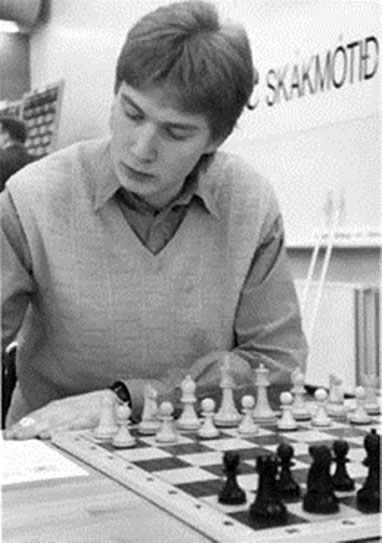
The other big push of the knight’s pawn was much less common in my own games and in general. Of course, it was common in the Yugoslav Attack against the Dragon, and there was the Benko Gambit — well away from both kings. But an early g2-g4 was extremely rare until Paul Keres introduced it against the Sicilian Scheveningen, and then decades later Alexei Shirov [pictured], after working with Alex Shabalov, launched it against the Semi-Slav.
Today it’s become so common that when I watch Shakhriyar Mamedyarov play, I’m almost tempted to bet with myself when the bayonet will be deployed. It features in lines of the Queen’s Gambit Declined and in some English/Reti types of position. And against the Sicilian, they nowadays sometimes play g4 before a black knight has even considered grazing the pastures on f6.
In the games analysed below, I’m looking at a selection of games with an early g2-g4, and I finish with an example from the British Championship of Black playing 3...g7-g5: an idea which totally discombobulated his opponent.
We begin with the stem game of the Keres Attack against the Scheveningen, followed by the stem game of g4 against the Semi-Slav. I had to have at least one example by Mamedyarov and have added one, albeit just a blitz game. To finish, Richard Pert’s game from the British.
Select an entry from the list to switch between games

There are few names which, like that of Alexei Shirov, can be associated with fantastically imaginative and tactically influenced play. Now the Latvian grandmaster is presenting a DVD on precisely that element of the game of chess. And one that is completely based on his own games.
Jonathan SpeelmanJonathan Speelman, born in 1956, studied mathematics but became a professional chess player in 1977. He was a member of the English Olympic team from 1980–2006 and three times British Champion. He played twice in Candidates Tournaments, reaching the semi-final in 1989. He twice seconded a World Championship challenger: Nigel Short and then Viswanathan Anand against Garry Kasparov in London 1993 and New York 1995.
London System Powerbase 2026 is a database and contains in all 11 285 games from Mega 2026 and the Correspondence Database 2026, of which 282 are annotated.
The London System Powerbook 2026 is based on more than 410 000 games or game fragments from different opening moves and ECO codes; what they all have in common is that White plays d4 and Bf4 but does not play c4.
In this course, Grandmaster Elisabeth Pähtz presents the London System, a structured and ambitious approach based on the immediate Bf4, leading to rich and dynamic positions.
Opening videos: Open Spanish (Sipke Ernst) and Classical Sicilian (Nico Zwirs). Endgame Special by Igor Stohl: ‘Short or long side’ – where should the defending king be placed in rook endgames? ‘Lucky bag’ with 35 master analyses.
YOUR EASY ACCESS TO OPENING THEORY: Whether you want to build up a reliable and powerful opening repertoire or find new opening ideas for your existing repertoire, the Opening Encyclopaedia covers the entire opening theory on one product.
The Queen’s Gambit Declined Exchange Variation with 5.Bf4 has a great balance between positional play and sharp pawn pushes; and will be a surprise for your opponents while being easy to learn for you, as the key patterns are familiar.
€9.90
We use cookies and comparable technologies to provide certain functions, to improve the user experience and to offer interest-oriented content. Depending on their intended use, analysis cookies and marketing cookies may be used in addition to technically required cookies. Here you can make detailed settings or revoke your consent (if necessary partially) with effect for the future. Further information can be found in our data protection declaration.
Pop-up for detailed settings
We use cookies and comparable technologies to provide certain functions, to improve the user experience and to offer interest-oriented content. Depending on their intended use, cookies may be used in addition to technically required cookies, analysis cookies and marketing cookies. You can decide which cookies to use by selecting the appropriate options below. Please note that your selection may affect the functionality of the service. Further information can be found in our privacy policy.
Technically required cookies
Technically required cookies: so that you can navigate and use the basic functions and store preferences.
Analysis Cookies
To help us determine how visitors interact with our website to improve the user experience.
Marketing-Cookies
To help us offer and evaluate relevant content and interesting and appropriate advertisement.