The Nimzo-Indian Defence (1.d4 Nf6 2.c4 e6 3.Nc3 Bb4) is considered such a powerful weapon that White players have always been trying to find ways to avoid it. This has led, especially thanks to World Champion Kramnik, to a flood of Catalans and Queen’s Indians that put Black under considerable pressure.
This DVD allows you to learn from the example of one of the best players in the history of chess and from the explanations of the authors (Pelletier, Marin, Müller and Reeh) how to successfully organise your games strategically, consequently how to keep y
It was therefore only natural that Black players began searching for an equally flexible defence against 3.Nf3, aiming to demonstrate that “Black is okay.”
As a result, the Orthodox Queen’s Gambit, in its modern form, returned to practice more prominently. In particular, the characteristic Ragozin move 4...Bb4, with its typically Nimzo-Indian flavour, once again became a central focus of opening theory among strong and elite players.
If you're looking to expand your opening knowledge with a modern, cutting-edge approach, the Ragozin Carlsbad is a must-have addition to your repertoire.
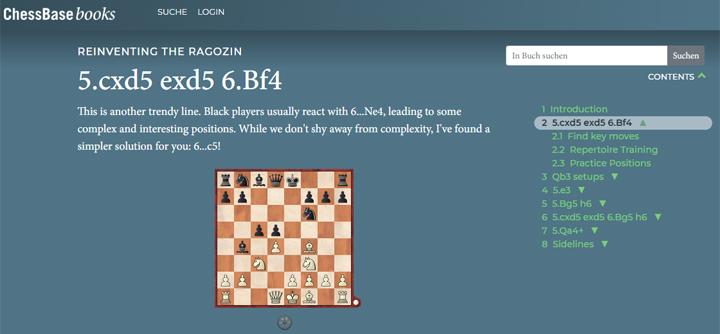
If you think you know the Carlsbad structure, think again! The Ragozin Carlsbad introduces a fresh and dynamic approach, where Black delays …c6, keeping the c7-pawn flexible and allowing for a quicker …c5 break. This variation adds complexity and sharpness, making it an excellent choice for ambitious players.
Free Video Sample: Introduction
Free Video Sample: 6.Qa4 and 6.Nf3
Why Play the Ragozin Carlsbad?
✅ Faster …c5 Break – Black skips the typical …c6 move and can strike in the center more efficiently.
✅ Kingside Pawn Storm – Plans with …h6, Bh4, and g5 lead to aggressive, unbalanced positions.
✅ Proven at the Highest Level – Ian Nepomniachtchi chose this line in a must-win game against Caruana in the Candidates Tournament.
✅ Flexible Structures – White can opt for slower setups, but Black can transition into a better version of the classic Carlsbad.
Who Should Play This?
🔹 Carlsbad Structure Enthusiasts – Add variety and new attacking options to your repertoire.
🔹 Players Seeking Complexity – If you enjoy sharp, rich middlegame battles, this is for you.
🔹 Anyone Looking for a Solid yet Aggressive Repertoire – Mix positional understanding with dynamic play!
If you're looking to expand your opening knowledge with a modern, cutting-edge approach, the Ragozin Carlsbad is a must-have addition to your repertoire. Start outplaying your opponents today!
Free video sample: Introduction
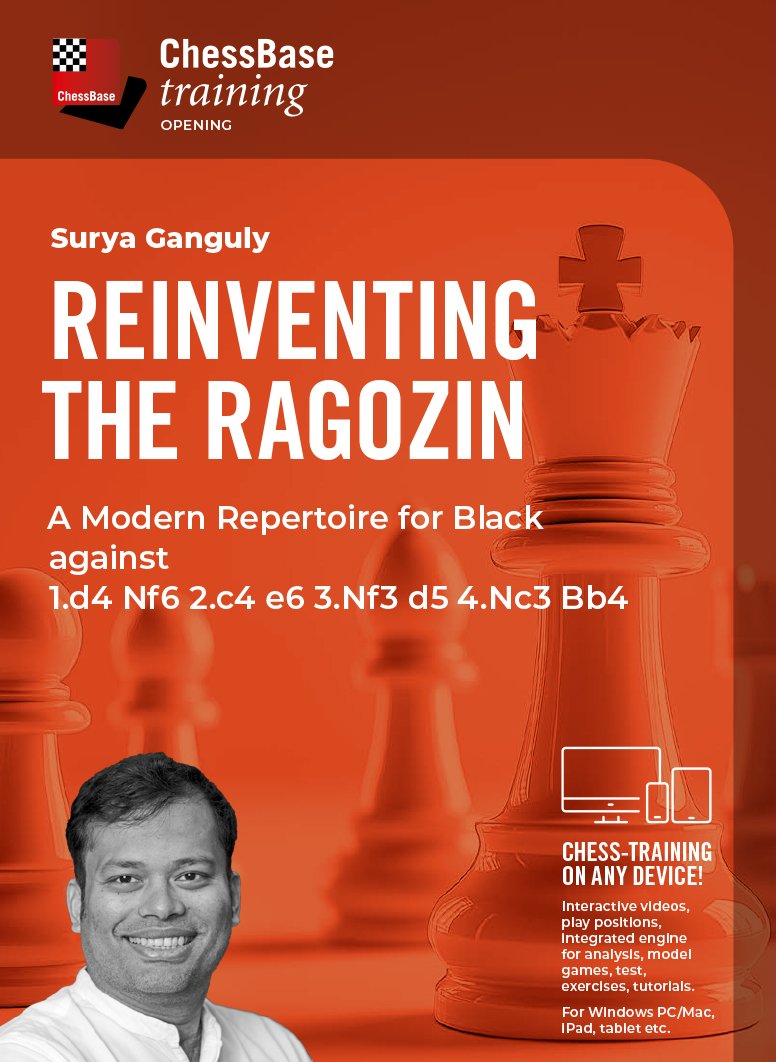
The new Fritztrainer “Reinventing the Ragozin” by the popular Indian grandmaster Surya Ganguly presents an interesting opening repertoire for Black based on the Ragozin move order 1.d4 Nf6 2.c4 e6 3.Nf3 d5 4.Nc3 Bb4. The table of contents covers all the key variations: the modern 5.cxd5 exd5 6.Bf4, setups with Qb3 or with e3, lines with an early Bg5 — with or without the inclusion of cxd5 followed by exd5 or Qa4+ — and of course the critical 5.Qa4+.
Free video sample: 5.cxd5 exd5 6.Bf4
GM Surya Ganguly, whose peak rating was 2676, is among India’s most successful chess players and won the national championship six times in a row (2003–2008). He represented India in six Chess Olympiads and twice claimed individual gold at the World Team Championships (2010 and 2019). Ganguly was also part of Viswanathan Anand’s team of seconds during his World Championship victories over Kramnik, Topalov, and Gelfand, and he received the Arjuna Award, one of India’s highest sporting honours, for his achievements. In short, few are as qualified as Ganguly, who has a clear and highly instructive pedagogical style.
This DVD allows you to learn from the example of one of the best players in the history of chess and from the explanations of the authors how to successfully organise your games strategically, and how to keep your opponent permanently under pressure.
Using a key Ragozin variation, I would like to illustrate why Ganguly’s approach appealed to me so much — and why even players already familiar with the Ragozin will find plenty of new material in this Fritztrainer. Grandmaster Ganguly, to borrow from Frank Sinatra, does it his way — which in this case leads to a particularly individualised choice of lines.
Let us look at one of the critical main variations after 1.d4 Nf6 2.c4 e6 3.Nf3 d5 4.Nc3 Bb4, namely 5.Qa4+. This forces the reply 5...Nc6 and makes the central thrust ...c5 impossible for a long time. 5.Qa4+ is considered a critical line and has been recommended to White by a number of opening theoreticians.
At this point, 6.e3, 6.Bg5 and 6.a3 are regarded as the main continuations. Taking the last one as an example: after 6...Bxc3+ 7.bxc3, the Indian grandmaster recommends the relatively new move 7...O-O!? and immediately explains what he thinks of the more common 7...Ne4.
"How is this position in times of Computer? Zero point zero zero.
Can we Play this? Obviously, yes, we can play this.
Are we playing this? No, we are not playing this."
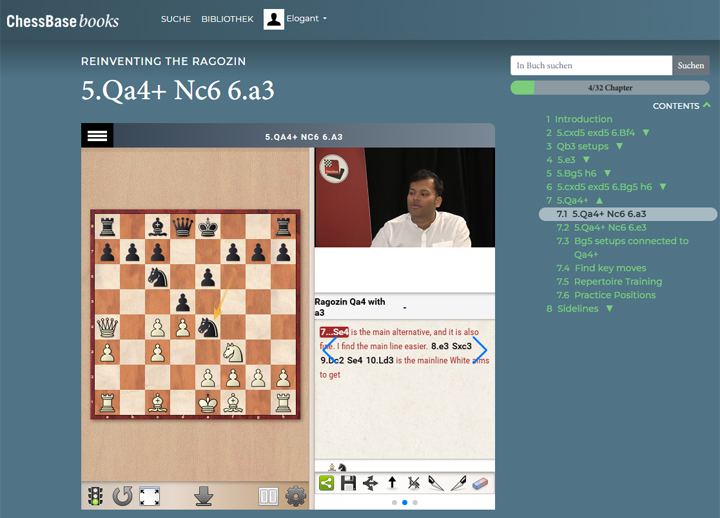
At this point he smiles knowingly into the camera before explaining why he opted for 7...O-O. Simply delightful!
Elsewhere, he once again presents a move order that deviates from standard theory and describes his aim of finding new wine in old bottles — his “system,” as he calls it — as follows:
"How am I finding something fresh?" – "We are checking differently. We are fine-tuning our move-order and making it unique and special in our own way."
The nearly five hours of video content pass by quickly. For those who want to engage more deeply, the new variations can easily be integrated into one’s own opening repertoire and stored in ChessBase or the Opening WebApp. Naturally, the repertoire can also be trained and key moves identified — with the interactive tests providing corresponding video feedback and further explanations.
The free app from ChessBase! ChessBase Mobile has everything you need as a chess player on the go:
access your chess data in cloud databases - and 13 million games.
ChessBase Mobile has everything you need as a chess player on the go:
- Access the ChessBase online database - with more than 13 million games: search for players, positions, openings etc.
- Save your own games and analyses in cloud databases
- Synchronise your personal databases across all your devices
- Analyse your games with the built-in engine
- Live opening book: use the most comprehensive and up-to-date statistics for every opening position
- Access your opening repertoire in the cloud: create and edit your personal opening repertoire
- 300 opening overviews, with repertoire suggestions: get started with new systems!
- Practise opening variations with three modes.
- Advanced notation: add comments, symbols, variations, arrows and markings to your games
- Advanced sharing options: share games and positions via link, image, GIF, FEN or QR code
- PGN compatibility: upload and download games or databases as PGN files
Conclusion
The training sessions with GM Ganguly are enjoyable. Like a good friend from the chess club — just with far more Elo — Ganguly shares his discoveries and insights with the viewer, creating the impression that finding these largely new ideas is completely natural and effortless. Highly recommended.
About Surya Shekhar Ganguly
Surya Shekhar Ganguly is one of the most decorated Grandmasters that India has produced. His best achievements include winning the National Championship a record six consecutive times from 2003 to 2008, the Asian Continental Championship in 2009, and such monumental open events as the Fujairah International Open in 2012 and the Belt and Road Open in 2019. He has also represented India in as many as six Olympiads and clinched individual golds at the World Teams Championship twice, in 2010 and 2019. Moreover, he has worked in the team of seconds that assisted Vishy Anand to victory in three World Championship Matches, against Kramnik, Topalov, and Gelfand, in 2008, 2010, and 2012, respectively.
Surya Shekar Ganguly in the ChessBase shop...




.jpeg)