The game will go down in history as one of the great queen sacrifices, and fans were given an absolute treat. Let’s skip straight away to the key points, always enjoyable to see again and remember.
Above is the position after 18…e5 and both players had been playing fairly quickly, which led one to understand that both had seen this position and line in their preparation. White played here the beautiful queen sacrifice 19.Qxf6!! Here is where it makes sense to see what the engines saw since no one would enter this position nowadays at such a high level in the opening without having studied it thoroughly. All engines see the queen sacrifice almost instantly, but the main line they display involves recovering the queen with a roughly equal position. After the more or less forced 19… Bxf6 20.Nd5 Qd8 we reach the next key crossroads.
Presuming no one is privy to exceptional hardware such as 16 cores or more, a look at Stockfish 8 or Houdini 5 for at least three minutes on a good quad-core (an Intel i5 at 4 x 3.0GHz for the purposes of this article) will show a roughly equal evaluation with the main line 21.Nc6 (the black queen is trapped) 21…Bxg4 22.Nxd8 Bxd8.
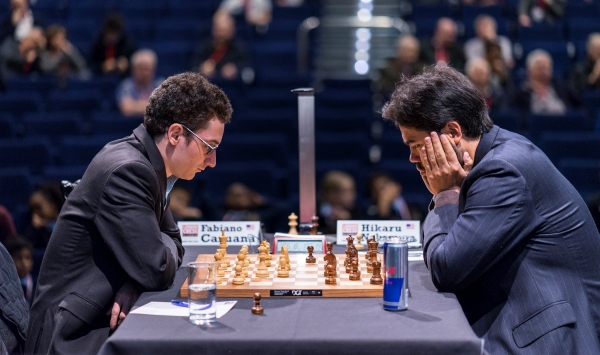
Caruana's sparkling win over Nakamura was the highlight of the London Classic (photo by Lennart Ootes)
Instead, Caruana uncorked 21.Nf5!!, leaving the material imbalance on the board with White down a queen for two pieces. Thus when Polish grandmaster Krasenkow commented in his Round Six analysis that engines struggle with such positions, and that it could only be the result of human ingenuity and intuition, it was no doubt after seeing no engine coming up with it in a reasonable time.
"I must say that such "real" queen sacrifices are an Achilles' heel of analytic engines. They almost always evaluate positions with, say, two minor pieces for a queen in favour of the strongest piece, while in reality, in human play, there may be a more than sufficient compensation for the material. Therefore such positions should be analysed and evaluated "manually", and kudos to Caruana and his team for doing that!"
There seems little doubt this is what happened to Nakamura and his second(s), who used an engine, but did not insist after seeing nothing after a few minutes. How long would they take on a normal quad-core?

Stockfish 8, a top free engine, using 2GB hash tables, takes around eight full minutes. So the user would need to wait a full eight minutes before the engine announced it had made a breakthrough.
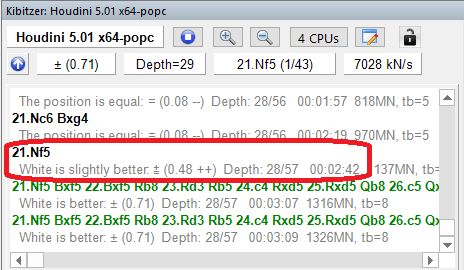
The new member of the family of elites, Houdini 5, takes about half that time, and finds it in 2 minute 47 seconds. By no means is this to suggest Houdini 5 will always outdo its rival by a factor of three, since solving a position varies enormously from one to the next. The point is that it too takes nearly several minutes to find Caruana's 21.Nf5
Still, readers may recall an article that was posted a few days ago describing the special Tactical Mode in Houdini 5. An option in the engine that turns it into a single-minded combination seeker, a bit like the late great Tal, hell bent on trying to find a tactical shot.
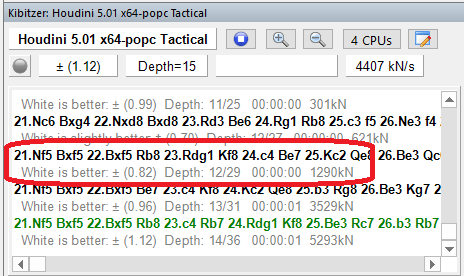
When Houdini 5’s Tactical Mode is enabled it finds Caruana’s 21.Nf5!! In exactly… zero seconds! Not only that, but it finds the full winning continuation, and displays a large plus score for White.

So what if you analyzed the position before the queen sacrifice? How long would it take to see 21…Nf5 in its main line? Meaning how long would it take to see the complete winning sequence from 19.Qxf6 until 21…Nf5? The answer is two seconds!
Once more, this emphasizes the usefulness of the Tactical Mode in Houdini 5 as a special tool to help analyze just such chaotic positions, helping avoid fatal oversights.
Live Book
It should be mentioned that Priyadarshan Banjan, editor of ChessBase India, correctly pointed out in his article on Round Six that as soon as one had opened an engine in ChessBase 13 or 14, one would also see the top three engine analyses from others in the Live Book. Your engine might have only analyzed a second and seen nothing of note, but others might have already seen this in great depth, and that analysis is immediately available.

As you can see above, Houdini 5 (normal mode) has only been running for a few of seconds, but on the right are analyses of Stockfish 8 at a depth of 60 plies (!!). The brown colored lettering means it was analyzed for the equivalent of 60 minutes on an i7 processor. No matter what you are analyzing, never forget to consult the Live Book as it is quite possible someone has already analyzed your position to great depths, saving you the time of doing it yourself.
You can purchase Houdini 5 in the ChessBase Shop