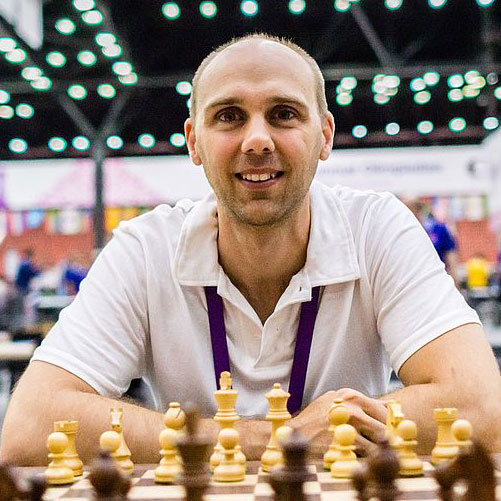
David Smerdon is an Australian chess grandmaster and economist. He is the second highest ranked chess player of Australia. Smerdon has played for the Australian team in the Chess Olympiad since 2004. He is now a lecturer at the University of Queensland, with areas of research in Applied Economics; Economic Development and Growth; Experimental, Behavioural, and Evolutionary Methods.
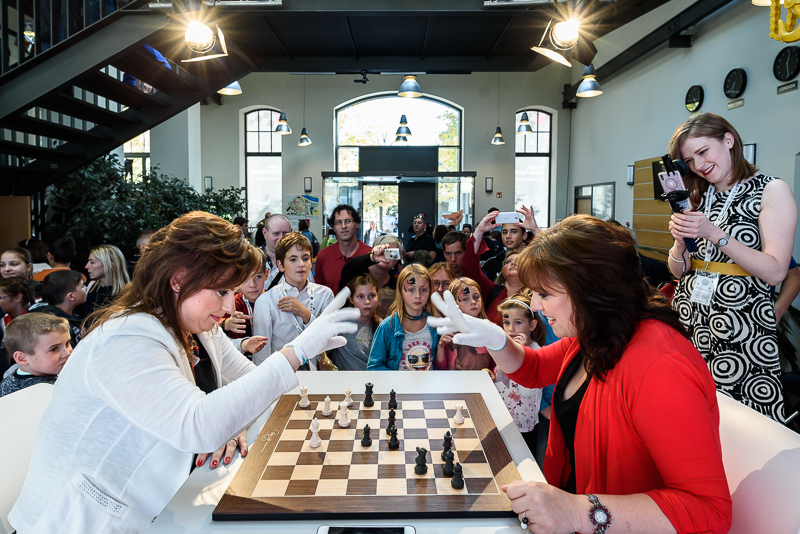
5/4/2019 – Australian Grandmaster and Ph.D. in Economics DAVID SMERDON recently published a thorough analysis regarding how female participation rates differ across the world. The results are surprising: countries that rank higher in gender equality do not have a higher rate of female participation — quite the opposite, actually! The author suggests some hypotheses to explain this phenomenon. A must read. | Pictured: Judit and Sofia Polgar in 2017. | Photo: Alina l'Ami
8/21/2018 – Australian Grandmaster DAVID SMERDON is semi-retired from chess after getting married, returning to his hometown of Brisbane to take up a professorship in the School of Economics at the University of Queensland. He still blogs occasionally and recently published a fascinating two-part story about a trip to Kenya, which we bring you with kind permission of the author. | Pictured: Chess players from Alliance Girls’ High School, Nairobi, who sometimes play against their brother school, and they enjoy playing — and beating — the boys. | Photos: DavidSmerdon.com
12/22/2017 – Other chess reviewers have been at best dismissal and at worst harshly critical of The Secret of Chess, by Lyudmil Tsvetkov. However, according to GM David Smerdon, this book is a one of a kind work that legitimately has the potential to revolutionise how we think about chess. | Photo: Smerdon at the Tromsø Chess Olympiad, by Andreas Kontokanis CC BY-SA 2.0 via Wikimedia Commons
In this course, you’ll learn how to take the initiative against the London and prevent White from comfortably playing their usual system by playing 1.d4 Nf6 2.Bf4 Nh5.
London System Powerbase 2026 is a database and contains in all 11 285 games from Mega 2026 and the Correspondence Database 2026, of which 282 are annotated.
The London System Powerbook 2026 is based on more than 410 000 games or game fragments from different opening moves and ECO codes; what they all have in common is that White plays d4 and Bf4 but does not play c4.
In this course, Grandmaster Elisabeth Pähtz presents the London System, a structured and ambitious approach based on the immediate Bf4, leading to rich and dynamic positions.
Opening videos: Open Spanish (Sipke Ernst) and Classical Sicilian (Nico Zwirs). Endgame Special by Igor Stohl: ‘Short or long side’ – where should the defending king be placed in rook endgames? ‘Lucky bag’ with 35 master analyses.
YOUR EASY ACCESS TO OPENING THEORY: Whether you want to build up a reliable and powerful opening repertoire or find new opening ideas for your existing repertoire, the Opening Encyclopaedia covers the entire opening theory on one product.
In this course, you’ll learn how to take the initiative against the London and prevent White from comfortably playing their usual system by playing 1.d4 Nf6 2.Bf4 Nh5.
London System Powerbase 2026 is a database and contains in all 11 285 games from Mega 2026 and the Correspondence Database 2026, of which 282 are annotated.
The London System Powerbook 2026 is based on more than 410 000 games or game fragments from different opening moves and ECO codes; what they all have in common is that White plays d4 and Bf4 but does not play c4.
In this course, Grandmaster Elisabeth Pähtz presents the London System, a structured and ambitious approach based on the immediate Bf4, leading to rich and dynamic positions.
Opening videos: Open Spanish (Sipke Ernst) and Classical Sicilian (Nico Zwirs). Endgame Special by Igor Stohl: ‘Short or long side’ – where should the defending king be placed in rook endgames? ‘Lucky bag’ with 35 master analyses.
YOUR EASY ACCESS TO OPENING THEORY: Whether you want to build up a reliable and powerful opening repertoire or find new opening ideas for your existing repertoire, the Opening Encyclopaedia covers the entire opening theory on one product.
€169.90
We use cookies and comparable technologies to provide certain functions, to improve the user experience and to offer interest-oriented content. Depending on their intended use, analysis cookies and marketing cookies may be used in addition to technically required cookies. Here you can make detailed settings or revoke your consent (if necessary partially) with effect for the future. Further information can be found in our data protection declaration.
Pop-up for detailed settings
We use cookies and comparable technologies to provide certain functions, to improve the user experience and to offer interest-oriented content. Depending on their intended use, cookies may be used in addition to technically required cookies, analysis cookies and marketing cookies. You can decide which cookies to use by selecting the appropriate options below. Please note that your selection may affect the functionality of the service. Further information can be found in our privacy policy.
Technically required cookies
Technically required cookies: so that you can navigate and use the basic functions and store preferences.
Analysis Cookies
To help us determine how visitors interact with our website to improve the user experience.
Marketing-Cookies
To help us offer and evaluate relevant content and interesting and appropriate advertisement.