2/5/2026 – The Löwenthal Variation of the Sicilian Defence is often treated with caution in theoretical discussions. Yet detailed investigation by Nico Zwirs suggests the line holds more practical value than its reputation implies. By combining enterprising attacking setups with more measured, positionally sound alternatives, the repertoire aims to offer Black flexible, workable positions while steering play away from the heavily analysed Sicilian main lines.
new: ChessBase Magazine 225
Chess Festival Prague 2025 with analyses by Aravindh, Giri, Gurel, Navara and others. ‘Special’: 27 highly entertaining miniatures. Opening videos by Werle, King and Ris. 10 opening articles with new repertoire ideas and much more. ChessBase Magazine offers first-class training material for club players and professionals! World-class players analyse their brilliant games and explain the ideas behind the moves. Opening specialists present the latest trends in opening theory and exciting ideas for your repertoire. Master trainers in tactics, strategy and endgames show you the tricks and techniques you need to be a successful tournament player! Available as a direct download (incl. booklet as pdf file) or booklet with download key by post. Included in delivery: ChessBase Magazine #225 as “ChessBase Book” for iPad, tablet, Mac etc.!
YOUR PERSONAL CHESS COACH - Whether you’re taking your first steps into the world of club chess, or already playing at a tournament level: with FRITZ, you can train more efficiently, intelligently and with a more personalised approach than ever before. FRITZ is more than just a chess engine – it’s a training revolution! Whether you’re taking your first steps into the world of club chess, or already playing at a tournament level: with FRITZ, you can train more efficiently, intelligently and with a more personalised approach than ever before.
The Sicilian Defence has long been the fighting player's answer to 1.e4, prized for imbalance, counterplay and winning chances with the black pieces. Yet its most famous branches - from the Najdorf, the Sveshnikov and the Dragon, among others - are also among the most heavily analysed areas of opening theory, often demanding extensive memorisation. Against this backdrop, lesser-known systems can offer a practical alternative, combining sound ideas with surprise value.
One such line is the Löwenthal Variation, arising after 1.e4 c5 2.Nf3 Nc6 3.d4 cxd4 4.Nxd4 e5 5.Nb5 a6.
Traditionally viewed with some suspicion because of the structural concessions Black makes, it has nevertheless continued to attract independent thinkers. Rather than accepting long-standing verdicts at face value, Dutch IM Nico Zwirs set out to examine the variation in depth, testing its foundations and practical potential.
The result is a repertoire built on flexibility. The course does not present a single, rigid path, but two complementary approaches:
Sharp, enterprising continuations designed to seize the initiative early
More restrained lines that prioritise structure and long-term play while remaining active
This dual framework allows players to adapt their choice to the opponent, the tournament situation or simply their own mood at the board.
A section of this course can be previewed for free. Find below a few snippets to see if you want to become a Löwenthal specialist!
Whether you’re looking for thrilling attacks, or steady positional play, the Löwenthal Variation has more to offer than meets the eye. The Löwenthal Variation (1.e4 c5 2.Nf3 Nc6 3.d4 cxd4 4.Nxd4 e5 5.Nb5 a6!?) has long had a dubious reputation – but is it really so unsound? After delving deep into theory to refute the opening, Nico Zwirs uncovered fascinating ideas that made him rethink everything. Now, he's ready to share his findings, and arm you with a complete Löwenthal repertoire.
What makes this course special? Flexibility and unpredictability! Zwirs provides you with two distinct approaches:
Highly aggressive, razor-sharp lines to surprise and overwhelm your opponents. Solid, safer alternatives for those games where you want reliable positions without compromising activity.This dual approach allows you to mix up your play, keep your opponents guessing, and choose the style that suits your mood or game situation.
Whether you’re looking for thrilling attacks, or steady positional play, the Löwenthal Variation has more to offer than meets the eye. With Nico Zwirs as your guide, you’ll master this versatile weapon and make it a dangerous addition to your repertoire.
Ready to redefine the Löwenthal? Start now and dominate your games!
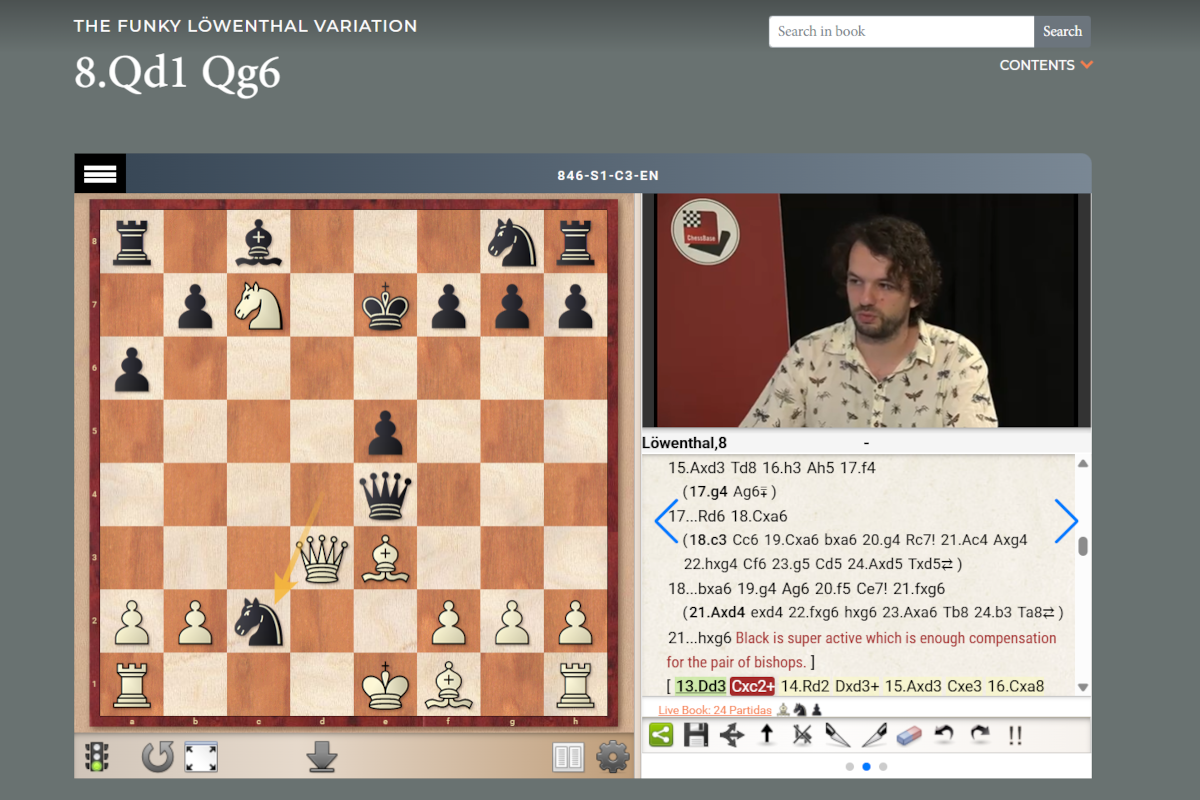
Video sample: 8.Qd1 Qg6
The line with 8.Qd1 Qg6
Returning with the queen to d1 after Black plays 7...Qf6 is the main line of the Löwenthal. The main line then continues with 8.Qd1 Qg6
This position was seen, for example, in round 11 of the 1962 Candidates Tournament in Curaçao, as Bobby Fischer defeated Mikhail Tal from the white side. In 2005, Paco Vallejo defeated Vladimir Kramnik (during his prime) playing black at the blindfold section of the Amber Tournament.
Nico Zwirs here starts to explore the many alternatives arising from this position. Many of the lines involve White giving a check from c7 with his knight, when Black must respond with ...Ke8-e7. As explained by Zwirs, even when White captures the rook on a8, Black should not hurry to grab material, but focus on gaining the initiative!
For example, in the sideline arising from 8.Qd1 Qg6 9.Nc3 d5 10.Nxd5 Nxe4+ 11.Be2 Nd4 12.Nc7+ Ke7 13.f3 Nxc2+...
...and after 14.Kf2 Qc6 15.Nxa8 Qc5+ 16.Kf1...
...Black should not hurry to capture the rook with 16...Nxa1, but play 16...Nf6 instead, focusing on development.
Once we get the feel for the position, demonstrated with clear explanations by Zwirs, we notice that it is these kinds of decisions which justify playing this line. At various points during the opening and early middlegame battles, it is evident that White needs to make tough decisions - and, if he is not deeply prepared to face this line, it is likely that he will go wrong!
Whether you’re looking for thrilling attacks, or steady positional play, the Löwenthal Variation has more to offer than meets the eye. The Löwenthal Variation (1.e4 c5 2.Nf3 Nc6 3.d4 cxd4 4.Nxd4 e5 5.Nb5 a6!?) has long had a dubious reputation – but is it really so unsound? After delving deep into theory to refute the opening, Nico Zwirs uncovered fascinating ideas that made him rethink everything. Now, he's ready to share his findings, and arm you with a complete Löwenthal repertoire.
What makes this course special? Flexibility and unpredictability! Zwirs provides you with two distinct approaches:
Highly aggressive, razor-sharp lines to surprise and overwhelm your opponents. Solid, safer alternatives for those games where you want reliable positions without compromising activity.This dual approach allows you to mix up your play, keep your opponents guessing, and choose the style that suits your mood or game situation.
Whether you’re looking for thrilling attacks, or steady positional play, the Löwenthal Variation has more to offer than meets the eye. With Nico Zwirs as your guide, you’ll master this versatile weapon and make it a dangerous addition to your repertoire.
Ready to redefine the Löwenthal? Start now and dominate your games!
Video sample: 8.Qd1 Qg6
Carlos Alberto ColodroCarlos Colodro is a Hispanic Philologist from Bolivia. He works as a freelance translator and writer since 2012. A lot of his work is done in chess-related texts, as the game is one of his biggest interests, along with literature and music.
YOUR PERSONAL CHESS COACH - Whether you’re taking your first steps into the world of club chess, or already playing at a tournament level: with FRITZ, you can train more efficiently, intelligently and with a more personalised approach than ever before.
If you're looking for a dynamic alternative to the Slav, Queen's Gambit Declined, or other mainstream systems, the Chigorin Defence offers exactly what modern tournament players need.
Michael Kotyk presents a complete repertoire after 1.e4 e5, built around creative ideas, surprising move orders, and practical weapons designed to catch your opponents off guard.
Michael Kotyk presents a complete repertoire after 1.e4 e5, built around creative ideas, surprising move orders, and practical weapons designed to catch your opponents off guard.
Michael Kotyk presents a complete repertoire after 1.e4 e5, built around creative ideas, surprising move orders, and practical weapons designed to catch your opponents off guard.
“Attack with Qh5!!” – Tactical training with Oliver Reeh, “6…g5 – nothing ventured, nothing …” – Le Quang Liem comments on one of his victories in Biel, “Grischuk’s stroke of genius” – Petra Papp reveals a surprise in the Sicilian Kan Variation, and much
YOUR PERSONAL CHESS COACH - Whether you’re taking your first steps into the world of club chess, or already playing at a tournament level: with FRITZ, you can train more efficiently, intelligently and with a more personalised approach than ever before.
While tactics decide the game in concrete moments, strategy guides the entire battle. Understanding how to improve your pieces, create weaknesses, execute maneuvers, and steer the game toward favorable structures is what defines strong players.
€39.90
We use cookies and comparable technologies to provide certain functions, to improve the user experience and to offer interest-oriented content. Depending on their intended use, analysis cookies and marketing cookies may be used in addition to technically required cookies. Here you can make detailed settings or revoke your consent (if necessary partially) with effect for the future. Further information can be found in our data protection declaration.
Pop-up for detailed settings
We use cookies and comparable technologies to provide certain functions, to improve the user experience and to offer interest-oriented content. Depending on their intended use, cookies may be used in addition to technically required cookies, analysis cookies and marketing cookies. You can decide which cookies to use by selecting the appropriate options below. Please note that your selection may affect the functionality of the service. Further information can be found in our privacy policy.
Technically required cookies
Technically required cookies: so that you can navigate and use the basic functions and store preferences.
Analysis Cookies
To help us determine how visitors interact with our website to improve the user experience.
Marketing-Cookies
To help us offer and evaluate relevant content and interesting and appropriate advertisement.