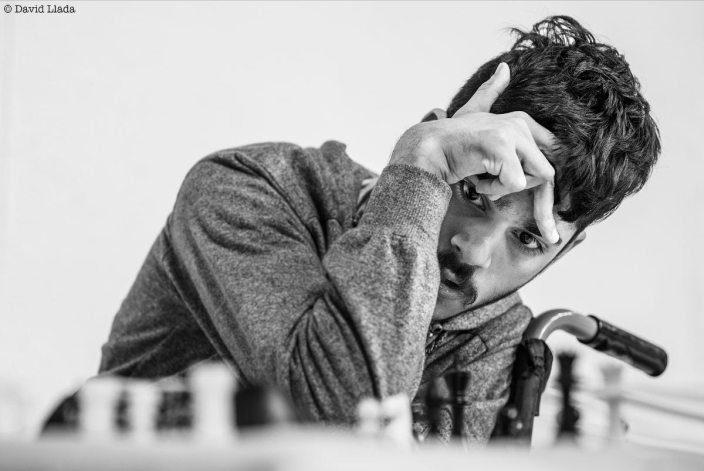

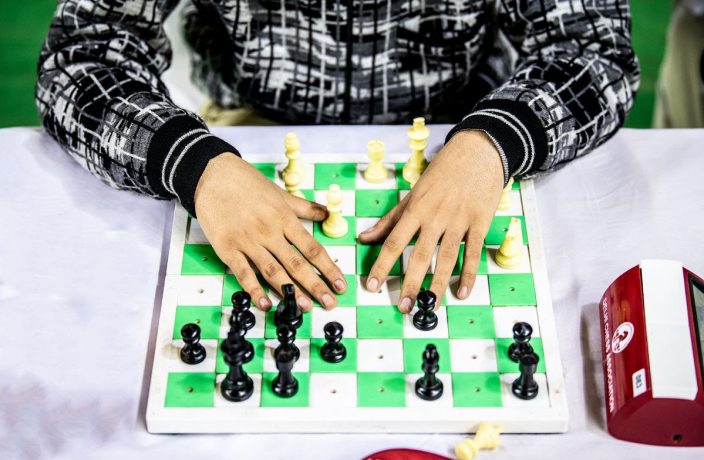
11/21/2020 – The first Online Chess Olympiad for People with Disabilities, organized by the International Chess Federation, kicks off today (November 21) and will run until December 3, a day recognized by the United Nations as the International Day of Persons with Disabilities. The competition brings together 400 players from all over the world, including two grandmasters. | Photo: David Llada
new: Fritz 20
Your personal chess trainer. Your toughest opponent. Your strongest ally. FRITZ 20 is more than just a chess engine – it is a training revolution for ambitious players and professionals. Whether you are taking your first steps into the world of serious chess training, or already playing at tournament level, FRITZ 20 will help you train more efficiently, intelligently and individually than ever before.
In this video course experts examine the games of Steinitz. Let them show you which openings Steinitz chose, where his strength in middlegames were, how he outplayed his opponents in the endgame & you’ll get a glimpse of his tactical abilities!
61 teams from 45 different countries are taking part in the first Online Chess Olympiad for People with Disabilities, organized by the International Chess Federation (FIDE). The event kicks off today (November 21) and will run until December 3, a day recognized by the United Nations as the International Day of Persons with Disabilities.
The competition brings together 400 players from all over the world (including reserves). Among them, there are two participants with the Grandmaster title, the highest distinction in chess.
Poland, Germany, the Philippines, Israel, and Cuba are the favorites according to the initial rating, followed by other traditional “chess superpowers” like Russia and Ukraine.
During a colorful and eventful opening ceremony [see full video below], FIDE President Arkady Dvorkovich greeted the participants of the competition: “I am happy and proud to announce the opening of the first-ever FIDE Online Chess Olympiad for People with Disabilities. It is a real honor to have it under FIDE’s auspices. Chess is winning against obstacles and challenges. You already won against your challenges, you are great people, and I wish you health and all the luck.”
What’s the easiest way to win a chess game? We all know finding a good tactic in a game can let you win a point immediately. Therefore, Fundamentals of Tactics is an excellent choice for you if you wish to learn how to start finding tactics in your games!
In chess, all that counts is how strong your ideas are.
Physical differences due to age and sex are not an impediment to battle over the board, and of course, this has huge implications in the case of people with physical impairments.
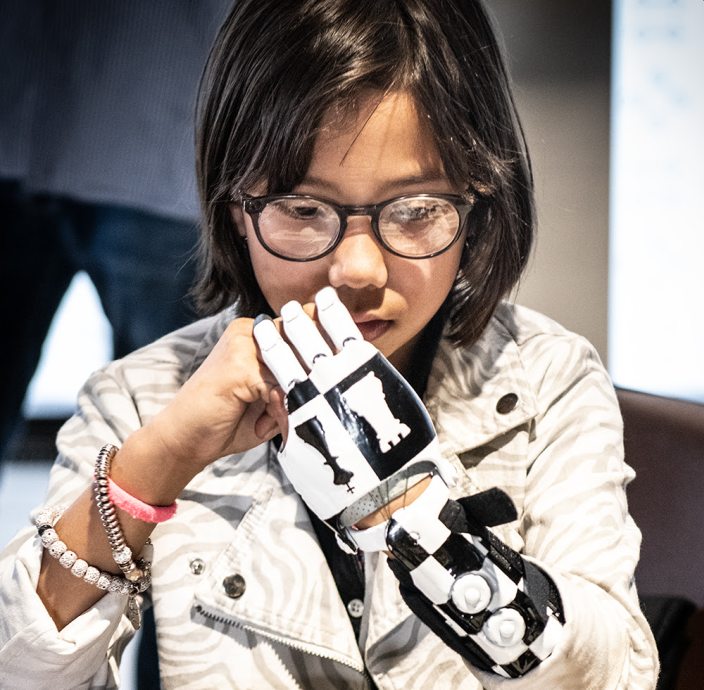
“I don’t let my disability define who I am. I let my mind, and what I can do, define who I am”, explained to CNN Anna Miller, an 11-year old participant in the 2019 FIDE World Junior Championship for People with Disabilities. “Just spread the word around: chess is for anybody. Anyone can play chess: girls, boys, people with disability”.
“The potential of chess is quite big, not only in terms of leisure but also in terms of meeting the need for communication, cognitive development, and expanding communication capabilities of people with impairments”, explains Irina Mikhaylova, an Associate Professor at the Russian State Social University in Moscow.
“It is a way to develop self-esteem and earn recognition”
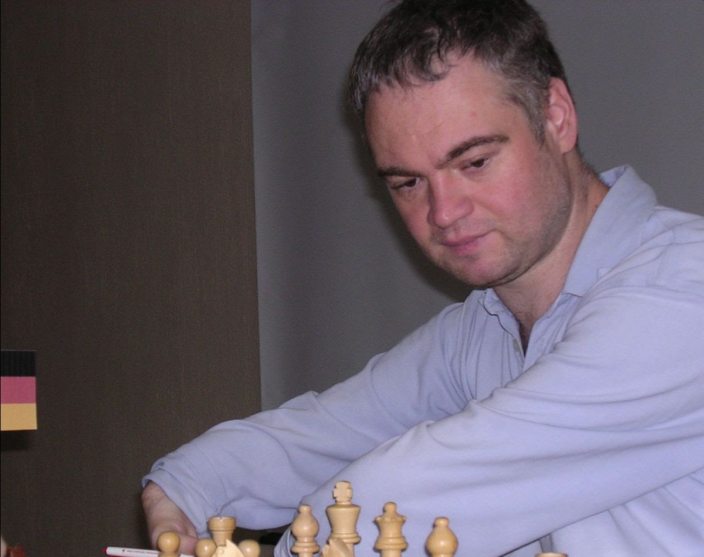
Grandmaster Thomas Luther is a three-time German Champion (1993, 2002, 2006), who reached the top 100 in the world ranking. Thomas became a world-class figure in an extremely competitive field despite the added challenge of being born with a physical disability.
“Learning chess at an early age was key for me to succeed in life. The Chess Olympiad for People with Disabilities will give a voice to disadvantaged people and will also help them to develop self-esteem and earn recognition. Chess is the only all-inclusive sport”, explains Thomas.
“In these events, there are people who are facing challenges in life, and they will have the opportunity to meet other people facing similar chances. So there is a lot of communication, and friendships develop among the players. The social aspects are very important.”
These DVDs are about Understanding Middlegame Strategies. In the first DVD dynamic decisions involving pawns are discussed. The second DVD deals with decision making process concerning practical play.
Taking up chess has been life-changing for many people with physical impediments: “I was more vulnerable before I started playing chess. But then I took up chess and the game made me stronger. Soon I learned to not give up after defeats, and this is one of the defining characteristics of my personality”, says Handenur Şahin.
Handenur, who was born with spinal muscular atrophy (SMA), will defend the first board of the Turkish team at the upcoming Olympiad. “Chess also taught me to be more patient. Due to my disability, this feature of being more determined about my goals is crucial. Most things are more difficult to achieve for me and it is so important to know not to give up when you encounter any obstacle which comes from physical problems, or from other people’s prejudices.”
The first-ever inclusive sport
Chess became the first-ever inclusive sport in 1848 when, for the first time in history, a chess set was specially adapted to enable visually impaired players to recognize the position of the pieces by touching them. Theodore Tylor was among England’s leading players in the 1930s, and despite being nearly blind he managed to score a draw against Alekhine and Capablanca, two of the best players in the first half of the XX century.
Currently, there are three international associations for blind players (IBCA), for physically impaired players (IPCA), and deaf players (ICCD). Each one of them is affiliated to FIDE and, traditionally, each one of these three organizations would have a team representing them at the World Chess Olympiad.
Now, FIDE has materialized the ambitious project of organizing a dedicated Chess Olympiad exclusively for people with disabilities, to be held every two years. This event will give more players with disabilities the opportunity to compete at an international event, representing their country.
Format, facts and figures
This is a team competition, played on four boards, where at least one of the players has to be a woman.
The event consists of two stages. The first one is a 7 round Swiss System, from which the best 4 teams will qualify to play a double-round semifinal (November 29-30). The two best teams will advance to the finals, while the two others will compete for the third prize. The time control in all stages is 25 minutes + 10 seconds.
'Hopefully you've never read any book in your life.'
Why do you hope that? Curious. Please explain.
fgkdjlkag 11/25/2020 02:25
Curious how the most vacuous commenters seem to think they know something. @Shakey, really? I'm assuming you've never read a chess book or seen a chess video in your life. Why would you, because personal experience is the only way one can learn, right? Hopefully you've never read any book in your life. No attempt to respond to any point I mentioned.
And the other commenter needs to ask what it means to be disabled? The idea that most top chess-players are disabled is so absurd as to not require a response.
Minnesota Fats 11/24/2020 08:54
checkmate by Shakey? ;-)
Shakey 11/23/2020 02:43
'Do not have any personal experience or knowledge...'
The comment could just stop there. It's the internet, we grant you. But still.
fgkdjlkag 11/22/2020 11:44
Do not have any personal experience or knowledge, but I am a little surprised by this question and would say of course: players, especially strong players, spend a lot of time analyzing with each other. Some players have credited that as the main reason they became a strong player. All of the online video resources could not easily be accessed. If an opponent makes a claim in a tournament game, it will be harder to understand. Etc.
AFAIK, there is only 1 deaf GM.
Shakey 11/22/2020 12:09
I genuinely mean no disrespect, and this is a genuine question.
To relmeza who just commented, others - is being deaf something that would detract from your ability to play chess?
Blind obviously, impaired motor skills in arms and hands etc, yes.
But is a hearing impairment relevant here?
reylmeza 11/22/2020 12:25
I am Deaf I would love to joined a team for the first disabilities olympiad if it posible
Minnesota Fats 11/21/2020 08:24
Funny thing is, most 'normal' top chess players are also kind of disabled, as many of them are Asperger or autistic or narcistic or have an antisocial personal disorder.
(Fischer, Morphy?)
Some of the most physical disabled persons are the most healthiest mental persons you can meet!.
So...., what does it mean 'handicapped or disabled, mental or physical?
GM Blohberger presents a complete two-part repertoire for Black: practical, clear, and flexible – instead of endless theory, you’ll get straightforward concepts and strategies that are easy to learn and apply.
Opening videos: Sipke Ernst brings the Ulvestad Variation up to date + Part II of ‘Mikhalchishin's Miniatures’. Special: Jan Werle shows highlights from the FIDE Grand Swiss 2025 in the video. ‘Lucky bag’ with 40 analyses by Ganguly, Illingworth et al.
In this video course, Grandmaster Ivan Sokolov explores the fascinating world of King’s Indian and Pirc structures with colours reversed, often arising from the French or Sicilian.
€39.90
We use cookies and comparable technologies to provide certain functions, to improve the user experience and to offer interest-oriented content. Depending on their intended use, analysis cookies and marketing cookies may be used in addition to technically required cookies. Here you can make detailed settings or revoke your consent (if necessary partially) with effect for the future. Further information can be found in our data protection declaration.
Pop-up for detailed settings
We use cookies and comparable technologies to provide certain functions, to improve the user experience and to offer interest-oriented content. Depending on their intended use, cookies may be used in addition to technically required cookies, analysis cookies and marketing cookies. You can decide which cookies to use by selecting the appropriate options below. Please note that your selection may affect the functionality of the service. Further information can be found in our privacy policy.
Technically required cookies
Technically required cookies: so that you can navigate and use the basic functions and store preferences.
Analysis Cookies
To help us determine how visitors interact with our website to improve the user experience.
Marketing-Cookies
To help us offer and evaluate relevant content and interesting and appropriate advertisement.