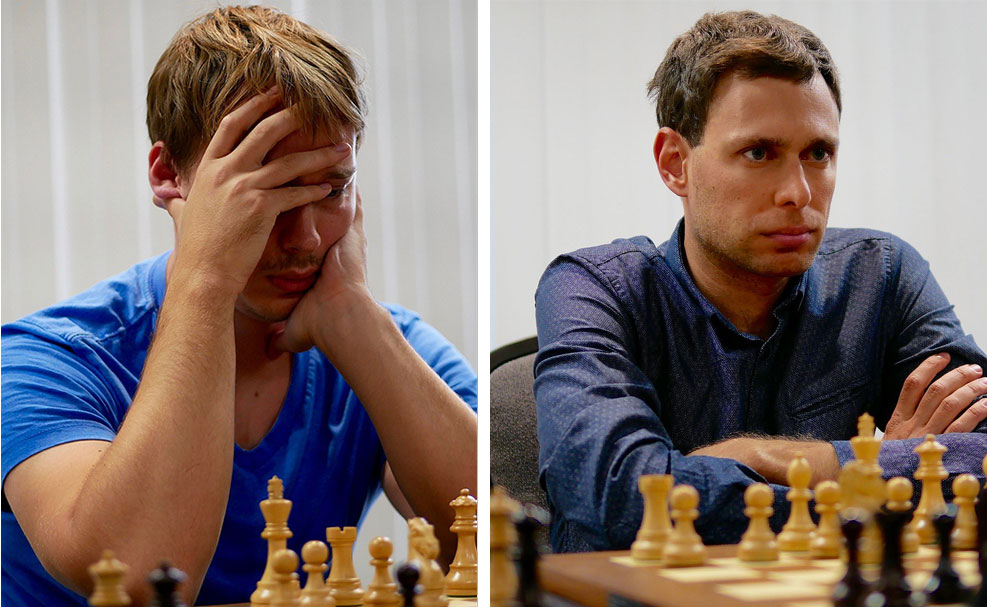
9/3/2018 – GM Hovhannes Gabuzyan (pictured left) outpaced the competition in the Masters Section of the Washington International, held in Rockville, Maryland, adjacent to the US capital city from August 11-15, 2018. A full point behind him in the nine-round Swiss open tournament was a trio of international grandmasters including NICLAS HUSCHENBETH (pictured right) who annotated two games for our report. The top American player was US number ten and the sixth best Junior player in the world, GM Sam Sevian, who finished with 6 points. | Photos: Maryland Chess Association
new: Fritz 20
Your personal chess trainer. Your toughest opponent. Your strongest ally. FRITZ 20 is more than just a chess engine – it is a training revolution for ambitious players and professionals. Whether you are taking your first steps into the world of serious chess training, or already playing at tournament level, FRITZ 20 will help you train more efficiently, intelligently and individually than ever before.
GM Blohberger presents a complete two-part repertoire for Black: practical, clear, and flexible – instead of endless theory, you’ll get straightforward concepts and strategies that are easy to learn and apply.
€49.90
Gabuzyan leads the pack
The Masters section attracted a total of 71 players, including 22 GMS and 15 IMs. Gabuzyan moved into sole first place after winning his first four games. After that, no one could catch him, and he finished with a final score of 7½ out of 9, earning the first place prize of USD $4,500.
Russian GM Andrey Stukopin, who studies at the University of Texas at Brownsville, finished second with 6½ alongside GMs Niclas Huschenbeth (GER) and Evgeny Postny (ISR). Each took home $1,400 for the week.
Andrey Stukopin and Evgeny Postny rounded out the top four | Photo: Maryland Chess Association
Gabuzyan's most interesting game was his third round win over GM Gil Popilski. You don't often see a player sacrifice a queen twice in one game and win!
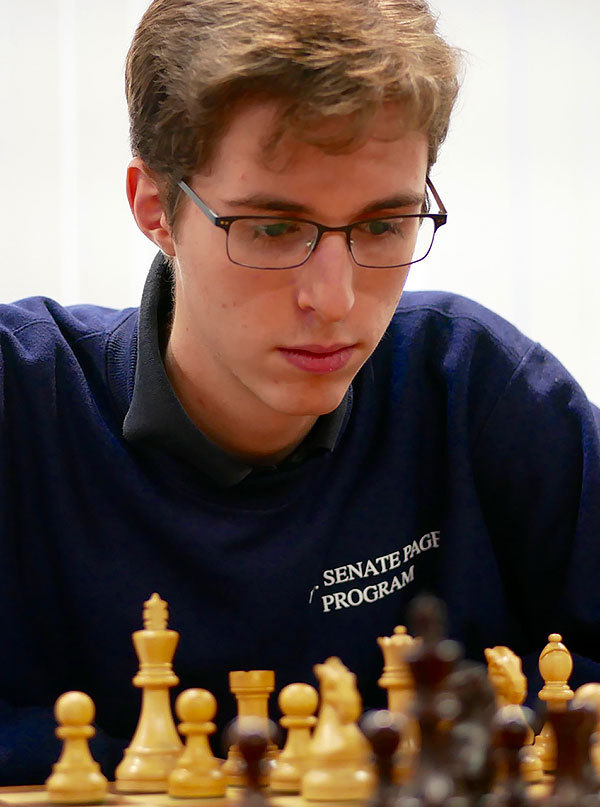
Despite there being five players in the running for Grandmaster norms going into the last round, only Nico Checa (pictured) earned a norm. In fact, he didn't need to score any points going into the last round, having already reached the required score threshold, but still drew his last game.

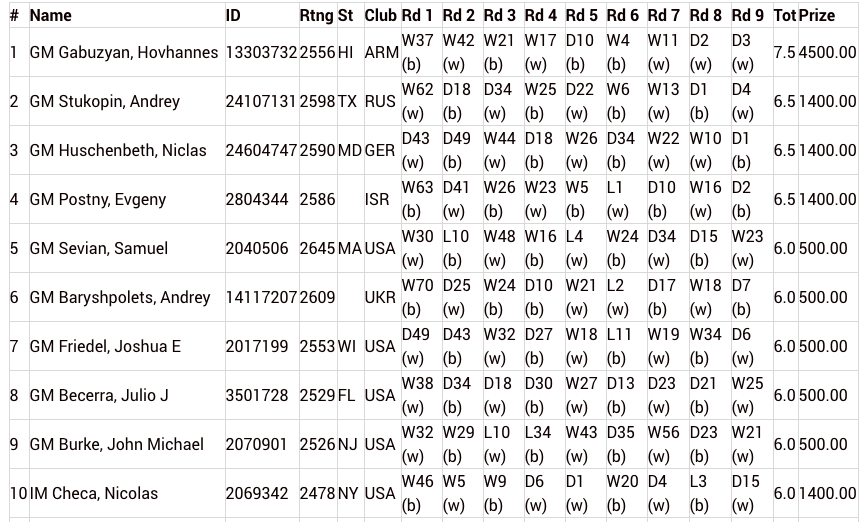
Checa also went over 2500 during the tournament, leaving him just one norm short of the GM title. Nico showed signs of being in good form from the start when he won the blitz event by a full point ahead of seven GMs. One of his best games was his win against the top-seeded player in the tournament, GM Sam Sevian, which came already in the first round in a Queens Gambit Declined exchange variation.
The Queen’s Gambit Declined Exchange Variation is one of the most important opening systems, having been played by most of the great players in history and from both sides of the board. The most outstanding specialists in this method of play include Garry Kasparov, Mikhail Botvinnik and Samuel Reshevsky. The Black side proponents include Anatoly Karpov, Boris Spassky and Paul Keres. It is truly an opening of champions!
Sam Sevian, with 6 points, had to settle for fifth place | Photo: Maryland Chess Association
A total of 142 players competed in the Masters, Experts, and Contenders sections combined. The Experts section (under 2201 USCF national rating) ended with a five-way tie at 6½/9 between Akshay Indusekar, Noah Thomforde-Toates, Richard Tan, David Siamon and Daniel Pomerantz, while the Contenders section (Under 1800 USCF) ended in a three-way tie between Barzin Badiee, Duane Smith, and Ariel Joshi.
The tournament was organized by the Maryland Chess Association, and the Chief Arbiter was Michael Regan.
In this course, you’ll learn how to take the initiative against the London and prevent White from comfortably playing their usual system by playing 1.d4 Nf6 2.Bf4 Nh5.
London System Powerbase 2026 is a database and contains in all 11 285 games from Mega 2026 and the Correspondence Database 2026, of which 282 are annotated.
The London System Powerbook 2026 is based on more than 410 000 games or game fragments from different opening moves and ECO codes; what they all have in common is that White plays d4 and Bf4 but does not play c4.
In this course, Grandmaster Elisabeth Pähtz presents the London System, a structured and ambitious approach based on the immediate Bf4, leading to rich and dynamic positions.
Opening videos: Open Spanish (Sipke Ernst) and Classical Sicilian (Nico Zwirs). Endgame Special by Igor Stohl: ‘Short or long side’ – where should the defending king be placed in rook endgames? ‘Lucky bag’ with 35 master analyses.
YOUR EASY ACCESS TO OPENING THEORY: Whether you want to build up a reliable and powerful opening repertoire or find new opening ideas for your existing repertoire, the Opening Encyclopaedia covers the entire opening theory on one product.
The Queen’s Gambit Declined Exchange Variation with 5.Bf4 has a great balance between positional play and sharp pawn pushes; and will be a surprise for your opponents while being easy to learn for you, as the key patterns are familiar.
€9.90
We use cookies and comparable technologies to provide certain functions, to improve the user experience and to offer interest-oriented content. Depending on their intended use, analysis cookies and marketing cookies may be used in addition to technically required cookies. Here you can make detailed settings or revoke your consent (if necessary partially) with effect for the future. Further information can be found in our data protection declaration.
Pop-up for detailed settings
We use cookies and comparable technologies to provide certain functions, to improve the user experience and to offer interest-oriented content. Depending on their intended use, cookies may be used in addition to technically required cookies, analysis cookies and marketing cookies. You can decide which cookies to use by selecting the appropriate options below. Please note that your selection may affect the functionality of the service. Further information can be found in our privacy policy.
Technically required cookies
Technically required cookies: so that you can navigate and use the basic functions and store preferences.
Analysis Cookies
To help us determine how visitors interact with our website to improve the user experience.
Marketing-Cookies
To help us offer and evaluate relevant content and interesting and appropriate advertisement.