

One of the advantages of playing in the Netherlands is that you get to take part in continuous events one after the other. After the Leiden Open, which ended on 24th of July, next on agenda was the Dutch Open in Dieren that began after a day’s break, from the 26th of July.
The best way to reach Dieren from Leiden is by train. It takes you two hours and costs you around €20.
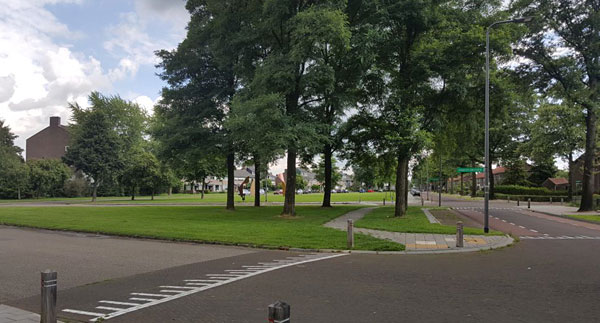
Dieren is a beautiful town located in the eastern Netherlands. With a population of just 15,000 you can hardly see people on the streets. It is a perfect place to have your mind at peace and play a strong chess tournament.
The Dutch Open 2016 sponsored by Condigne was held from the 26th of July to the 4th of August 2016 in the Theothorne Café in Dieren. This open event is one of the most prestigious tournaments in the country with a long standing tradition of 48 years. The schedule was perfect with one round a day that began at 1 p.m. and a rest day after five rounds. There were different category tournaments that took place (A, B, C) simultaneously with the Dutch Open. The cutoff rating for the main event was 2050 and the 58 participants included ten grandmasters, with Erwin l’Ami (2606) as the top seed.
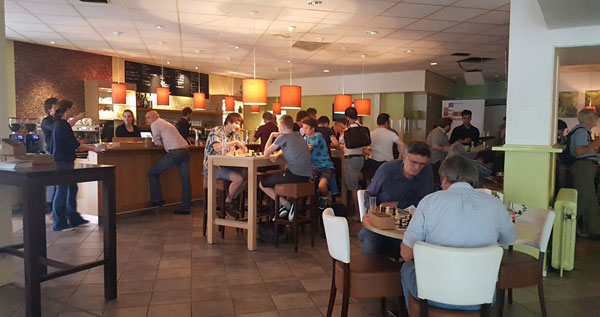
The entrance to the tournament hall was through the Theothorne Cafe. This place was used by players to analyze their games with each other, and in general you could find chess enthusiasts sitting there all the time, sipping on a glass of beer and pondering over the complex positional decisions! However, one cannot really imagine the massive tournament hall which lies hidden underneath this cafe.

The beautiful and spacious playing hall which hosted 488 players from all over the world
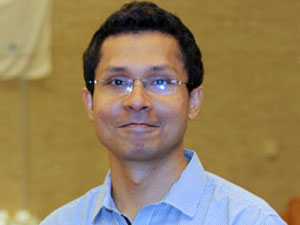
The tournament was led right from the start until the end by Indian grandmaster Sandipan Chanda. Sandipan started the event as the third seed. He drew a completely winning position against the top seed Erwin l’Ami in the fourth round, but got his act together after the rest day by beating GM Dmitri Reindermann and GM Roeland Pruijssers.
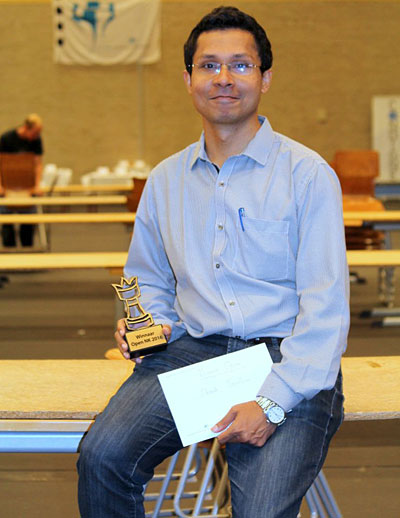
GM Sandipan Chanda with his winner’s trophy and cash prize of €2,500. He performed at an Elo of 2741 and gained 19 Elo points.
The critical moment of the tournament was reached in the last round when Sandipan had the white pieces against GM Vyacheslav Ikonnikov. The grandmaster from West Bengal was on 6.5/8 and had a half point lead over four other players (l’Ami, Horvath, Khenkin and Ikonnikov). A normal reaction could have been to play it safe, make a draw, and secure the joint first spot at the very least. But Chanda decided to play a full-fledged game and emerged as the winner.
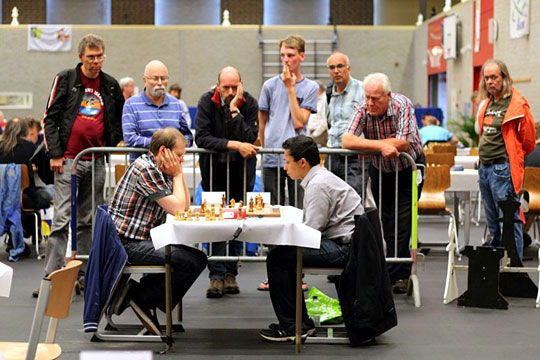
The crucial last round battle between Sandipan Chanda and Vyacheslav Ikonnikov was followed with great interest by the spectators
The game was an amazing topsy-turvy battle that could have gone either way. Let’s go through the moves in depth. However, before that here’s a position where you should pull out your chess board and pieces, set up the position and think over it for 25 minutes.
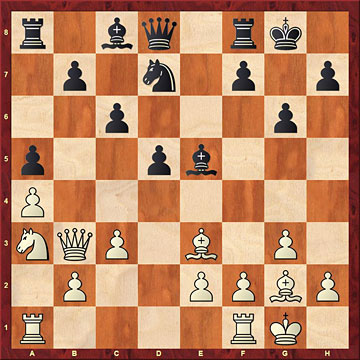
It’s White (Sandipan) to move. You can see that the knight on a3 and bishop on g2 are hampered because of the pawn chain b7-c6-d5. It is obvious that White has to break with c4. However, c4 right now is met with d5-d4. So White must bring his rook on d1. Which rook would you get to the d1 square and why? Mind you, Sandipan took nearly 25 minutes to find the right move. The reason: he needed to find something against a very strong black idea. Of course, I cannot spill the beans any further. Try your best at cracking Rad1 or Rfd1 problem and then let Sandipan explain you the nuances.
In this seven minute video Sandipan explains the answer to the above position and how he made his decision

When Sandipan lifted his rook to e5 with 22.Re5, it seemed as if the game would end in a few moves in his favour. However, Ikonnikov had a surprise up his sleeve and he went 22…Nxa4 and after 23.Rxg5 Nxc3 24.bxc3 f5 we reach the following position:

It is true that White is a piece up, but look at the complete discord in his position. The knight on a3 is stuck to the blockade of the a-pawn. The bishop on g2 is hampered by the b7 and c6 pawns and the rook on g5 and h4 are shut off on the wrong side. All in all the game became extremely exciting and any of three results were possible. In the end the Russian GM didn’t play exactly and Chanda emerged victorious.
[Event "Condigne Dutch Open 2016"] [Site "dieren"] [Date "2016.08.04"] [Round "9"] [White "Sandipan, Chanda"] [Black "Ikonnikov, Vyacheslav"] [Result "1-0"] [ECO "D02"] [WhiteElo "2568"] [BlackElo "2538"] [Annotator "Sagar Shah"] [PlyCount "103"] [EventDate "2016.07.27"] [EventCountry "NED"] [WhiteClock "0:38:33"] [BlackClock "0:24:29"] {At this point Sandipan was already leading the tournament by half a point. With the white pieces he could have tried to play for a draw, but instead he came to the board with an intention to fight and play for a win.} 1. Nf3 Nf6 2. g3 g6 3. Bg2 Bg7 4. O-O O-O {Ikonnikov is a hard core Nimzo Indian and a Bogo Indian expert. However, recently he has incorporated the King's Indian Defence in his repertoire.} 5. d4 d5 {Suddenly we are in Grunfeld territory.} 6. c3 $5 {Reversed Schlecter?!} Nbd7 (6... c5 7. dxc5 {reaches the famous game between Carlsen and Caruana from the Shamkir Memorial 2014.}) 7. a4 a5 8. Na3 {Little would have Sandipan imagined that this knight would cause him maximum trouble throughout the game.} (8. Bf4 {with the idea of Nbd2 looks like an alternative way of developing.}) 8... Nb6 9. Ne5 c6 10. Qb3 Ng4 $5 11. Nd3 $1 e5 12. Nxe5 ( 12. f3 {Sandipan didn't really think too much about this move. After his opponent had thought for a long time about 10...Ng4, he imagined that ...e5 would not be so bad. And he was right to some extent. But White is surely better.} e4 $1 13. fxe4 dxe4 14. Bxe4 {White is a pawn up and here he has a small edge.} Be6 (14... Bxd4+ $2 15. cxd4 Qxd4+ 16. Nf2 Nxf2 17. Rxf2 Qxe4 18. Qxb6 $18) 15. Qd1 $1 f5 16. Bf3 $14 {White has a clear edge.}) 12... Nxe5 13. dxe5 Bxe5 14. Be3 Nd7 (14... Ra6 {looks clumsy but it makes sense because it prevents White from opening up the position with c4.}) {[%tqu "It is clear that White has to bring his rook to d1. But which one?","","",Rfd1,"As Sandipan said, he was at a crossroads here. Playing Bd4 and offering a draw was natural here. But he wanted to see if there was any way to play for an edge. And after 25 minutes of thought he found this idea of bring the f rook to d1 and not the a1 rook.",10,Rad1,"This move is possible but it creates some issues after Black plays Qe7. Check the main line for more details.",0]} 15. Rfd1 $1 {As Sandipan said, he was at a crossroads here. Playing Bd4 and offering a draw was natural. But he wanted to see if there was any way to play for an edge. And after 25 minutes of thought he found this idea of bringing the f rook to d1 and not the a1 rook.} (15. Rad1 {is possible but the rook needs to be on a1 as you will see in the main line.}) 15... Qe7 {Black logically gets out from the d-file.} {[%tqu "White is ahead in development. What should he do?","","",c4,"Yes, of course! When you are ahead in development, it makes complete sense to open up the position!",10]} 16. c4 { When you are ahead in development, it makes complete sense to open up the position! But I hope you have seen what to do for Qb4.} d4 {A practical and pragmatic decision by Ikonnikov to exchange the d4 pawn for the one on e2.} ( 16... Qb4 {This is the move that was the most difficult for Sandipan to find a refutation for.} {[%tqu "White seems to be in trouble. What should he do?","", "",Qa2,"Excellently calculated. Black can play many moves but all them lead to a slight or significant advantage for White. It was important to see that the rook was necessary to make this variation work.",10,Qxb4,"",0]} 17. Qa2 $1 { Black can play many moves but all them lead to a slight or significant advantage for White.} (17. Qxb4 axb4 {With the c4, b2 and a4 pawns hanging, not to mention the knight on a3, this is a completely losing position for White.}) 17... Qxb2 (17... Nf6 18. cxd5 Nxd5 19. Bxd5 cxd5 20. Qxd5 (20. Nb5 $1 $14 {gives White a tangible edge.}) 20... Bxb2 21. Bc5 $6 {Sandipan looked at this move during the game. But it turns out to be a mistake as after} (21. Rab1 $1 Be6 (21... Qxa3 22. Bc5 $16) 22. Qb5 Rad8 23. Rxd8 Rxd8 24. Qxb4 axb4 25. Nc2 Bf6 26. Nxb4 $44 {Although White is a pawn up, Black has compensation and the position should be round about equal.}) 21... Qxa4 $1 {Black not only takes the pawn but keeps an eye on the d1 rook.} (21... Qg4 {was Sandipan's move and indeed after} 22. Bxf8 Be6 23. Qxb7 $18 {White wins.}) 22. Bxf8 Be6 23. Qxb7 Bxa1 {And the rook on a8 cannot be picked as the one on d1 is hanging. } 24. Rxa1 Rxf8 $17) (17... Bxb2 18. Nc2 $1 Qc3 19. Bd4 Qxc2 20. cxd5 $16 { With the dark squared bishop about to be lost, Black's king starts to feel the heat.}) 18. cxd5 $1 {This is exactly the point. The rook on a1 defends the queen on a2 and hence,White can simply take the pawn on d5 and be better.} cxd5 19. Bxd5 $14) 17. Bxd4 Bxd4 18. Rxd4 Qxe2 19. Qc3 Nc5 {This move suddenly create tactical opportunities because the knight on c5 is loose and can be lost to some double attacks. However, things are not at all simple.} (19... Qe7 {was plausible.} 20. Re1 Qb4 21. Qc1 $1 {After some effort we found this move in the post mortem analysis. Turns out that it is important to keep the b2 pawn defended.} (21. Qe3 $6 Nc5 $15 {There is no attack on the kingside and the b2 pawn is falling.}) 21... Nc5 22. Nc2 $1 (22. Rh4 Nd3 $19) 22... Qb6 23. Rh4 $1 $16 {and with Qh6 coming up, this would be a pretty strong attack.}) 20. Re1 Qh5 21. Rh4 Qg5 $1 {This came as a shock to Sandipan. Doesn't Re5 simply win a piece? Well, that's the half truth. Re5 does win a piece but Black is able to cause some grave damage to White's position and pawn structure.} 22. Re5 {[%cal Ge1e5]} {[%tqu "It seems like Black is losing a piece. What should be do?","","",Nxa4,"A blow for a blow! It's true that Black loses a piece, but in the resulting position things are far from clear as the knight on a3 would be bad and the a-pawn is a passer that is ready to roll.",10]} Nxa4 $1 { A blow for a blow! It's true that Black loses a piece, but in the resulting position things are far from clear as the knight on a3 would be bad and the a-pawn is a passer that is ready to roll.} 23. Rxg5 Nxc3 24. bxc3 {[#] Let us try and assess this position. White is a piece up but his forces are in complete discord. The two rooks on the kingside can be trapped and the funny thing is that this is not the most worrying factor. The knight on a3 is faced with an uneviable task of blockading the a5 pawn. Also the b7-c6 structure is most often bad for the g2 bishop. But, finally material is material. White can maintain the balance but one would not be wrong if he said that it is easier to play with the black pieces. What is very interesting to note is that Ikonnikov would have most certainly not assessed this position when he went for 19...Nc5. And Sandipan who was trying to play only for two results was suddenly feeling the heat as all three outcomes were possible now.} f5 { [%csl Ra3,Ga5,Ga8,Gb7,Gc6,Rg2,Rg5,Rh4] What can be more natural that to lock up the rook on g5.} (24... Rd8 {was another possibilty that gave Black good compensation, but one would not like the rook on h4 to come back to the game in a move.} 25. Rd4 $1) (24... Re8 $1 25. Kf1 f5 {is somewhat similar to the game but slightly more accurate.}) 25. g4 $1 {Sandipan doesn't get bogged down. He is ready for a fight and ready to make sharp moves.} Rd8 $6 (25... Re8 $1 26. Bh3 f4 {and with no Re5, White is badly placed.}) 26. Bh3 Rd1+ (26... f4 27. Re5 $1 $16 {This is why it was appropriate to play Re8 instead of Rd8.}) 27. Kg2 Ra1 28. Nc2 Rc1 29. Nd4 {The game becomes extremely sharp now. The knight on a3 enters the game and is proudly standing on d4. But it means that the a5 pawn is now free to roll.} f4 $6 ({A sample variation of just pushing the a-pawn at all costs could go something like} 29... a4 30. gxf5 a3 31. fxg6 Bxh3+ 32. Rxh3 a2 33. gxh7+ Kh8 34. Rhg3 $1 Kxh7 (34... a1=Q 35. Rg8+ Kxh7 36. R3g7+ Kh6 37. Nf5+ Kh5 38. Rh7#) 35. Rh5#) (29... fxg4 30. Bxg4 Bxg4 {is yet another critical position. The obvious move seems to be to take with the h-rook, but it is important to leave a rook targetting the h7 pawn and use the other one to penetrate inside the black camp.} 31. Rgxg4 $1 (31. Rhxg4 a4 32. Re4 (32. Kh3 Rxc3+ $19) 32... a3 $17 {White is in trouble.}) 31... a4 32. Re4 a3 33. Re7 {The way in which the two rooks and the knight co-ordinate is quite nice.} h5 (33... a2 34. Rhxh7 Re8 $1 (34... a1=Q 35. Reg7+ Kf8 36. Ne6+ Ke8 37. Rg8#) 35. Reg7+ Kf8 36. Rxb7 Kg8 37. Rbg7+ Kf8 38. Ra7 Kg8 39. Nb3 a1=Q 40. Nxa1 Rxa1 41. Rag7+ Kf8 42. Rxg6 $18) 34. Ne6 a2 35. Rg7+ Kh8 36. Rxg6 Rg1+ 37. Kxg1 a1=Q+ 38. Kg2 Qd1 39. Rh6+ Kg8 40. Rf4 $18 {White's pieces are superior and the black king is in trouble, which gives the first player a decisive advantage.}) 30. Re5 $1 {The rook comes into the game very quickly and Black's position falls apart.} Rxc3 31. Re8+ (31. Re7 {was more accurate.}) 31... Kf7 32. Rh8 h5 33. gxh5 g5 34. Bxc8 Kg7 (34... gxh4 35. Be6+ $18) 35. Re8 $1 gxh4 36. Nf5+ Kf6 37. h6 (37. Rf8+ Kg5 38. h6 h3+ 39. Kf1 f3 40. Ke1 $18) 37... h3+ 38. Kf1 f3 39. Ke1 Rxc4 40. h7 (40. Kd2 $1 $18) 40... Re4+ 41. Rxe4 Rxc8 42. Nd6 Rh8 43. Nxb7 Rxh7 44. Nxa5 Ra7 45. Nxc6 Ra1+ 46. Kd2 Rh1 47. Nd4 Rxh2 48. Ke3 Rh1 49. Nxf3 Kg6 50. Rg4+ Kf6 51. Kf4 Rf1 52. Kg3 {It's rare to see such fights on the top board in the last round. The game was filled with a lot of nice ideas and one must congratulate both the players for enriching the game by fighting hard rather than making a tame draw!} 1-0
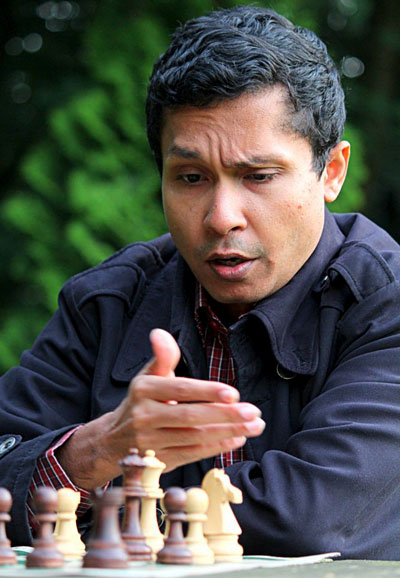
Play uncompromising chess – that’s the secret of becoming a strong player

The spectator’s favourite was surely the top seed Erwin l’Ami (left), who has been coming to Dieren to play in the Dutch Open ever since he was a young kid.
The Dutch grandmaster started off well with three wins, the third one being against the in-form Roeland Pruijssers, who had recently won the Leiden Open. He was then held to three draws. In the last three rounds he managed to score 2.5/3 beating GMs Debashis Das and Dmitri Reindermann. The score of 7.0/9 was good enough to give him the second spot. However, one game that stands out from the rest was his 22 move miniature against Das.
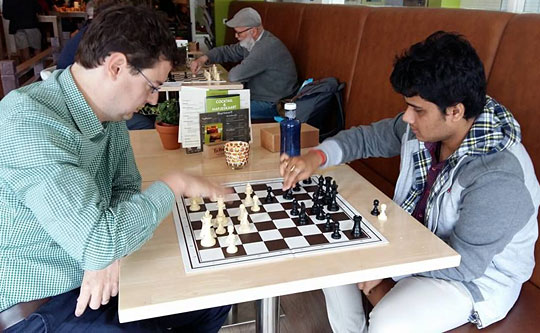
Erwin and Debashis try to analyze what went wrong for Black in the game
Before we go to the game here are two positions that you should think about:
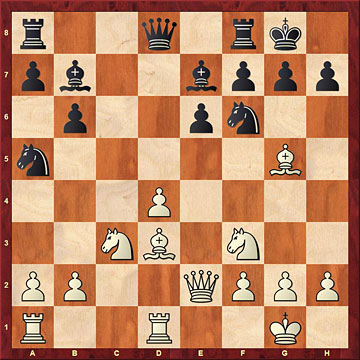
It is a normal Queen’s Gambit Accepted position that has been reached 142 times in the past. The previously played moves here have been Rac1 or Ne5. But Erwin came up with something very interesting. Can you find it? Do not take more than five minutes for this decision.

L’Ami’s (White’s) attack seems to be breaking through here. But Black has an excellent defensive resource. And mind you it is the only one! I can completely understand that you would want to skip the position and go over to check the answer. However, if you really want to improve as a chess player we recommend that you take 30 minutes on the clock and have a deep think here. How should Black defend? And after you are done thinking then let Erwin explain you the answer in the video below.
Erwin L’Ami explains the answer to both the positions given above in this video
[Event "Condigne Dutch Open 2016"] [Site "dieren"] [Date "2016.08.02"] [Round "7"] [White "L'Ami, Erwin"] [Black "Debashis, Das"] [Result "1-0"] [ECO "D26"] [WhiteElo "2606"] [BlackElo "2451"] [Annotator "Sagar Shah"] [PlyCount "43"] [EventDate "2016.07.27"] [EventCountry "NED"] [WhiteClock "0:19:13"] [BlackClock "0:29:34"] 1. d4 d5 2. c4 dxc4 {Debashis Das doesn't usually play the Queen's Gambit Accepted but in this game he goes for it.} 3. e3 Nf6 4. Bxc4 e6 5. Nf3 c5 6. O-O Nc6 7. Qe2 cxd4 8. Rd1 Be7 9. exd4 O-O 10. Nc3 Na5 {Until now we have seen the normal moves. This knight sortie to the side of the board is a little abnormal. But the idea is to force the bishop away from the control of d5, so that d4-d5 is no longer a threat and then play b6 followed by Bb7.} 11. Bd3 b6 12. Bg5 Bb7 {Diagram [#] It seems as if Black is quite nicely developed. Logical moves for White would be Rc1 or Ne5. However, Erwin thought for a while and decided to spice up things with a pawn sacrifice.} 13. d5 $5 { Nearly 142 games had reached the previous position but only one continued with d4-d5. The move is tricky, but against a careful opponent it is at best tricky and cannot guarantee an advantage.} exd5 (13... Nxd5 14. Bxh7+ Kxh7 15. Bxe7 Qxe7 (15... Nxe7 16. Rxd8) 16. Nxd5 Bxd5 17. Rxd5 $14) 14. Nd4 {The knight is looking at juicy squares like f5 and the queen is ready to transfer herself to the battle zone with Qf3-h3.} Re8 15. Nf5 Bc5 16. Qf3 d4 {The game becomes extremely sharp.} 17. Ne4 Rc8 $2 {A poor move by Debashis not at all in the spirit of the position.} (17... Rxe4 $1 18. Bxf6 Re5 $3 (18... Qxf6 19. Bxe4 $16) 19. Bxd8 (19. Qg3 Qxf6 $19) 19... Bxf3 20. Bc7 Rxf5 21. Bxf5 Bxd1 22. Rxd1 $11 {White has some compensation but it is not more than a pawn.}) 18. Re1 (18. Nxf6+ $1 Qxf6 (18... gxf6 19. Qh5 $18) 19. Qh5 g6 20. Bxf6 gxh5 21. Ng7 $1 Rf8 22. Nxh5 $16) 18... Re6 (18... Bxe4 19. Bxe4) 19. Nxf6+ Qxf6 20. Qg3 Rxe1+ 21. Rxe1 Qc6 22. Be7 $1 {If the mate on g7 is prevented, then b4 wins a piece. An imaginative game by Erwin.} 1-0
L’Ami is a hardcore 1.d4 player. However, recently he has recorded two DVDs for ChessBase – A Gambit Guide for the Open Games after 1.e4 Vol. 1 and 2. We ask Erwin the reason for not playing 1.e4 and what he thinks about Fischer’s statement “1.e4 – best by test!”
|

The proud parents of Erwin – Wout and Eef l’Ami

L’Ami is so accustomed to playing in Dieren that he travels to the tournament hall on his bike. The picture on the left was taken in 2016, while the one on the right is from Alina l’Ami’s beautiful report on the Dutch Open in 2014. It must be mentioned that cycling is the best way to travel in the Netherlands, and the number of cycles in the country are far more than the number of people.
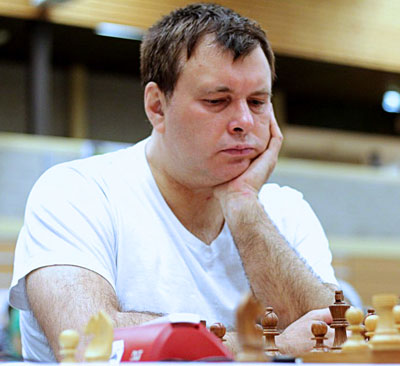
GM Igor Khenkin is a class act. Just four years ago, that is in 2012, he had a rating of 2675. He has drawn against the best players in the world like Anand, Kramnik, Topalov, etc. and beaten top guys like Wang Hao, Judit Polgar, Kasimdzhanov and many more. And now his Elo is down to 2553. What happened? As Igor describes, “I see a lot more than my opponents and that is one of my biggest problems.” More often than not he is unable to make quick decisions, lands in time trouble, and makes a lot of draws against lower rated opposition. However, in this tournament things went very well for him. His last round win against Csaba Horvath was especially nice. It was a case of a high class player coming to the board with extreme willpower and wanting to win at all costs.
[Event "Condigne Dutch Open 2016"] [Site "dieren"] [Date "2016.08.04"] [Round "9"] [White "Khenkin, Igor"] [Black "Horvath, Csaba"] [Result "1-0"] [ECO "D39"] [WhiteElo "2553"] [BlackElo "2520"] [Annotator "Sagar Shah"] [PlyCount "63"] [EventDate "2016.07.27"] [EventCountry "NED"] [WhiteClock "0:33:05"] [BlackClock "0:12:25"] 1. d4 Nf6 2. c4 e6 3. Nf3 d5 4. Nc3 dxc4 5. e4 Bb4 6. Bg5 (6. Bxc4 {is another sharp line in the Vienna.}) 6... c5 7. Bxc4 cxd4 8. Nxd4 Bxc3+ (8... Qa5 { is also possible but it gives White an option to come back with Bd2.}) 9. bxc3 Qa5 10. Bb5+ Bd7 11. Bxf6 gxf6 (11... Qxc3+ 12. Kf1 gxf6 13. Rc1 $18 {followed by Rc8 finishes off the game.}) 12. Bxd7+ Nxd7 13. O-O {This line is very interesting. White has his king safely tucked in on g1. But is it really safe? The g-file is open and there are chances of launching an attack. At the same time, the black king cannot castle long or short but on e7 it is not so badly placed. All in all it boils down to whether White can make use of Black's king position. Because statically Black's pawn structure is better.} a6 14. Rb1 Qc7 15. Qh5 Nc5 {We see one more advantage of Black's setup. The knight on c5 cannot be dislodged so easily.} (15... Ke7 {looks natural but White can just go } 16. f4 $1 {and with e5 coming up it will open up the position in the centre.} ) 16. Rb4 Qe5 {Black would be more than happy to exchange queens.} 17. Qh6 { Keeping the queens on.} Qg5 18. Qh3 Rg8 19. g3 b5 (19... Nxe4 20. Nxe6 $1 $18) 20. Qxh7 {White snaps up a pawn, but Black isn't too worried about it. He has his pieces in good position.} Nd3 (20... Rc8 $1 $132) 21. Nf3 (21. Rbb1 Rg7 22. Qh3 Nf4 23. Qh8+ Rg8 24. Qh7 Rg7 {and Black has at least a draw here.}) 21... Qg4 22. h3 Qg7 {The queens will come off now, but White is a pawn up and Black is not so well co-ordinated.} 23. Qxg7 Rxg7 24. Rd4 Nf4 25. Kh2 Ne2 26. Rd3 Rc8 27. a3 $1 {A very nice move. The idea is to prevent Nxc3 followed by b5-b4.} a5 (27... Nxc3 {is impossible due to} 28. Rc1 $18) (27... Rxc3 {is possible but not so great as after} 28. Rfd1 {a mate in two is threatened on d8 and after} Rxd3 29. Rxd3 e5 30. Rd6 {White will be up a pawn and clearly pushing.}) 28. c4 $1 {Khenkin is on fire. In a position that could very well peter out into a draw he keeps finding resources that make his opponent's task as difficult as possible.} Rxc4 (28... bxc4 29. Re3 $18) 29. Rfd1 {Threatening a mate} Rc7 $2 ( 29... Rc8 {was preferable. And at this point we could say that Black is still in the game.}) 30. R1d2 Nc3 $2 (30... Nc1 31. Rd8+ Ke7 32. Rb8 $16 {was the lesser evil but still pretty bad for Black.}) 31. Nd4 $1 {A powerful move. Can you see the threat? Csaba couldn't and that's why he took the e4 pawn.} Nxe4 { [%tqu "How to finish off the game?","","",Nc6,"",10,Nxb5,"Why go for a pawn when you can win the game?",0]} 32. Nc6 $1 {A powerful blow. There is absolutely no way to prevent mate. Look how the rook on g7 prevents the king to escape from f8-g7. A great game by Igor Khenkin.} (32. Nxb5 {Why go for a pawn when you can win the game?}) 1-0
This win helped Igor Khenkin score 7.0/9 and finish third at the event.
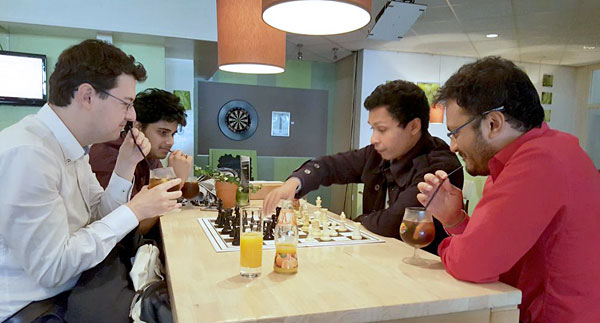
What is the secret of winning strong open tournaments? You analyze your game for fun with your friends after the closing ceremony! Mind you, the drinks were on Sandipan!
| # | Name | Pts | Rtng | TPR | W-We | BH | SB |
| 1 | GM Sandipan, Chanda | 7.5 | 2568 | 2741 | +1.91 | 53.0 | 43.0 |
| 2 | GM L'Ami, Erwin | 7.0 | 2606 | 2665 | +0.70 | 51.5 | 39.25 |
| 3 | GM Khenkin, Igor | 7.0 | 2553 | 2575 | +0.42 | 45.0 | 33.75 |
| 4 | GM Horvath, Csaba | 6.0 | 2520 | 2553 | +0.52 | 52.0 | 32.5 |
| 5 | GM Ikonnikov, Vyacheslav | 6.0 | 2538 | 2528 | +0.02 | 50.5 | 31.75 |
| 6 | GM Pruijssers, Roeland | 6.0 | 2463 | 2539 | +0.96 | 49.0 | 27.5 |
| 7 | GM Debashis, Das | 6.0 | 2451 | 2515 | +0.84 | 44.5 | 26.0 |
| 8 | GM Hausrath, Daniel | 6.0 | 2483 | 2400 | -0.77 | 43.0 | 27.0 |
| 9 | IM Hendriks, Willy | 6.0 | 2407 | 2289 | -1.07 | 42.0 | 28.0 |
| 10 | GM Reinderman, Dimitri | 5.5 | 2584 | 2497 | -0.83 | 51.0 | 27.75 |
| 11 | FM Beerdsen, Thomas | 5.5 | 2414 | 2437 | +0.51 | 49.0 | 26.0 |
| 12 | FM Maris, Ivo | 5.5 | 2370 | 2361 | +0.01 | 44.0 | 24.75 |
| 13 | IM De Jong, Migchiel | 5.5 | 2342 | 2352 | +0.19 | 42.0 | 24.5 |
| 14 | Zwirs, Nico | 5.5 | 2374 | 2333 | -0.28 | 42.0 | 23.5 |
| 15 | IM Sagar, Shah | 5.5 | 2433 | 2407 | -0.12 | 42.0 | 22.25 |
| 16 | GM Milov, Leonid | 5.5 | 2430 | 2295 | -1.36 | 41.0 | 23.25 |
| 17 | Geurink, Jasper | 5.5 | 2359 | 2354 | +0.00 | 41.0 | 22.0 |
| 18 | FM Kollen, Zyon | 5.5 | 2310 | 2321 | +0.23 | 40.0 | 23.0 |
| 19 | FM Maatman, Nick | 5.0 | 2314 | 2360 | +0.53 | 47.5 | 24.5 |
| 20 | Gerlagh, Joris | 5.0 | 2172 | 2381 | +2.29 | 47.0 | 24.25 |
| 21 | IM Beukema, Stefan | 5.0 | 2355 | 2353 | +0.03 | 42.0 | 19.5 |
| 22 | Van Foreest, Lucas | 5.0 | 2367 | 2221 | -1.53 | 41.5 | 20.5 |
Part II of this article with details about other prize winners, a beautiful composition by Yochanan Afek and impressions of the city will follow shortly.
Pictures by Amruta Mokal of ChessBase India
LinksYou can use ChessBase or any of our Fritz compatible chess programs to replay the games in PGN. You can also download our free Playchess client, which will in addition give you immediate access to the chess server Playchess.com. |
 |







 A
Gambit Guide through the Open Game Vol. 1 and 2 by Erwin l'Ami
A
Gambit Guide through the Open Game Vol. 1 and 2 by Erwin l'Ami