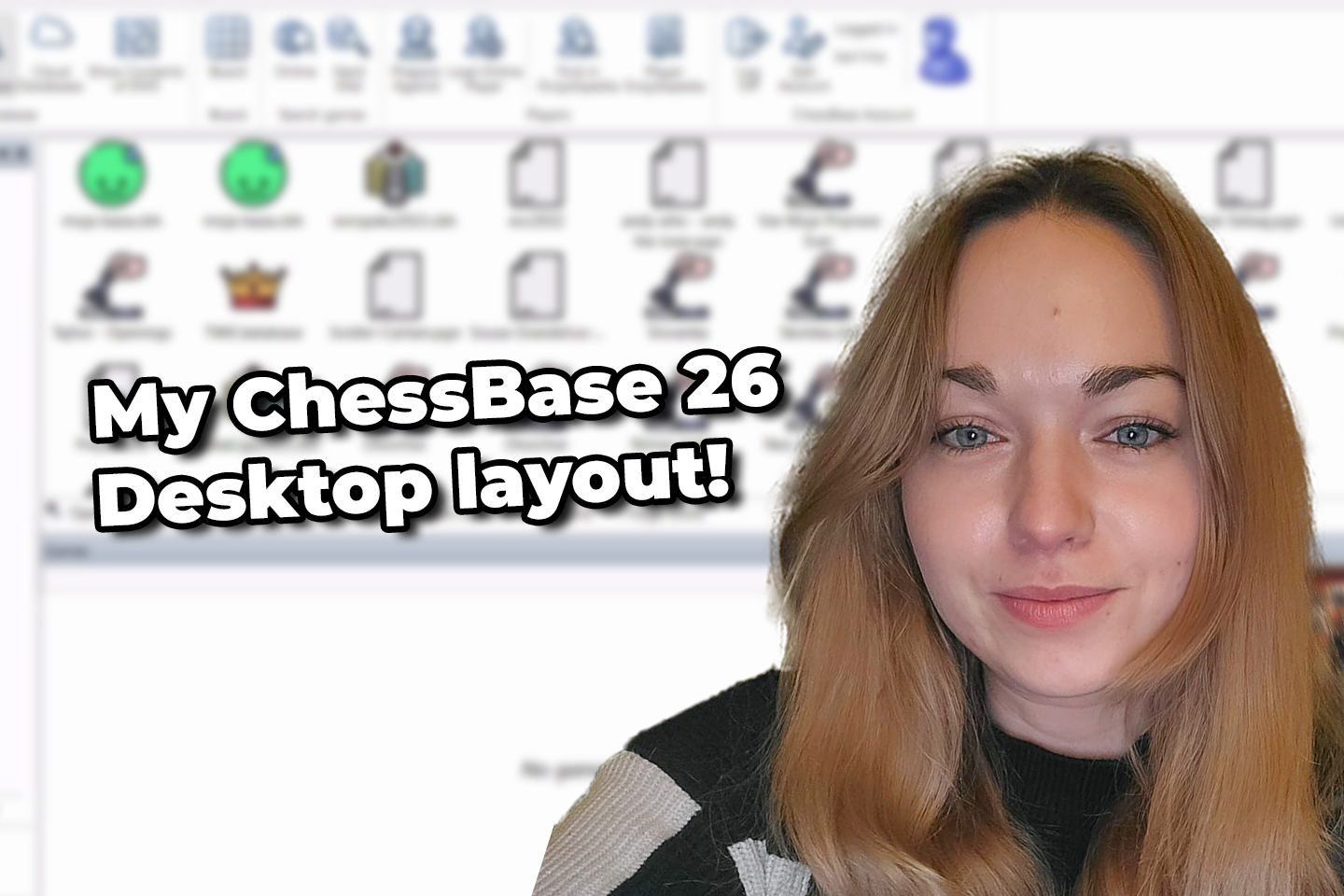
12/15/2025 – We take a unique behind-the-scenes look at how top chess masters organize their digital workspace. Grandmasters and trainers reveal their personal ChessBase 26 setups — from meticulously clean desktops to chaotic databases full of ideas. They show us their board designs, current projects, and discuss their favourite or most-used ChessBase functions, offering fascinating insights into how great minds prepare, study, and work with chess every day.
new: ChessBase 18 - Mega package
Winning starts with what you know
The new version 18 offers completely new possibilities for chess training and analysis: playing style analysis, search for strategic themes, access to 6 billion Lichess games, player preparation by matching Lichess games, download Chess.com games with built-in API, built-in cloud engine and much more.
YOUR PERSONAL CHESS COACH - Whether you’re taking your first steps into the world of club chess, or already playing at a tournament level: with FRITZ, you can train more efficiently, intelligently and with a more personalised approach than ever before. FRITZ is more than just a chess engine – it’s a training revolution! Whether you’re taking your first steps into the world of club chess, or already playing at a tournament level: with FRITZ, you can train more efficiently, intelligently and with a more personalised approach than ever before.
In this volume, we dive into core aspects of chess technique. Smyslov taught the principle of tactical hierarchy, “checks, double attacks, and unprotected pieces”, and Mikhalchishin demonstrates how this method of calculation is vital.
€34.90
My ChessBase 26 Desktop! - Chess Masters invite us in
Laura Unuk
Laura Unuk explains that she chose the bright ChessBase 26 theme and playful icons simply because they felt intuitive and comfortable, especially during tournament preparation, and she plans to keep this setup for a long time.
Her desktop is intentionally messy, reflecting a busy tournament life, with old preparation folders and games kept for motivation rather than strict organization, including examples from past coaching sessions.
Functionally, she relies heavily on the reference database for modern opening preparation, prefers filtering recent games, and still combines Mega Database with manually downloaded updates in an old-school but practical workflow.
EXPAND YOUR CHESS HORIZONS Data, plans, practice – the new Opening Report In ChessBase there are always attempts to show the typical plans of an opening variation. In the age of engines, chess is much more concrete than previously thought. But amateurs in particular love openings with clear plans, see the London System. In ChessBase ’26, three functions deal with the display of plans. The new opening report examines which piece moves or pawn advances are significant for each important variation. In the reference search you can now see on the board where the pieces usually go. If you start the new Monte Carlo analysis, the board also shows the most common figure paths.
YOUR PERSONAL CHESS COACH - Whether you’re taking your first steps into the world of club chess, or already playing at a tournament level: with FRITZ, you can train more efficiently, intelligently and with a more personalised approach than ever before.
“Attack with Qh5!!” – Tactical training with Oliver Reeh, “6…g5 – nothing ventured, nothing …” – Le Quang Liem comments on one of his victories in Biel, “Grischuk’s stroke of genius” – Petra Papp reveals a surprise in the Sicilian Kan Variation, and much
YOUR PERSONAL CHESS COACH - Whether you’re taking your first steps into the world of club chess, or already playing at a tournament level: with FRITZ, you can train more efficiently, intelligently and with a more personalised approach than ever before.
While tactics decide the game in concrete moments, strategy guides the entire battle. Understanding how to improve your pieces, create weaknesses, execute maneuvers, and steer the game toward favorable structures is what defines strong players.
The Italian Four Knights is the ideal choice. It combines the solid foundation of classical openings like the Ruy Lopez or the Italian Game with an active, initiative-driven style of play.
IM Andrew Martin shows why this 19th-century opening weapon still is a fantastic choice for club players. The Evans produces exciting chess and teaches the art of attack.
IM Andrew Martin complements his Evans Gambit course with a simple and attacking repertoire against all of blacks sidelines after 1.e4 e5.
€34.90
We use cookies and comparable technologies to provide certain functions, to improve the user experience and to offer interest-oriented content. Depending on their intended use, analysis cookies and marketing cookies may be used in addition to technically required cookies. Here you can make detailed settings or revoke your consent (if necessary partially) with effect for the future. Further information can be found in our data protection declaration.
Pop-up for detailed settings
We use cookies and comparable technologies to provide certain functions, to improve the user experience and to offer interest-oriented content. Depending on their intended use, cookies may be used in addition to technically required cookies, analysis cookies and marketing cookies. You can decide which cookies to use by selecting the appropriate options below. Please note that your selection may affect the functionality of the service. Further information can be found in our privacy policy.
Technically required cookies
Technically required cookies: so that you can navigate and use the basic functions and store preferences.
Analysis Cookies
To help us determine how visitors interact with our website to improve the user experience.
Marketing-Cookies
To help us offer and evaluate relevant content and interesting and appropriate advertisement.