5/13/2015 – Grandmaster Vladislav Tkachiev is a flamboyant character. His most recent escapade: to test how easy it is to cheat in chess. He spent an hour and a half researching the subject, $30 to rent some equipment and a hidden conspirator to wirelessly send him key moves. That was enough to thoroughly trash a colleague of similar strength. Tkachiev had it all recorded on video.
new: Fritz 20
Your personal chess trainer. Your toughest opponent. Your strongest ally. FRITZ 20 is more than just a chess engine – it is a training revolution for ambitious players and professionals. Whether you are taking your first steps into the world of serious chess training, or already playing at tournament level, FRITZ 20 will help you train more efficiently, intelligently and individually than ever before.
YOUR PERSONAL CHESS COACH - Whether you’re taking your first steps into the world of club chess, or already playing at a tournament level: with FRITZ, you can train more efficiently, intelligently and with a more personalised approach than ever before. FRITZ is more than just a chess engine – it’s a training revolution! Whether you’re taking your first steps into the world of club chess, or already playing at a tournament level: with FRITZ, you can train more efficiently, intelligently and with a more personalised approach than ever before.
Grandmaster Dr. Karsten Müller, one of the world’s leading endgame experts, guides you step by step through everything you need to know in this second volume.
€39.90
Before we come to the video of the fraudulent games, we should find out
what drove Vladislav Tkachiev to undertake this experiment. It is described
in a Russian language article available on
his ChEsSay web site and summarizes the current status of the problem.
It was the recent case of GM Gaioz Nigalidze, who was caught
cheating at the Dubai Open, with a smartphone hidden in the toilet,
that set Tkachiev thinking. He believed it was time to take concrete action
and conducted a survey amongst his colleagues. They came up with all kinds
of different solutions: monitor toilet visits; use metal detectors to scan
participants; use polygraphs on suspicious players; make everyone sign solumn
assurances not to cheat. One thing everyone seems to agree on: people caught
cheating, with no room for doubt, must receive a lifetime ban from tournament
chess. "What bloodthirsty people chess players are!" says Tkachiev.
The Kazakh grandmaster has some tongue-in-cheek ideas of his own on the
subject and presents a short list of the most promising:
Competent cheaters who are caught or surrender themselves are offered
amnesty and a chance to turn their weapons onto other cheaters. Equip
them with ultra-modern technology and set them up as a 21st century inquision
for chess, so that they can redeem themselves, just like former hackers
have done in the FBI.
Open Cheaters Anonymous, a club where people can drop in and help each
other overcome their harmful tendencies.
Provide bounties for people who successfully hunt down cheaters.
Introduce criminal responsibility for the crime of cheating in chess,
and help judges and prosecutors to become chess literate.
Tkachiev points out the the last point was already addressed by lawyer
and WGM Irina Lymar (above), who in a ChessBase
interview proposed that cheating in chess be dealt with under Article
165 of the Russian Criminal Code – damage to property by deception
or abuse of trust. He quotes the case of Darren Woods who was sentenced
to three years in prison and a fine of one million pounds sterling for cheating
in poker. (We haven't researched this case thoroughly, but it appears that
Woods had succeeded in overcoming the protection of online poker sites and
used multiple accounts in a single game in order to be able to see more
than just one set of cards).
FIDE has, as Tkachiev points out, published Anti-Cheating Guidelines, which
ere prepared by the FIDE/ACP Anti-Cheating Committee and approved by the
FIDE Presidential Board in Sochi (November 2014). It is a 22-page PDF document
you can study here.
In it the Committee describes the procedures of checking and searching suspicious
players; how to deal with frivilous complaints (two unfounded complaints
in six months will result in a three-month suspension of the "witch
hunter"); and the promise of an online Game Screening Tool that will
help identify suspicious correlations with computer moves in human games.
The penalties for cheating are:
First offence: suspension from the game for three years, one year if
the player is under 14 years of age or two years if the players is under
18.
Second offence: suspension for 15 years.
The offender will be stripped of his FIDE titles and norms.
Chess tournaments are divided into three categories, standard, increased
and maximum, with different levels of anti-cheating protection, depending
on the average rating of the players and the prize funds at stake.
The technical equipment recommended for cheating prevention are:
Mobile phone jammers
Hand-held security metal detectors
Walk-through metal detectors
Automatic electro-magnetic screening devices for metallic/non-metallic
items
Closed circuit cameras
The hand-held metal detectors should always be considered as the first-choice
device for maximum protection. FIDE has promised to obtain "extremely
sophisticated anti-cheating equipment" for use in sample checks, but
will not disclose th features of such devices.
How I became a cheater
"After delving into the details of the fight against the new incarnation
of evil, and then the solution came by itself: I set out to become a cheater,"
Tkachiev says. He decided that it was only necessary for him, as a 2657
grandmaster, to receive assistance two or three times during a game.
It is interesting to note that twenty years ago Garry Kasparov had drawn
attention to exactly this circumstance: that a strong player doesn't need
all the moves from the computer. In part four of his History of Cheating
in Chess (link below) Frederic Friedel describes how in 1996 during the
Las Palmas Super-GM Kasparov would have needed just one bit – literally
– of external information ("Now!") to win his game against
Anand. Lacking this during the game he was only able to draw.
Kasparov's second Juri Dokhoian checking a
key move with Fritz in real time during the game,
Kasparov and Anand analyse after it six hours of play – video grabs
from CBM 56 multimedia.
Tkachiev decided to put his theory to the test. He discovered that with
the progressive miniaturisation of electonics it becomes easier and easier
to hide cheating devices on your person – he adds "or in your
person" – or in the playing hall. He spent about an hour and
a half to find the equipment required for his deception on the Internet,
and renting it for a day cost him just 1500 Roubles (less than $30).
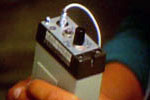
A colleague would be following the game on a notebook outside the playing
room and occasionally transmitting a key move to a tiny device hidden in
Tkachiev's ear – one he says is very popular amongst certain students
(i.e. those cheating in exams). A walk-through airport detector would not
find it, and a hand-operated scanner would need to be set to high sensitivity
and directly scan the ear.
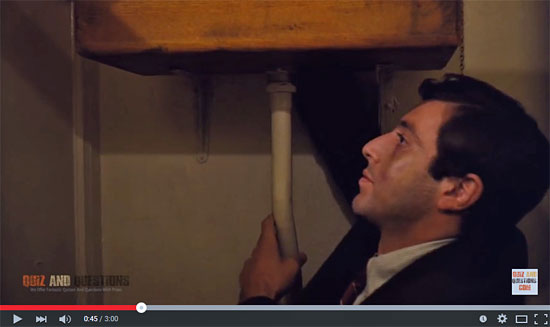
To this we add: any spy worth his salt will never carry the device to the
scene of his activity himself. He will have it placed there for him to retrieve,
much like Michael Corleone when he killed McCluskey and Sollozzo in Godfather
One – a scene to which Tkachiev eliptically alludes (warning: brutal,
lots of fake blood):
After setting everything up Tkachiev played three blitz games against a
colleague, GM Daniil Dubov, who is slightly higher on the rating list (2647).
The hidden assistant was Stas Romanov, a candidate master rated 2100, who
followed the action via closed circuit video and used a notebook to calculate
key moves. These were transmitted to Tkachiev's earpiece via radio. Sample
instruction by Stas: "Play b4, and on axb4 go a5 and gloat!"
Tkachiev (left, with invisible earpiece) won both games. When he wanted
to play a third Dubov refused: "That's enough, you really thrashed
me today. A circus!" He leaves fairly dejected, and the two perpetrators
reveal their secret.
Now watch the five-minute video, written and directed by Irina Stepaniuk.
We have known French-Russian-Kazakh GM Vlad Tkachiev for a long time now
and always enjoyed his company. He is a flamboyant personality, very frank
and open, with a wide range of subjects one can discuss with him for hours.
He may be a bit wild, but he is never dull or boring. Here's
an extraordinary intervew we conducted with in ChessBase Magazine, him
back in 2003. Read also this
interview from 2004.
Earlier ChessBase reports
A history of cheating in chess (1) 29.09.2011 – Hardly a month goes by without
some report of cheating in international chess tournaments. The problem
has become acute, but it is not new. In 2001 Frederic Friedel contributed
a paper to the book "Advances in Computer Chess 9". It traces the
many forms of illicit manipulations in chess and, a decade later,
appears disconcertingly topical and up-to-date. We
reproduce the paper in five parts.
A history of cheating in chess (2) 04.10.2011 – Coaching players during the
game is probably the most widespread form of cheating (rivaled only
perhaps by bribery and the throwing of games). Although this practice
began long before the advent of chess playing machines, computers
have added a new and dramatic dimension to this method of cheating
in chess. You will never guess: who were the pioneers
of cheating with computers?
A history of cheating in chess (3) 18.12.2011 – In January 1999 the main topic
of conversation amongst top players like Kasparov, Anand and others:
who was the mysterious German chess amateur, rated below 2000, who
had won a strong Open ahead of GMs and IMs, with wonderfully courageous
attacking chess and a 2630 performance? How had he done it? Turns
out it was with unconventional methods, as
subsequent investigation uncovered.
A history of cheating in chess (4) 28.2.2012– Las Palmas 1996: Garry Kasparov
is agonizing over his 20th move against Vishy Anand. He calculates
and calculates but cannot make a very tempting pawn push work. Immediately
after the game he discovers, from his helpers, that it would have
won the ultimately drawn position. The point that became clear to
him: a single bit of information, given at the top level in chess,
can
decide a game.
A history of cheating in chess (5)
10/6/2014 – A few weeks ago FIDE took
first executive steps to combat the most serious threat that the game
of chess currently faces: the secret use of computer assistance during
the game. In a paper written fourteen years ago Frederic Friedel had
first drawn attention to the dangers that are lurking. We re-published
this historical document in four parts. Here is the fifth
and final section.
Cheating in chess: the problem won't go away
3/30/2011 – As you know the recent suspicion of organized cheating
during a Chess Olympiad has led to three French players being suspended.
One is currently playing in the European Individual Championship, where
his colleagues have published an open letter demanding additional security.
For years we have been proposing a remedy for this very serious problem.
It needs to be implemented now.
Anti-cheating:
the fifteen minute broadcast delay
5/13/2011 – For five years we have been trying to get FIDE to implement
a 15-minute delay in the Internet broadcast of important games – to
make organised cheating harder. A chess journalist has now pointed out a
fatal flaw in the plan: it would force chess journalists to walk many yards
to find out the current status of the games. Damn – and we thought
it was such a good idea! What is your opinion?
Anti-cheating:
the fifteen minute debate continues
6/29/2011 – Our recent reply to stern criticism leveled against us
in the Dutch magazine New in Chess resulted, unsurprisingly, in a large
number of letters from our readers, many quite effusive. But we decided
not to publish any until at least one turned up supporting the views of
our NiC critic. Six weeks went by until it at last came, authored by the
critic himself. Now we can publish your letters.
YOUR PERSONAL CHESS COACH - Whether you’re taking your first steps into the world of club chess, or already playing at a tournament level: with FRITZ, you can train more efficiently, intelligently and with a more personalised approach than ever before.
Michael Kotyk presents a complete repertoire after 1.e4 e5, built around creative ideas, surprising move orders, and practical weapons designed to catch your opponents off guard.
YOUR PERSONAL CHESS COACH - Whether you’re taking your first steps into the world of club chess, or already playing at a tournament level: with FRITZ, you can train more efficiently, intelligently and with a more personalised approach than ever before.
Michael Kotyk presents a complete repertoire after 1.e4 e5, built around creative ideas, surprising move orders, and practical weapons designed to catch your opponents off guard.
Michael Kotyk presents a complete repertoire after 1.e4 e5, built around creative ideas, surprising move orders, and practical weapons designed to catch your opponents off guard.
“Attack with Qh5!!” – Tactical training with Oliver Reeh, “6…g5 – nothing ventured, nothing …” – Le Quang Liem comments on one of his victories in Biel, “Grischuk’s stroke of genius” – Petra Papp reveals a surprise in the Sicilian Kan Variation, and much
YOUR PERSONAL CHESS COACH - Whether you’re taking your first steps into the world of club chess, or already playing at a tournament level: with FRITZ, you can train more efficiently, intelligently and with a more personalised approach than ever before.
While tactics decide the game in concrete moments, strategy guides the entire battle. Understanding how to improve your pieces, create weaknesses, execute maneuvers, and steer the game toward favorable structures is what defines strong players.
€39.90
We use cookies and comparable technologies to provide certain functions, to improve the user experience and to offer interest-oriented content. Depending on their intended use, analysis cookies and marketing cookies may be used in addition to technically required cookies. Here you can make detailed settings or revoke your consent (if necessary partially) with effect for the future. Further information can be found in our data protection declaration.
Pop-up for detailed settings
We use cookies and comparable technologies to provide certain functions, to improve the user experience and to offer interest-oriented content. Depending on their intended use, cookies may be used in addition to technically required cookies, analysis cookies and marketing cookies. You can decide which cookies to use by selecting the appropriate options below. Please note that your selection may affect the functionality of the service. Further information can be found in our privacy policy.
Technically required cookies
Technically required cookies: so that you can navigate and use the basic functions and store preferences.
Analysis Cookies
To help us determine how visitors interact with our website to improve the user experience.
Marketing-Cookies
To help us offer and evaluate relevant content and interesting and appropriate advertisement.