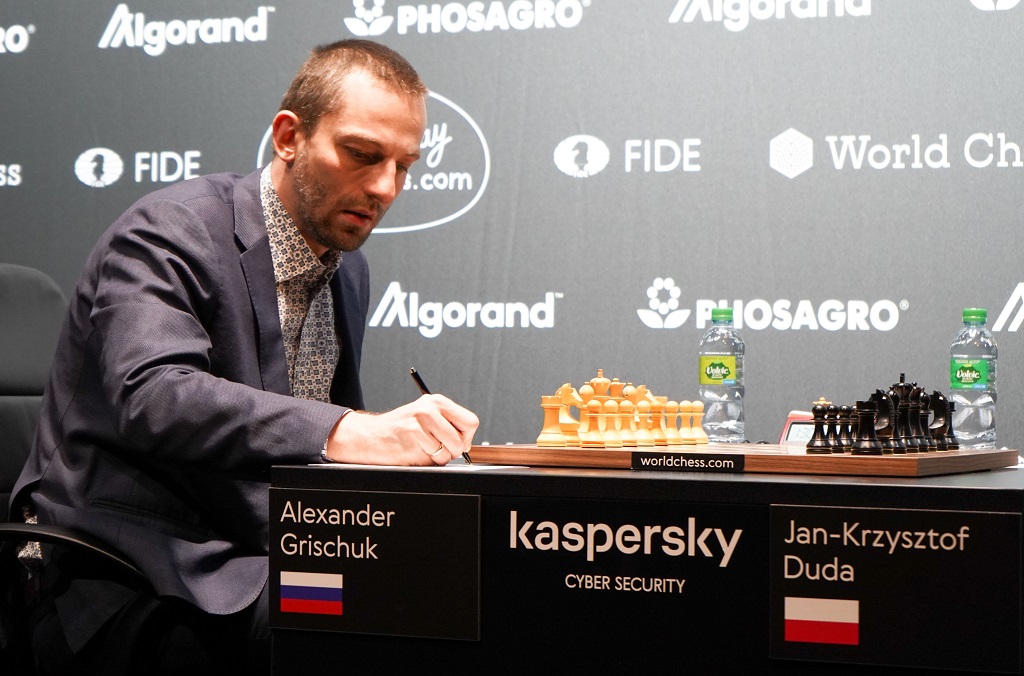
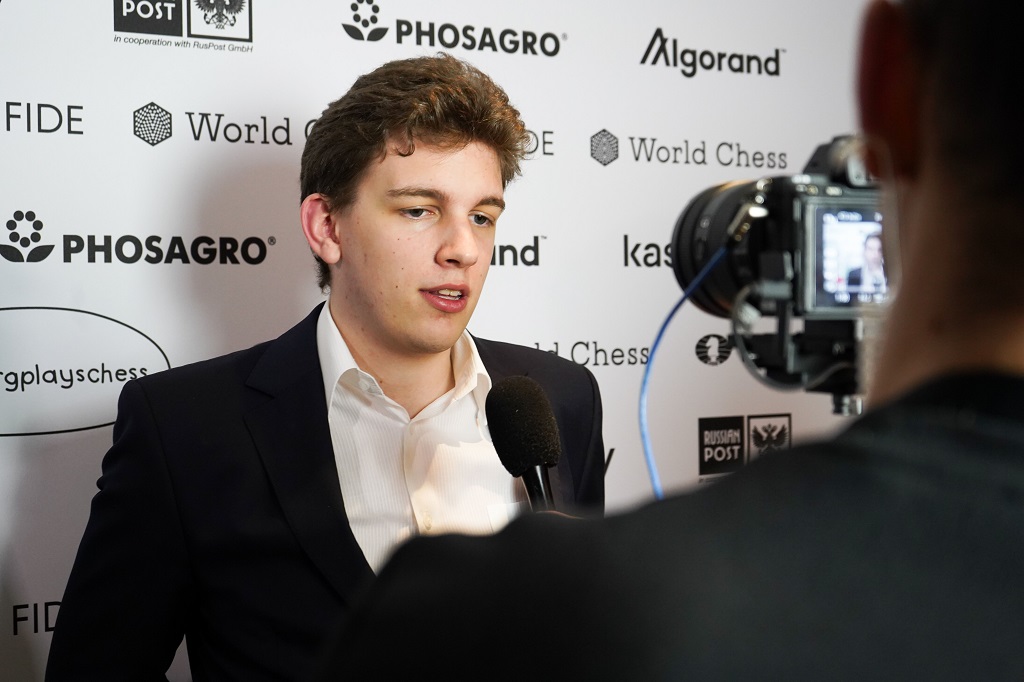
11/16/2019 – In the first game of the FIDE Grand Prix in Hamburg, Alexander Grischuk was the one missing a good chance to get ahead on the score board. The Russian got a promising position with White, but could not make the most of it, after both he and Jan-Krzysztof Duda survived a deep time trouble scramble. Another draw in game two will mean the final will be decided in Sunday's tiebreaks. | Photo: Official site
new: ChessBase Magazine 225
Chess Festival Prague 2025 with analyses by Aravindh, Giri, Gurel, Navara and others. ‘Special’: 27 highly entertaining miniatures. Opening videos by Werle, King and Ris. 10 opening articles with new repertoire ideas and much more. ChessBase Magazine offers first-class training material for club players and professionals! World-class players analyse their brilliant games and explain the ideas behind the moves. Opening specialists present the latest trends in opening theory and exciting ideas for your repertoire. Master trainers in tactics, strategy and endgames show you the tricks and techniques you need to be a successful tournament player! Available as a direct download (incl. booklet as pdf file) or booklet with download key by post. Included in delivery: ChessBase Magazine #225 as “ChessBase Book” for iPad, tablet, Mac etc.!
YOUR PERSONAL CHESS COACH - Whether you’re taking your first steps into the world of club chess, or already playing at a tournament level: with FRITZ, you can train more efficiently, intelligently and with a more personalised approach than ever before. FRITZ is more than just a chess engine – it’s a training revolution! Whether you’re taking your first steps into the world of club chess, or already playing at a tournament level: with FRITZ, you can train more efficiently, intelligently and with a more personalised approach than ever before.
In this course, you will learn the foundations and key ideas of the Vienna Game and discover a variety of systems that make you extremely difficult to prepare for.
€39.90
Time trouble
The third leg of the FIDE Grand Prix is being played in Hamburg, Germany. The 16-player knockout has a €130,000 prize fund, with the series as a whole having an additional prize fund of €280,000 plus two qualifying spots for the 2020 Candidates Tournament. The tournament takes place in the Kehrwieder Haus from November 5th to 17th. You can find more info here.
With his ticket to the Candidates all but secured, Alexander Grischuk did not go for a safety-first strategy at the start of his final match-up against Jan-Krzysztof Duda. The Russian has explained in the past that he comes from a generation in which players were used to look for 'the truth of the position' at every turn, so if they feel there is a chance to fight for an advantage they will look for the way to get something out of it. There is a flip side to this approach, of course: frequent problems with the clock, an issue Grischuk has been struggling with during his career.
36-year-old Grischuk is a fan favourite | Photo: Official site
Out of a Queen's Indian Defence, the players quickly reached a position that called for deep analysis. The first one taking his time was Duda:
Let FIDE Senior Trainer and IM Andrew Martin introduce you to the Tiviakov method, where he covers all of 8.b3, 8.Re1, 8.Bf4, 8.Bg5, 8.a3, 8.Qa4 and 8.d5 and all in around an hour!
This is not a new position. In fact, it was recently seen in a game between Ivan Cheparinov and Sandro Mareco at the Grand Swiss. At this point, Mareco had gone for 13...♞f8, which led to him eventually going into an endgame a pawn down — he defended successfully until move 132. Duda instead opted for 13...♝f8 and responded to 14.♗f4 with 14...c5. Both fine moves, except that he spent 33 and 19 minutes deciding on each one of them. Surely there were deep strategic considerations to be taken into account, and Grischuk is the kind of player that leaves no stone unturned — he responded in kind, spending 16 and 31 minutes on moves 14 and 15.
The Russian was the one on the driver's seat soon after, transferring his knight to the strong c4-square after having wrecked Black's pawn structure on the kingside. Duda was defending exemplary though, despite living with the permanent concern of his clock dangerously ticking down — a situation he is not as used to as his opponent.
However, the Polish faltered on move 34:
Grischuk had less than a minute on his clock and here played 35.♕g5, going for an ending he probably considered would give him chances — let us not forget that he came from showing great endgame technique to take down 'MVL' in the semis. This was not the best alternative though, as Duda's previous 34...♜e2 allowed the very strong 35.♘e5. The idea is that after 35...Qe4 36.♕xe4 ♜xe4 White has 37.♘e3, placing his knight in an ideal square, while Black's bishop is rather restricted on the dark squares.
After this missed chance, the players made no more mistakes during the time trouble scramble, and when the dust had settled it was clear White did not have much to fight for. The draw was signed after Black's 46th move.
This DVD is packed full of new, exciting and novel ideas; based on a repertoire starting with the moves 1 d4 Nf6 2 c4 e6 3 Nf3 with g3! to follow.
Duda will have the white pieces in Saturday's return game. Poland's number one has been doing quite well in Hamburg when playing White, defeating Ian Nepomniachtchi and Yu Yangyi in rounds one and two. Grischuk, on the other hand, beat David Navara with Black to get match victory without needing tiebreaks in the second round. Will we see a decisive game or will the final be decided on Sunday?
The most popular chess program offers you everything you will need as a dedicated chess enthusiast, with innovative training methods for amateurs and professionals alike.
Carlos Alberto ColodroCarlos Colodro is a Hispanic Philologist from Bolivia. He works as a freelance translator and writer since 2012. A lot of his work is done in chess-related texts, as the game is one of his biggest interests, along with literature and music.
YOUR PERSONAL CHESS COACH - Whether you’re taking your first steps into the world of club chess, or already playing at a tournament level: with FRITZ, you can train more efficiently, intelligently and with a more personalised approach than ever before.
1.c4 e5 2.Nc3 Bb4!? is an opening idea well worth considering. Black immediately threatens to double the pawns on c3 in the style of the Trompowski or Sicilian Grand Prix attack.
Italian Game Powerbase 2026 is a database and contains 8571 top class games from Mega 2026 and the Correspondence Database 2026, of which 479 are annotated.
Videos: Nico Zwirs discusses the Sicilian with 2…e6 3.d4 cxd4 4.Qxd4 Nc6 5.Qe3 Nf6 6.Nc3. Mihail Marin examines Sindarov’s 6.Ne5 in the Queen’s Pawn Defence. Plus the ‘Lucky bag’ featuring 41 analyses by Berg, Ftacnik, Gupta and many others.
If you're looking for a dynamic alternative to the Slav, Queen's Gambit Declined, or other mainstream systems, the Chigorin Defence offers exactly what modern tournament players need.
Michael Kotyk presents a complete repertoire after 1.e4 e5, built around creative ideas, surprising move orders, and practical weapons designed to catch your opponents off guard.
€69.80
€59.90
We use cookies and comparable technologies to provide certain functions, to improve the user experience and to offer interest-oriented content. Depending on their intended use, analysis cookies and marketing cookies may be used in addition to technically required cookies. Here you can make detailed settings or revoke your consent (if necessary partially) with effect for the future. Further information can be found in our data protection declaration.
Pop-up for detailed settings
We use cookies and comparable technologies to provide certain functions, to improve the user experience and to offer interest-oriented content. Depending on their intended use, cookies may be used in addition to technically required cookies, analysis cookies and marketing cookies. You can decide which cookies to use by selecting the appropriate options below. Please note that your selection may affect the functionality of the service. Further information can be found in our privacy policy.
Technically required cookies
Technically required cookies: so that you can navigate and use the basic functions and store preferences.
Analysis Cookies
To help us determine how visitors interact with our website to improve the user experience.
Marketing-Cookies
To help us offer and evaluate relevant content and interesting and appropriate advertisement.












 The third leg of the FIDE Grand Prix is being played in Hamburg, Germany. The 16-player knockout has a €130,000 prize fund, with the series as a whole having an additional prize fund of €280,000 plus two qualifying spots for the 2020 Candidates Tournament. The tournament takes place in the Kehrwieder Haus from November 5th to 17th. You can find more info