

 Lucena's book, which appeared in 1497 |
I love books. I love to read them. I love to have them. As a result, I have a growing library. And because chess ranks top among my few absorbing hobbies, most of my books are on chess. It is a genuine source of delight for an aficionado like me, that chess possesses an extensive literature which in content probably exceeds that of all other games combined. Each year I have some interesting new book to look forward to.
Whenever I sit back to relax and appreciate my modest chess book collection, I never fail to think fondly, specially on the occasion of his 80th birthday, of a friend elsewhere in the world who must be two-hundred times as joyous about his – for he is in possession and has direct access to any one of a vast collection of more than 50,000 chess books!
He is International Grandmaster Lothar Schmid, the celebrated bibliophile owner of the largest private chess library in the world. Born Lothar Maximilian Lorenz Schmid in Dresden, West Germany, on May 10, 1928, his love for books must have been enkindled by the fact that his family owned the large publishing firm, the Karl May Verlag, whose management passed on to him when his father died. It is not just the sheer number, but also the quality of his collection that is remarkable. For example, he owns one of only ten extant copies of the first printed chess book by Luis Lucena, entitled Discourse on Love and the Art of Chess with 150 Endings (in English translation), which appeared in 1497.

GM Lothar Schmid, who celebrates his 80th birthday today
He also has all eight editions of Pedro Damiano’s book, Questo libro e da imparare giocare a scachi et de la partite (1512-64). About six feet of shelf-space in his library is taken up by all editions published in more than a century of Jean Dufresne’s famous little primer, Kleines Lehrbuch des Schachspiels (1881). These and many other fascinating features of GM Schmid’s legendary collection have been written about frequently. But does anybody know that it even has a Philippine section?

GM Schmid spent two and a half months of 1978 in Baguio City, the Philippines, as chief arbiter of the Karpov-Korchnoi match. He got to love the City of Pines and the famed Filipino hospitality. His stay, however, was abbreviated by pressing business concerns that required his physical presence in West Germany, so he was not in attendance at the match’s conclusion.
Schmid returned to our country fourteen years later to participate in the 1992 FIDE Congress held in Manila as member of the Commission on Chess Art and the Rules Commission. In the meantime, we became friends through correspondence that I had initiated with my request for an autographed picture in 1982. Along with it, GM Schmid sent me a souvenir booklet/program of the 100th Anniversary Celebration of the Bamberg Chess Club.

In genuine appreciation of his extraordinary thoughtfulness that I felt I had not deserved, I reciprocated by sending him several of our locally published chess booklets. I was gratified to learn from his response that he valued them even if, in my personal assessment, they were obviously inferior to most of the countless publications he was accustomed to. I was so impressed by such humility from a chess personality of his stature that I earnestly sought out all extant Philippine chess publications and sent them to him to augment his collection. Every time a new book of Philippine origin appeared, I made sure that GM Schmid promptly got his copy in mint condition. In due time his compilation grew in size to develop, according to him, into a noteworthy part of his library that he now refers to as the beloved “Philippine Section”.

Lothar Schmid (right) during the Spassky-Fischer match in 1972
Not to be outdone in generosity, GM Schmid has gifted me with some rare and precious titles such as Das Konigliche Spiel by Petzold and Schachspiel und Trictrac by Kluge Pinsker (Hg.). When he came to our country in 1992, he brought me a couple of limited-reprint vintage tournament booklets as souvenirs of his visit. I treasure and take great pride in them, together with all the letters and chess-inspired cards I have received from him through the years of our friendship. In mutual admiration, I call them my “Schmid Collection”.

Officiating at the Petrosian-Fischer Candidates Final in 1971
GM Schmid was consistently among the best three players of West Germany in the three decades following the Second World War. As an over-the-board (OTB) player, he represented West Germany in the Olympiads eleven times from 1950 to 1974, winning the silver medal on second board in Lugano 1968. He should have also won two more silver medals for his excellent debut performances on board two, in Dubrovnik 1950 and in Helsinki 1952, but medal honors, besides the gold, were not being awarded in the early years of the post-war Olympiads.
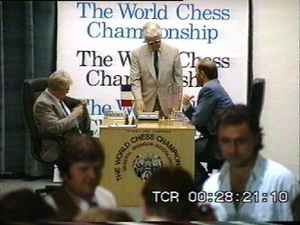
At the Fischer-Spassky Belgrade rematch in 1992

His most notable OTB achievement was shared second place with former World Champion Tigran Petrosian, half a point behind GM Paul Keres, but ahead of prominent contemporary GMs Wolfgang Unzicker, Borislav Ivkov, Jan Donner and Laszlo Szabo in the tournament held in his hometown Bamberg in 1968, to commemorate the 100th anniversary of the Bamberg Chess Club.
A man of great chess talent, Lothar Schmid also excelled in postal chess, where he holds the title of International Correspondence Chess Grandmaster. He won the great Dyckhoff Memorial Correspondence Chess tourney in 1956 and subsequently took second place equal with ICCGM Lucius Endzelins, half a point after ICCGM Viacheslav Ragozin, in the 2nd World Correspondence Chess Championship, 1956-58.

But his most famous chess-related activity involved chess organization. GM Schmid was the chief arbiter of several world championship matches. With great tack and patience, IA Schmid refereed the 1972 Fischer-Spassky in Reykjavik, 1978 Karpov-Korchnoi in Baguio, 1986 Kasparov-Karpov in London-Leningrad and 1992 Fischer-Spassky in Sveti Stefan-Belgrade. His study of and training in law found relevant application in the officiation at the highest levels of chess competitions.
As my way of congratulating GM Schmid for having lived life to the full for eight decades of a century, I am presenting his favorite game. It is not one of his big wins against the world-class players GMs Paul Keres and Efim Bogolyubov and former World Champion Mikhail Botvinnik. What he relishes most is this game against his old friend and fellow Olympic Team member GM Klaus Darga in Frankfurt 1966, given with his light annotations.
Schmid,Lothar - Darga,Klaus [C78]
Frankfurt 1966
1.e4 e5 2.Nf3 Nc6 3.Bb5 a6 4.Ba4 Nf6 5.0-0 b5 6.Bb3 Be7. Since Black has played 5...b5 one move earlier than usual, White does not answer Re1 followed by the typical maneuver Nb1-d2-f1-g3. Instead, he attacks the Queen's wing. 7.d4 d6 8.c3 0-0 9.h3 h6 10.Be3 Re8 11.Nbd2 Bf8 12.d5. It would have been possible to play 12.Nh2 with the idea f2-f4. The pawn e4 was safe because of the possibility Bd5. 12...Ne7 13.a4 Bb7 14.c4. Maybe a little bit too aggressive. Quite reasonable would have been 14.Qe2. 14...c6! 15.dxc6 Nxc6! A fine pawn sacrifice that gives good prospects in the center. A mistake would have been 15...Bxc6 16.axb5 axb5 17.cxb5 Bxb5 18.Bxf7+ Kxf7 19.Qb3+ wins. 16.axb5 axb5 17.cxb5 Nb4! 18.Qe2 Nxe4! 19.Bxh6 d5. Black has two strong and mobile pawns in the center and could be rather satisfied. However, he has to take care because of the broken pillar h6. 20.Be3 Nc5 21.Rxa8 Bxa8 22.Bxc5 Bxc5 23.Rc1 Bd6 24.h4! g6! 25.Ng5 Kg7? It should have been better to complete the strong central position by f5! Now there will follow several surprises. 26.Nde4! Be7. Short of time on the clock it was difficult to find the variation 26...dxe4 27.Nxf7 which would have been relatively the best. 27.Qe3! From this square the Queen looks to the left and right and demoralizes the opponent. As he does not move Qb8 he gets out of order. 27...Rh8? 28.Nc5 Qd6 29.f4 Bf6

30.Nce6+! fxe6 31.Rc7+! Qxc7 32.Nxe6+ Kh7 33.Nxc7 d4 34.Qd2 Be7 35.fxe5 d3 36.Ne6 Be4 37.Ng5+. This is quite an exciting game throughout that was enjoyed even by the loser. I thought to myself that it was necessary to be ready for great risks to get winning chances against my good friend. 37.Ng5+ Bxg5 38.hxg5 Nd5 (38...Nc2 39.Qf2 and Black will be mated.) 39.Qe1 wins a piece. 1-0. [Click to replay]
Lothar Schmid was born on May 10th 1928 in Dresden, Germany. In 1941, at the age of 13 and at the beginning of his career, he won the Dresden Championship. In 1943, he took second in Vienna (German Junior Championship). In September 1948, at the age of 20, he tied for fourth/fifth place at the full German Chess Championship (12th GER-ch) in Essen. In May 1949 he took third in Bad Pyrmont (13th GER-ch, which was won by Efim Bogoljubow). In 1956 he won in Göteborg, in 1957 he took fourth in the Dublin Zonal. In 1964 he won in Wilderness and tied for fourth/fifth in Zürich. In 1968 he tied for second/third with Tigran Petrosian, behind Paul Keres, in Bamberg. In 1970 he won in Mar del Plata. These are only a few of the successes in a long chess career.
Lothar Schmid played for West Germany at eleven Chess Olympiads:
| Year |
Board |
Olympiad | Score |
| 1950 |
2 |
9th Olympiad in Dubrovni | +7 -1 =4 |
| 1952 |
2 |
10th Olympiad in Helsinki | +7 -1 =4 |
| 1954 |
2 |
11th Olympiad in Amsterdam | +6 -4 =3 |
| 1956 |
2 |
12th Olympiad in Moscow | +4 -2 =7 |
| 1958 |
3 |
13th Olympiad in Munich | +6 -3 =4 |
| 1960 |
2 |
14th Olympiad in Leipzig | +7 -2 =5 |
| 1962 |
3 |
15th Olympiad in Varn | +4 -2 =2 |
| 1964 |
3 |
16th Olympiad Tel Aviv | +7 -2 =5 |
| 1968 |
2 |
18th Olympiad Lugano | +6 -0 =6 |
| 1970 |
2 |
19th Olympiad Siegen | +7 -1 =4 |
| 1974 |
1 |
21st Olympiad Nice | +5 -3 =7 |
Schmid won four individual silver medals (1950, 1952, 1968, 1970) and two team bronze medals (1950, 1964). He played for German team at twelve Clare Benedict Cups, winning nine gold, one silver, and two bronze medals in 1957–1973. He won first German Correspondence Championship (1950–1952), the first Eduard Dyckhoff Memorial (1954–1956), and came second with in the second World Correspondence Championship in (1956–1959). Schmid was awarded the IM title in 1951, and the GM and GMC titles in 1959.